On our most recent trip to the Rockies, we saw a low-lying marshy area – just the type of environment where you might see a moose. No matter how often we looked, nor what time of day, nor the angle from which we looked, we never saw a moose. We did, however, see a succession of beaver dams and their resulting pools. It was as if someone had engineered a system of locks to control the flow of water; that someone, of course, was a beaver, or more appropriately beavers.
We also did not see the beavers – the flood control architectural engineers – but their work was fascinating. We occasionally have seen beaver dams over the past few decades (and the beavers who built them), but never a succession like this. I believe the increasing frequency of our sightings correlates with the change in understanding and attitudes toward the ecologic benefit of beaver dams.
I briefly mentioned that ecologic benefit in my previous blog. Coincidentally, The New York Times published an article a day or two after my blog posting about a rancher who has seen the immense value of allowing beavers to do what they do naturally. The rancher’s change of perspective is particularly stark considering that his father, who previously worked the ranch, used dynamite to destroy every beaver dam he found on the ranch. Some of the article’s salient points/excerpts:
“As global warming intensifies droughts, floods and wildfires, Mr. Smith has become one of a growing number of ranchers, scientists and other ‘beaver believers’ who see the creatures not only as helpers, but as furry weapons of climate resilience.
Last year, when Nevada suffered one of the worst droughts on record, beaver pools kept his cattle with enough water. When rains came strangely hard and fast, the vast network of dams slowed a torrent of water raging down the mountain, protecting his hay crop. And with the beavers’ help, creeks have widened into wetlands that run through the sagebrush desert, cleaning water, birthing new meadows and creating a buffer against wildfires. . . .
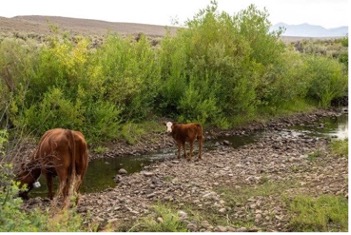
But beavers also store lots of water for free, which is increasingly crucial in the parched West. And they don’t just help with drought. Their engineering subdues torrential floods from heavy rains or snowmelt by slowing water. It reduces erosion and recharges groundwater. And the wetlands beavers create may have the extra benefit of stashing carbon out of the atmosphere.
In addition to all that, the rodents do environmental double duty, because they also tackle another crisis unleashed by humans: rampant biodiversity loss. Their wetlands are increasingly recognized for creating habitat for myriad species, from salmon to sage grouse.”
An Apple News-curated Vox article noted that “Dams can deepen streams, and deeper layers of water tend to be cooler. … ‘That is really important for a lot of temperature-sensitive species like salmon and trout,’ Fairfax says. In one recent study, scientists relocated 69 beavers to a river basin in northwestern Washington state, and found that, on average, their dams cooled the streams by more than 4 degrees Fahrenheit (2.3 Celsius) during certain times of the year.”
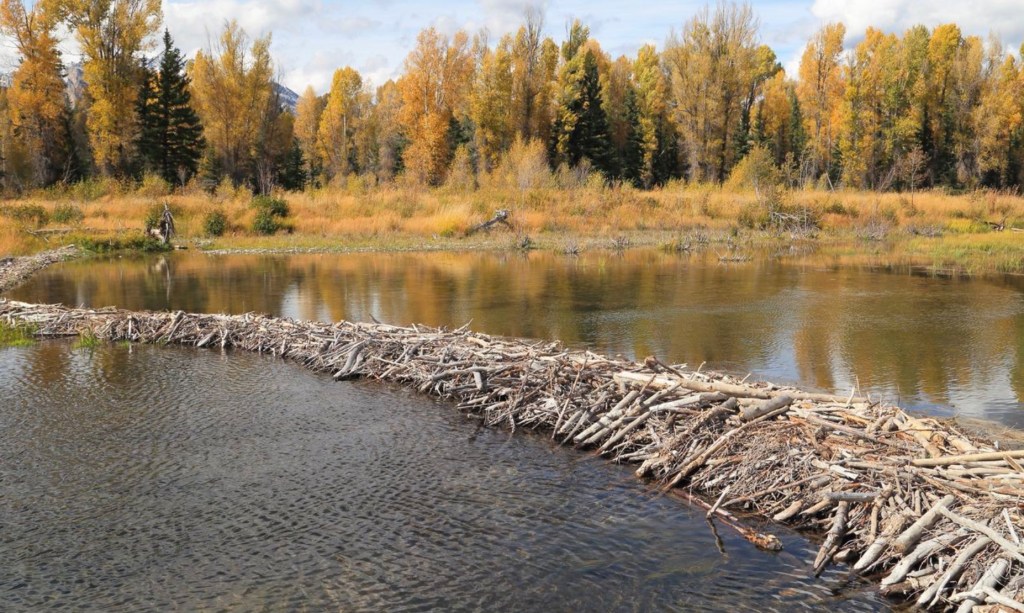
The relocation of 69 beavers in Washington reminded me of a story I read some time ago about a relocation effort that took place in the 1950s in Idaho. Beavers had been hunted to near extinction in northern Idaho, creating problems with erosion and loss of natural habitat. In the southern part of the state, where the human population was growing, beavers had become pests, building dams that were unintentionally destructive of “developed” land.
Relocation was the obvious solution. The number of beavers to be relocated, and the rugged terrain, presented some obstacles. The solution: have the beavers go in via parachute. Yes, parachuting beavers.
A family of six beavers has taken up temporary residence on the dock at the lake where we have a boat. No, the beavers had nothing to do with building the dam that created the 7,000 surface acre lake, though wouldn’t that be a grand story if they did! For a reason no one can explain, the beavers, like the river otters who previously took up residence three slips over, decided that they wanted to stay on the lifts that kept the boats out of the water.
We have dealt with a variety of wildlife that have staked out a claim to the docks: birds are constant invaders, but other than what one slip-holder refers to as “a long-legged lake loon” (a heron), they are mostly benign; racoons ran amok a few years ago, taking up lodging under cover of mooring tarps, destroying seats and excreting everything they ate; the river otters took their turn, but seem now to have moved on.
The beavers, however, make no sense. They aren’t building a dam. Their specific location doesn’t provide much protection from predators (though their most dangerous predator at the time is the angry boat owner on whose lift they took up residence). By whatever means, their numbers seem to be diminishing from the dock.
I agree that they have no business living on the dock – it’s not a natural habitat. On the other hand, in recognition of their immense contributions to our environment, I am fascinated and wish them well. Hopefully, they have moved upstream to the river tributaries that feed the lake, or they have been successfully relocated to where they can do what they do best.
As noted in The New York Times article, “ ‘We need to get beavers back to work,’ Wade Crowfoot, California’s secretary of natural resources, said in a webinar this year. ‘Full employment for beavers.’ (Beaver believers like to note that the animals work for free.)”


We had problems with muskrats at my father’s farm lake – their burrowings along the shore would cause the shore to erode away. Some amount of effort was put into eradicating them from time to time but it was a losing battle and my dad managed to control the erosion in other manner. Hope all is well with you. Sorry to have missed Megan’s last soccer game against Rockhurst (especially since Ellen providing a tailgate feast) but I had to finish my continuing legal education for the year (due date 9/15) and I still had most of a full day of listening to a downloaded seminar to get through. See Nancy and you soon – let me know if you go to Acre. Want to see what you think. (I’d go and order just the mashed potato puree)
LikeLike
I assume, then, that your dad did not sing along with Captain and Tensile on “Muskrat Love”! Yes, as Ellen usually does, she put out quite a spread of “snacks” for tailgating. Her ham and cheese on Hawaiian roll sandwiches were quite good. I will let you know about Acre; or perhaps we could meet there sometime.
LikeLike
I so enjoyed the interesting facts about beavers and how helpful they are to the environment. I would not have known. The critters at our lake dock seem more interesting now, rather than pests. Keep the Blogs coming.
LikeLike