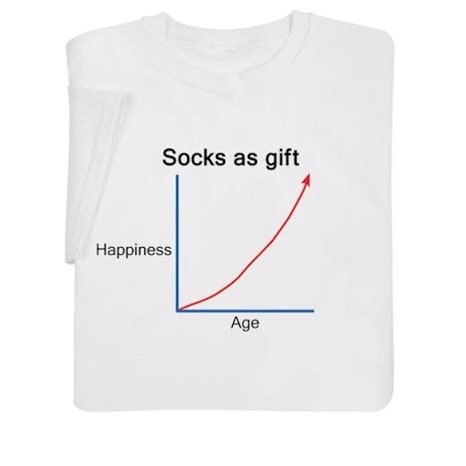
| Christmas is over. The artificial tree packed safely in its box for another year. Santa’s flown back to the North Pole to supervise elves making toys for next year. And I’m still waiting for my socks. My son asked me what I wanted for Christmas and the first thing out of my mouth was socks. I worked hard to come up with a list because I usually shrug and point out that I really don’t need anything. So socks was my list . . . and I even explained what kind of socks and where he might be able to get them. So much for the hours spent constructing that Christmas list! I’m at an age, though, when I don’t need anything (except lower prescription prices through Medicare). Note that I said need, not want. I have reined in my wants – I might still want stuff, but we have downsized, and anytime a little devil whispers a want in my ear, I ask myself if I want it enough to move it (it’s amazing how much stuff you’re willing to return to the universe when you’re moving . . . particularly if you’re downsizing!). Many in my generation want stuff. Makes sense. We’re Baby Boomers. We grew up during the huge population and economic post-war boom. To fuel that economic boom, companies created new products to meet our every need and desire, and marketers framed messages to help us understand that we had those needs. |

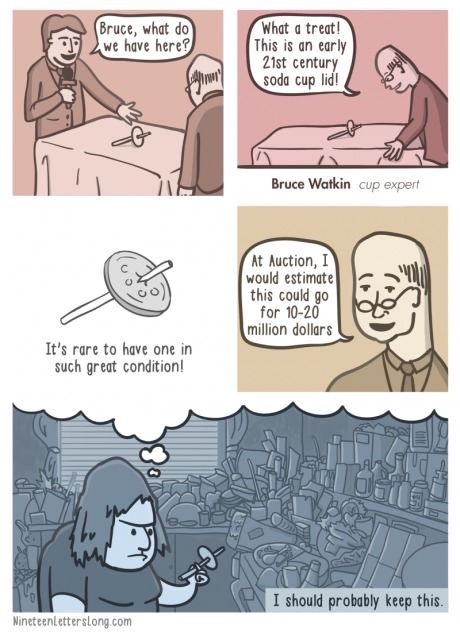
One contributing factor to Boomers’ desire for stuff was that our parents led by example. They threw away nothing! They were . . . hoarders. They survived the Great Depression; they never knew when something might be useful, so best to keep it.
We had neighbors years ago who were about my parents’ age. Hoarders. I came to the realization when their youngest son filled three large dumpsters with their stuff and had it hauled away while they were on a cruise. When they returned, they didn’t even notice that three dumpster-loads of their stuff were missing from their house! Seriously. They discovered it when they received a bill from the trash hauler; and they asked us to verify that the dumpsters had indeed been there.
They weren’t like the people on the show “Hoarders.” Our neighbors were neat, clean, orderly people. They organized their stuff mostly in their basement, on shelves with aisles. They hoarded out of a sense that, whatever the item was, it might serve a legitimate purpose in the future.
| My mom was a hoarder, but she hoarded antiques. She had them organized in our basement. We finally convinced her to open a shop to free up space in the house. It turned out to be a good thing for all concerned. (Mom generally had the living area filled with antique furniture. One time – and my mom never disputed this story – my brother and I were sitting on an antique sofa when a woman came to the house and bought it. We had to get up from watching our show and carry it out and load it on top of the woman’s car!) (And, yes, Mom knew a couple of the people who appraised on the Antiques Roadshow.) Don’t get me wrong. Not all Boomers’ parents were hoarders, especially to the degree depicted in that awful show; but the Great Depression left an indelible mark on many people who struggled and scraped their ways through. They tended to be folks at the lower end of the economic spectrum, so when the post-war economic boom began, they wanted in! |
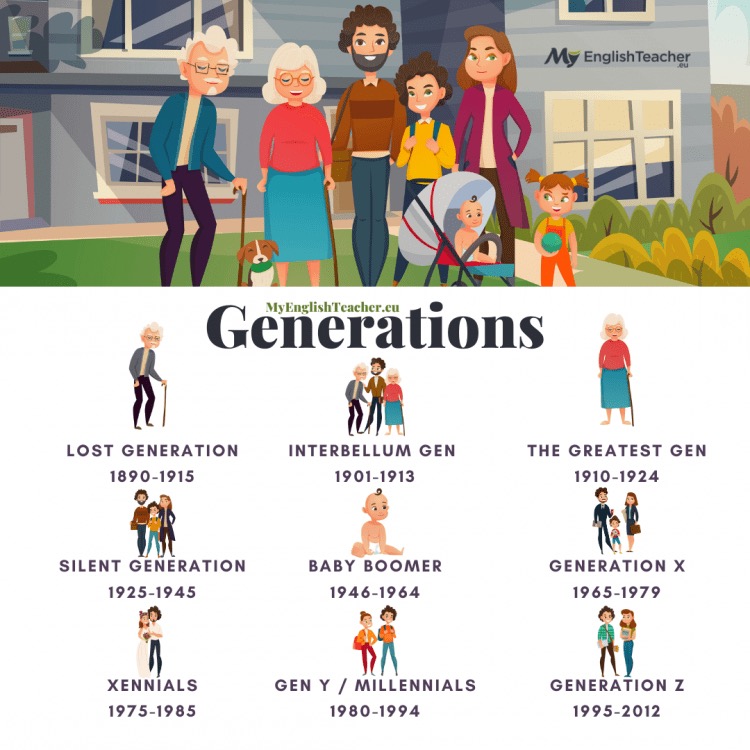
| A great deal has been said about the different generations. As we progressed through the various lifestyle stages, everything was Boomer This, Boomer That – we were a population, sociological, and economic boom; but that didn’t prevent us from screwing up a lot of stuff . . . little things like the environment! Of course, then we groused about Gen X, which is odd because they really didn’t have a lot of impact. Now, the Millennials: there’s a generation to scratch your head over. They and Gen Z/iGen tend to share characteristics, particularly their transition years. I included a graphic from MyEnglishTeacher.eu, that illustrates the different generations. One can quibble with the years – and I had not heard of the Interbellum Gen – but it’s a nice graphic summary. I also have included a video clip segment from a training video by Morris Massey. I enjoyed seeing his first video, which he made in the 70s, when he used “salty” language and wore a leisure suit! He is a very lively presenter, so be prepared to listen closely. I particularly like his premise, reflected in the title, “What You Are is Where You Were When . . . (You Were Ten).” He runs down numerous milestone events that occurred over the past several decades, and if you think of some of those from the perspective of a ten-year-old, you can see how your life could be influenced. |

Interestingly, one event that Massey elaborates on in his video clip is the assassination of John F. Kennedy, which coincidentally occurred when I was ten . . . sitting in Mrs. Klute’s 4th grade class when Principal Snyder announced the news to the school over its PA system.
This short clip from Kennedy’s 1961 inauguration speech underscores the sense of hope and possibility. His was a unifying voice. Regrettably, I fear that one of his most iconic lines – “Ask not what your country can do for you, ask what you can do for your country” – has been turned on its head in the 60 years since.
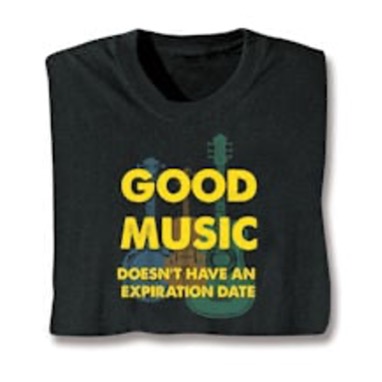
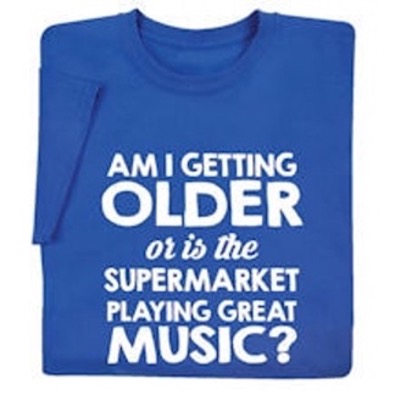
| My son had the misfortune of a dad stuck in 70s music. He was forced to listen to it when he worked at my Baskin Robbins and when he rode in the car with me. I mixed it up in the car sometimes by playing smooth contemporary jazz. Let’s be real: pop/rock music of the late 60s through the 70s produced some great music. An entirely new generation was introduced to the body of work with “Guitar Hero,” since they had to use so much of the guitar playing from that period. After suffering through my music preferences for years, my son finally thanked me for the experience because his music interests were more diverse . . . and he says he still listens to my Spotify mix occasionally. |
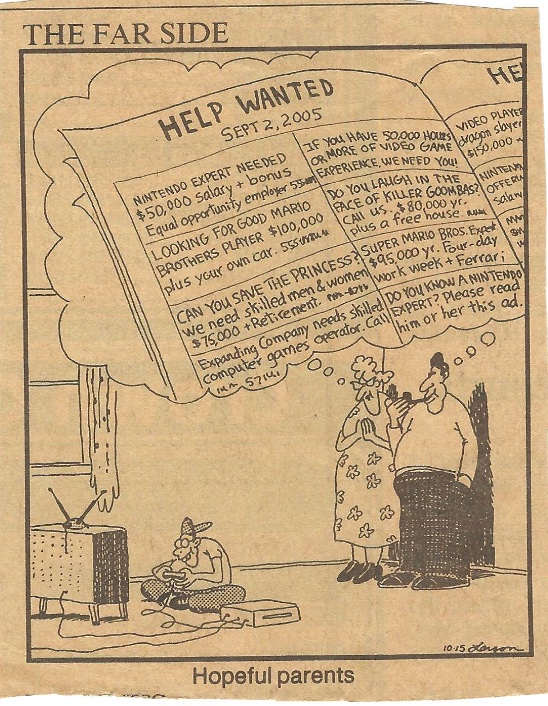
Something my son holds against me, though, is that I wouldn’t let him spend more time playing video games. Honestly, I thought, beyond some occasional recreation use, it would be detrimental to spend too much time playing games. He needed to go outside and play with friends, read books, study Latin! I just didn’t see a future in it. Little did I know that at some point in the future, people would pay money to sit in their homes watching someone else play computer video games!
Granted, it’s like football, where only about 400 players of the 1000s who play football in college, get drafted or invited to try out for an NFL team. But it still boggles my mind that there are people making five- and six-figure incomes playing video games as a spectator sport.
And what about Influencers?! Seriously?! People get paid for what? A friend told me about a young female reality star who was capturing her farts in a jar and selling them. Yeah, you read that right.
I’ve never known him to lie, but we do BS each other occasionally. I did a quick search. It’s true, but she had to put a lid on her business (pun intended) because of a work-related injury – she had to go to the hospital for severe intestinal cramps. I wonder if she qualifies for worker compensation; I wonder if she knows what work comp is.

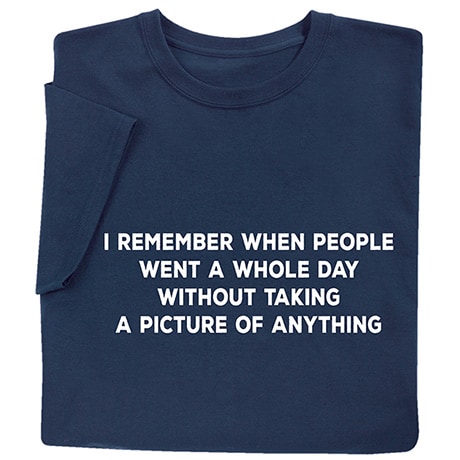
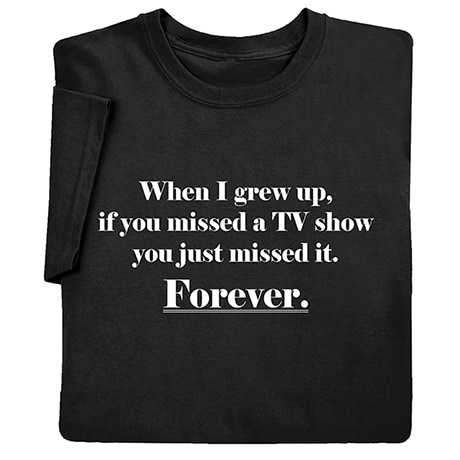
| AppleNews recently curated a BuzzFeed piece, “Boomers Are Sharing Things That Gen Z’ers And Millennials Will Never Understand And It’s Mostly True, TBH.” A few things on the list bear mentioning, and I can attest to their honesty with my personal twist. People smoked anywhere and everywhere: hospitals, movie theaters, public transportation. I was a smoker at the time, but even I thought it absurd to designate a nonsmoking area on an airplane. As soon as the No Smoking light went off, so many smokers lit up that the cabin was instantly shrouded in a smokey fog. There were three TV networks with shows to choose from; and if you were able to receive UHF channels, you might get the local PBS station. You had to watch the programs at the time they were broadcast – no VCR, DVR, streaming, play on demand – if you missed it, you had to hope it made it into the summer rerun schedule. I still miss Blockbuster. They began by renting VHS copies of movies; but not a lot of people had players, so you could check one out to take home and hook up to your TV (came in its own little carrying case). Cameras used film. And you had to take the film to a processor and pay to get prints. You took your best shot, not your best 100, to get the picture you wanted. Digital photography changed things dramatically. Now, if none of the 100 or so shots you took came out quite the way you wanted, edit it . . . on your phone! Speaking of digital photography and cell phone cameras . . . am I ever grateful those weren’t around when I was in college!!!!! |
Many differences exist within and between generations – they always have and always will. The complexities of global evolution grow. World hunger. Fifty years ago, concerns grew about global capacity for food production to support the growing world population; six billion people was estimated to be the practical limit. The world’s population in 1970 was 3.7 billion; it is 7.8 billion in 2020 – more than doubling the last half century. Hunger still a problem? Yeah.
Consider the rate of change in technology. Apple Computer introduced the Apple II in 1977; the same year, NASA launched the Voyager space ships. Apple’s technology and product line has change dramatically, but the Voyager’s has the same computer processor it was launched with. Its computer has 69 KB of memory; my iPhone has 128 GB of memory – that’s 69 kilobytes in a spaceship compared to 128 million kilobytes in my pocket. When I bought my first car in high school, I added an 8-track tape player, which would hold about a dozen songs per tape; all the Voyager’s scientific data is encoded on an 8-track tape.
The magnitude of these changes is unheard of. I no longer need to consider stopping at a gas station for directions; Google Maps will give them to me turn by turn. I used a card catalog to find a printed book in the library while the current generation has more information available at the stroke of a few keys than is contained in the entire Library of Congress, with its 34 million holdings.
Boomers grew up with the Korean War then Vietnam. Not to be outdone, Millennials experienced during their formative years the first enemy attack on American soil – 9/11 – and lived the next 20 years with the country engaged in war; Gen Z have lived their entire lives during that/those wars. I won’t try to count all the armed conflicts when we were involved to protect the innocent and keep the peace (one simile I ran across, Fighting for Peace is like Screwing for Virginity).
Young adults today don’t need to do things the way we did back in my day – it’s probably not possible because the capacity no longer exists in that form. They are forging new ways based on new circumstances and new knowledge in the world. Much as I hesitate to admit that the old ways don’t always apply today, we need to accept new approaches, encourage them, and move on together. Albert Einstein is often credited with saying, Insanity is doing the same thing over and over again and expecting different results.


Such an interesting review of aging and changes. Yes, the Boomers do like to hoard. The music of the 60’s and 70’s will be great forever, as you described. The memory of John F. Kennedy and his life will always have a pivotal place in our American History. From video games to making money from them, who would have known. Thanks for the cleaver and timely review of aging as a boomer. A walk down memory lane.
LikeLike