The mother decided it was time to teach her teenaged daughter the secrets of preparing the family ham. It was the centerpiece of their Christmas dinner, and the teen was captivated by the idea of participating in a generational legacy; and she was excited to impress her grandmother, who had taught her mother the secrets she was about to pass on.
The teen learned first how to cut off the ends of the ham. Next, the spices that went into a mixture for basting. Cooking the ham on a low heat of 225° for six hours in the covered roasting pan, basting the ham every hour. Removing the lid and broiling the top of the ham for about ten minutes at the end to sear in the juices. Topping the ham with pineapple rings when it is removed from the oven.
When the ham was finished, the teen admired her work. But she began to wonder about one of the steps – she asked her mother why they cut off the ends of the ham. Her mother was stumped. Finally, she said they should ask Grandma when she arrived. When asked, Grandma seemed puzzled, considered the question as she went through the process in her mind. She had an AHA! moment seeing the large roasting pan drying on the counter. She always had to cut off the ends because her pan was too small.
We all have traditions that we follow, perhaps none more so than Christmas. As a boy, my family went out to find the perfect tree. For several years, we would go to a Christmas tree farm (that is now a housing subdivision), search for and cut down the “perfect” tree, and ride in an old hay wagon back to the office where we would tie the tree on top of the car. We couldn’t finish decorating it until my older sister was there because she did NOT approve of my tinsel-hanging, which involved tossing up handfuls at a time; she hung each strand of tinsel individually. The effect was beautiful, but the process torturous for a young boy!
Nancy and I recently ventured to Branson to see the lights and Christmas parade at Silver Dollar City. The area has a strong Christian presence, and we saw many references, such as “Christ – ‘Tis the reason for the season.” So, what is the history of Christ and Christmas?
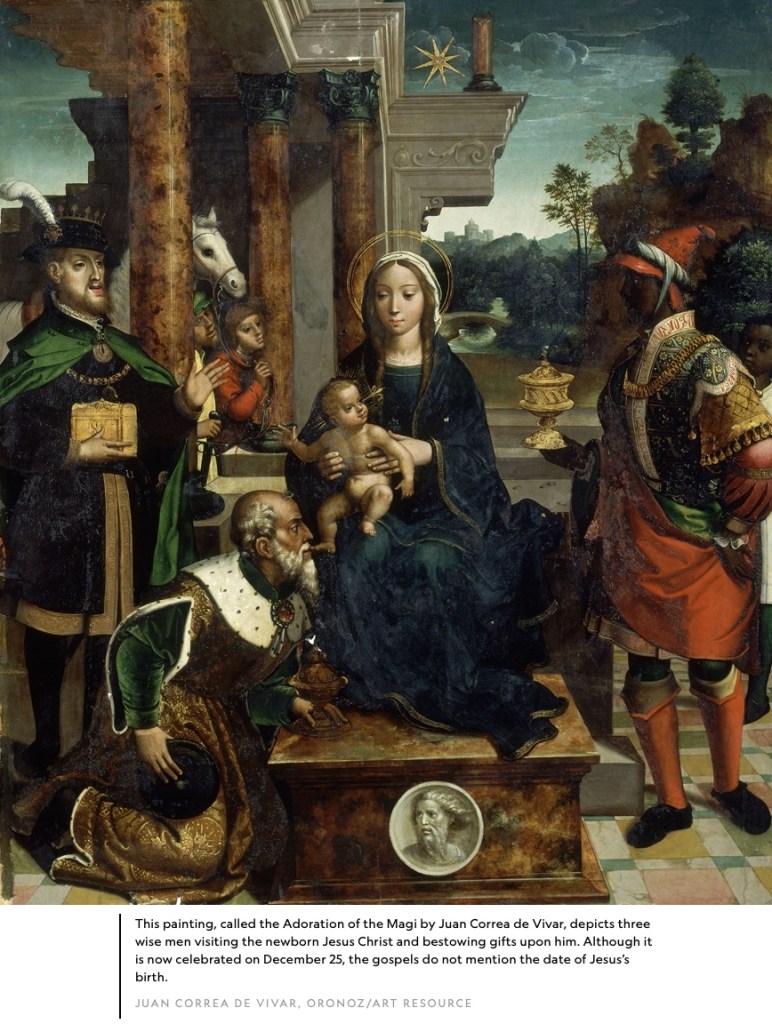
In the spirit of Christmas, Apple News recently curated a brief National Geographic article highlighting changes in Christmas traditions over time. I have included some here; all the excerpts are italicized.Laden with tradition and brimming with festivity, the Christian holiday, observed in most of the world on December 25, celebrates the birth of Jesus Christ in Bethlehem. … The Christian gospels do not mention the date of Jesus’ birth, known as the Nativity. They do tell the story of his immaculate conception and humble birth. … Historians disagree on how December 25 became associated with Christmas. However, by A.D. 336, Christmas was celebrated by the Christian church in Rome on that day, which coincided with the Roman winter equinox festival of Saturnalia.
I was worried the first Christmas after I got married, but it was unwarranted. Nancy’s family’s tradition was to celebrate on Christmas Eve, while my family celebrated on Christmas Day. The solution – we would spend a few days with Nancy’s family, culminating in a celebration with them Christmas Eve, then head to my family’s house Christmas morning.
My family liked to disguise and misdirect on presents as if it were part of a game. Very secretive. I learned, however, that my sister – the older one I mentioned before – was quite accomplished at opening wrapped gifts, seeing what was in them, and re-wrapping them so well that her work was undetectable. Not fair.
Nancy’s family lived on a farm in a small town and were very practical about gift-giving. I learned the hard way that there was no secrecy. Her mom took us to Walmart to shop. At one point Nancy said we would like a set of flannel sheets, so her mom put a package of flannel sheets in the cart. In all good humor, but still to Nancy’s chagrin, I told my mother-in-law that she couldn’t buy the sheets with us there; she needed to sneak back and buy them later so it would be a surprise. She replaced the sheets to the shelf . . . and we got nothing from her for Christmas!
In fun, years later I finally helped create a new tradition. Nancy’s sister’s family moved to the area and Thanksgiving and Christmas holidays moved with them; after all, it’s where all the grandchildren were! One year I had been perusing the Lands’ End catalog. With planning, intention, and a gleam in my eye, I marked pages with Post-it® notes that included specific items I would like, along with size, color, and other pertinent details.
Following Thanksgiving dinner, and after my sister-in-law’s family had gone home, I sat on the sofa between my mother- and father-in-law, Lands’ End catalog in hand. I began flipping to pages with Post-it® notes and pointing out things that I thought would make a great gift, look good on me, something I could really use, and so on. I approached it in a fun and funny way. My parents-in-law had as much fun as I did. It became a new tradition. Every year, thereafter, I would review the catalog, and before she left, my mother-in-law would smile and surreptitiously give Nancy some money and tell her to buy one of the things I had highlighted.
Family, friends, regions, cultures. Traditions create a fabric for our lives even when we don’t think of them as such. From oral traditions dating back hundreds, even thousands, of years that are now translated into children’s fairy tales to a Lands’ End Christmas gift guide dating back two or three decades, we find meaning and purpose.
What are some of your favorite traditions? Those things without which Christmas wouldn’t seem special. Gathering to watch A Christmas Carol or National Lampoon’s Christmas Vacation? Shopping to find the perfect gift to put under the tree? Preparing the Christmas ham?
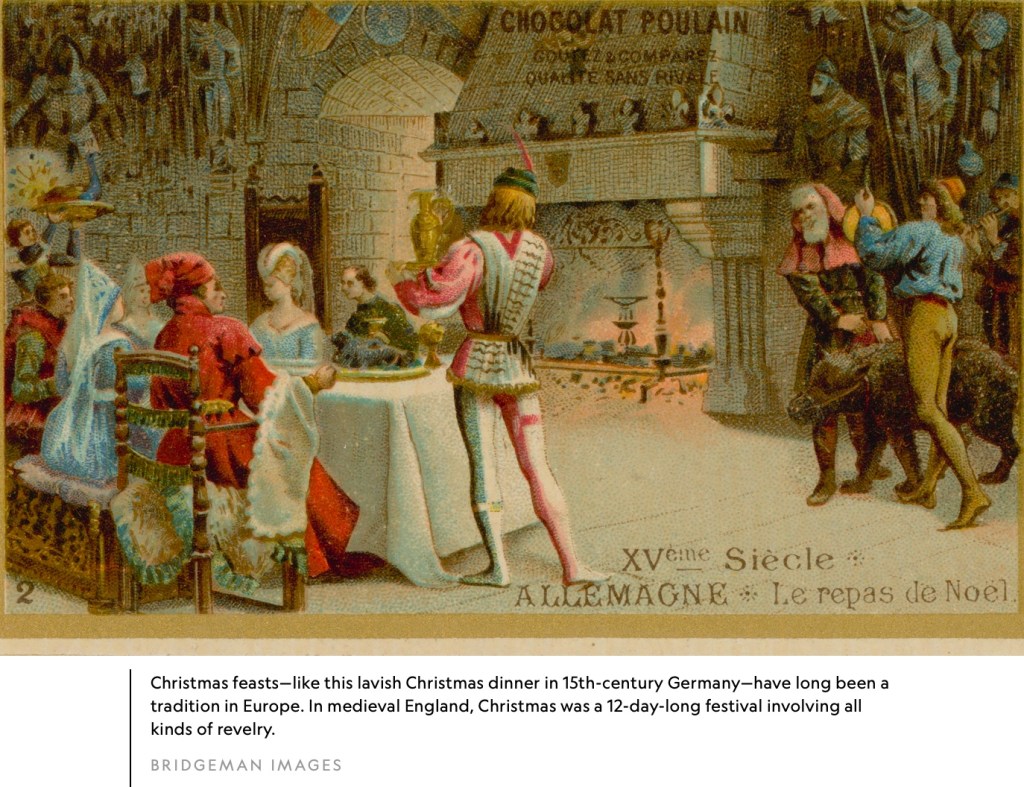
Winter festivals had existed worldwide since ancient times, and eventually many of those festivals’ traditions became linked with Christmas. For example, the Germanic solstice festival of Yule featured banquets and celebration, and Celtic Druids held a two-day solstice festival during which they lit candles and decorated their homes with holly and mistletoe. … Over time, Christmas gained popularity—and new traditions. In medieval England, Christmas was a 12-day festival involving all kinds of revelry, from plays to wild feasts to pageants celebrating Jesus’ birth. Music, gift giving, and decorations all became the norm.
“On the first day of Christmas . . . .”
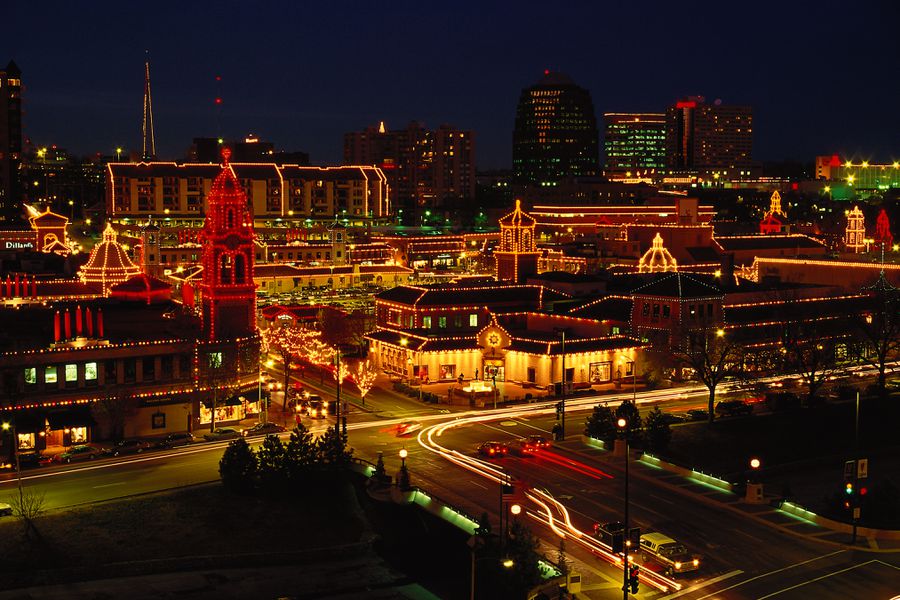
The unofficial launch of the “Christmas season” in Kansas City is the lighting on Thanksgiving night of approximately 80 miles of Christmas lights that outline every building in the historic Country Club Plaza shopping district. Coincidentally, and perhaps conveniently, this is the eve of “Black Friday.” An example of the evolving traditions, online shopping has now added “CyberMonday.”
One of the most popular figures of a modern Christmas is Santa Claus, the round-bellied, white-bearded patriarch who takes a reindeer-driven sleigh to deliver presents to good children the world over. The character is based on St. Nicholas, a third-century Greek bishop who became associated with December gift-giving. … Santa came to the U.S. with German and Dutch immigrants in the 18th and 19th centuries. … Santa’s iconic look was propagated by illustrator Thomas Nast, who drew on European folk tales to create a Santa whose popularity soon spread around the globe. In 1890, merchant James Edgar started an indelible custom when he dressed as Santa and greeted children in the aisles of his Brockton, Massachusetts, department store. The idea took off, and Santas have frequented department stores … ever since.
Christmas began nearly 1,700 years ago as a religious holiday. In the time since, its traditions have assimilated practices of different cultures. America – the “melting pot” – was central to cultural blending. As the world steamed into the Industrial Age, people began migrating to industrial hubs; the work was hard and the hours long, but the new jobs created greater economic wealth.
Mass production and distribution created opportunities for “store-bought” gifts. Montgomery Ward, who published his first catalog in 1872, and the renamed Sears, Roebuck and Co., who expanded with their first general catalog in 1893, brought shopping into homes across America. Their respective “wish books” could be found in many an outhouse; first, for shopping, then . . . um . . . let’s call it recycling!
The growing capacity for mass producing consumer goods required innovations in distribution to customers. Montgomery Ward and Sears, Roebuck became examples of another opportunity in retailing – department stores. In turn, the growth in retail outlets fueled the need for customers to buy more. Along came eight tiny reindeer and a jolly old Saint Nick aka Kris Kringle aka Santa Claus.
As noted above, Santas became fixtures in department stores, just like the racks and shelves displaying merchandise. What better way to stimulate Christmas giving than by having children tell Santa what they want. Complaints about commercialism intensified.
Whether you observe Christmas in its truest sense as a celebration of Christ, treat it as a secular celebration presided over by a Jolly Red Elf and his eight tiny reindeer, or somewhere in between, the time is filled with traditions. Enjoy those you have, adapt when it serves you better, and above all, enjoy. As Clement Clarke Moore penned in his famous poem, “Happy Christmas to all, and to all a good night.”
 Mike's Fountain Pen
Love this post. Such great Christmas memories. The integration you did with pictures is really nice for the reader to enjoy.
Love you,
Nancy
Sent from my iPhone
LikeLike
Such a beautiful read. Gave me some calm at the most appropriate time of need. Merry Christmas!
LikeLike