The middle-aged man walked from his car to the door of my Baskin Robbins. I could tell by the way he approached that he wasn’t coming for ice cream. The store was robbed five times in the eleven years I owned it. He wasn’t there to rob the store.
He was wearing a suit, white shirt, and tie. It wasn’t uncommon for a businessperson to stop for an ice cream cone during the workday; it was 2009 and suits were not yet uncommon attire. But this man was not coming to buy ice cream.
Not a week went by without someone calling to solicit my business: “Would you like to advertise in . . . ?” “Who does your payroll?” “What insurance company do you use?” These folks all carried a bulging portfolio with a collection of handouts; this man was carrying a single manila folder.
When he asked, I acknowledged that I managed the store. His anguish and desperation were palpable as he handed the manila folder to me. The manila folder contained his neatly typed resume. He was there seeking a job.
All but one of my employees were high school or college students, and all were part-time employees. For most it was their first job, and I started their pay at the minimum wage. He explained that he was seeking a full-time position. At $5.65 per hour, the annual compensation for full-time would be $11,752 – hardly a living wage.
This man was a casualty of the “Great Recession” that began in 2008. His unemployment benefits exhausted, unable to find work despite his best efforts, his desperation had pushed him to apply for a job I didn’t have. He was going virtually door-to-door in search of any work that could help stave off personal economic collapse for him and his family.
That was 2009. The pandemic of 2020 brought even higher unemployment – 14.8% – yet with a different approach by workers.
On Labor Day, “Pocket” curated a reprint of an article that appeared originally in The Washington Post in September 2019. The picture, which caught my attention as it always does, attracted me to the article. I find the picture captivating for a couple of reasons: first, having a fear of heights, I sometimes shudder at the thought of sitting on that beam; second, it’s a symbol for me of the American spirit and the possibilities of growth.

The picture was taken at the depth of the Great Depression. Although the photo often is seen as a symbol of American industriousness and the spirit to persevere, the Post article explains that it was posed with the intention of being a promotional piece for the skyscraper. (I shudder even more thinking that the photographer had these guys moving around for different takes!)
If you interpret the picture as a symbol of Americans’ drive to overcome the economic – and to many, an emotional – depression, you might wonder where that drive is now. We have high unemployment, and an even greater number of jobs that can’t be filled. What’s up with that?
Some are quick to assign fault. One economic school of thought is that people are inherently lazy, and that entitlement programs such as unemployment compensation foster such laziness; add the supplemental payments, and you hear cries that they refuse to go to work because they can make more on unemployment.
This claim merits some attention. Certainly, it is true that some laid-off workers made as much or more than when they worked, particularly with the first supplement of $600 per week. That amount alone – without their standard unemployment amount – equates to $15 per hour and annualizes to $31,200, which is more than many low-income workers make.
Some states whose leaders subscribe to the inherent laziness of their citizens ended the second round of unemployment supplements ($300/week) before the federal program expired. An analysis of those states’ unemployment rates did not change significantly, relative to the rates of states that continued the supplement.
Something else must be at work here. Actually, multiple something-elses are. It simply isn’t possible to distill aggregate economic behavior to a single factor. Any attempt to attribute a macroeconomic condition to this one thing is a fool’s game. In June, Apple News curated a Wall Street Journal article that nicely addressed several of the something-elses.
The WSJ article notes importantly that the economic downturn we have experienced is not for economic reasons: “Past recessions typically resulted from a rise in interest rates or a decline in asset values that hurt output, income and employment, sometimes for more than a year. . . . The damage to household finances and financial institutions after the 2007 housing crash led to lost demand that weighed on the economy for years. The Covid-19 recession, by comparison, didn’t result from financial factors, but from a disruption akin to a natural disaster.”
The pandemic forced temporary closure of a number of businesses, most of which were in direct-facing customer activities such as restaurants and hospitality. The article illustrates that the return of those business segments has been much faster than would be expected in a “normal” economic recession: “Widespread vaccination is containing the natural disaster by allowing consumers to spend more and businesses to reopen. In recent months, restaurant spending by vaccinated people has grown faster than that of the unvaccinated, according to market-research firm Cardify.ai. As more people get vaccinated, hiring is picking up.”
Stalling vaccination rates are contributing significantly to the recent weakening in economic activity, as the unvaccinated are filling hospital ICUs after contracting Covid. The resurgence of outbreaks and deaths has forced reimplementation of prevention techniques such as mask mandates, and even vaccinated people – including workers – are electing to stay home rather than risk breakthrough infections of the more virulent Delta mutation of the virus. Many more are choosing to not reenter the workforce at this time.
It’s not because they’re lazy and are relying on unemployment – the supplemental payment has ended. The large-scale inability to find enough workers for vacancies is forcing employers to raise wages. Despite the political ping-pong about a $15/hour minimum wage, the need for workers is pushing employers in that direction. One young woman I know, who is educated as a social worker, has gone to work full-time for a restaurant whose compensation package has been improved, along with adding benefits of health insurance, 401(K), and accrued paid time off.
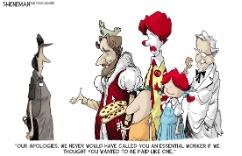
But even with wages increasing, and in addition to vaccinated workers’ fear of returning to work during the unvaccinated surge, availability and consistency of childcare complicates the effort. When schools went online in spring 2020, many working parents faced a conundrum: how can I stay at home to help my child with school and maintain my job? Many couldn’t. Our niece was fortunate in that between Grandma and Grandpa and us (mostly Aunt Nancy), we could cover the childcare issue.
One of the many other factors affecting the imbalance in unemployment rates and available jobs is that a significant number of workers came to the realization that they hated their jobs. In Kate Davis’s preview of Fast Company’s podcast, The New Way We Work, she interviews journalist Stephanie Vozza about the “Great Resignation”: “Vozza mentioned that the national quit rate dropped by half a percent in the spring of 2020. If you had a job then, you were likely hanging on tight in the face of so much uncertainty. In 2021 however, the quit rate shot back up and then some, with around 10 million people quitting their jobs by July 2021. ¶ Although labor shortages in the service industry might be the most visible, Vozza pointed out that tech and healthcare have actually seen the most people quit in the last few months, and burnout has been one of the driving reasons.” For example, 15 respiratory therapists have resigned in the past month from The University of Kansas Hospital. They are being rode-hard-and-put-away-wet, and have been for the past 18 months; and they must risk their lives daily to care for patients who have denied the medical knowledge that underpins their work.
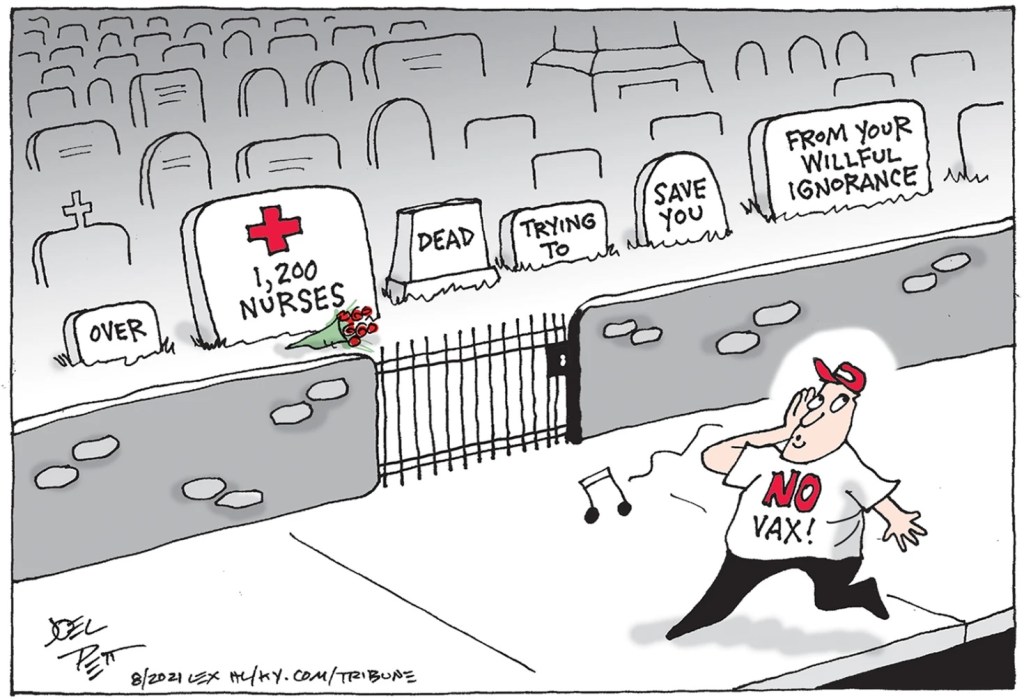
While I certainly understand burnout and working for a bad boss (another issue Vozza identified), I also question what those workers will do to find meaningful work in the future. Apparently, though, many are striking out on their own – new business start-ups have increased significantly in recent months. Again, the WSJ article summarizes this and provides some perspective: “New businesses are popping up at the fastest pace on record. The rate at which workers quit their jobs—a proxy for confidence in the labor market—matches the highest going back at least to 2000.”
How do we get beyond these challenges? Car lots are nearly empty for lack of parts, yet autoworkers want to work. Many restaurants have sections of their dining rooms closed due to inadequate staffing. The local supermarket can’t make one of its most popular chicken “grillers” because they can’t get the spices they need. The pandemic has pointed to problems inherent in sourcing (e.g., parts), outsourcing (e.g., labor), and distribution of goods to production and to market.
Just as there is not a this one thing we can fault for the economic turmoil, there is no one solution fits all for ending the turmoil. Politicians need to quit politicking and instead provide leadership. Collectively, they are in the best position to identify and implement comprehensive public health, social, and economic policies – they need to be the rising tide that raises all ships – if they can’t serve in that capacity, they need to be voted out; if they think the answer is simply less coordinating government direction; they need to reduce its size by resigning.
As citizens walking and driving through our towns and cities, we need to be more patient and slower to find fault, more empathetic and gracious, more understanding and less divisive, more appreciative of those around us who are working to provide goods and services needed by our friends, neighbors, and us. In the meantime, look up to find the resilience, the will to stand on steel beams to build new structures into the blue sky of the future!


Heigh -ho, heigh-ho. Such a good blog on what’s going on in a historical perspective. Keep on blogging.
Love your writing!
Sent from my iPhone
LikeLiked by 1 person