My mom’s antique shop in Parkville, Missouri, was decimated by the flood of ’93. I remember at the time monitoring how high the river was predicted to crest by the chalk marks the Army Corps of Engineers put on the building. When the mark was raised to a point that predicted the flood waters would exceed the three-step threshold and enter the store, we decided that we could mitigate most of the damage to her “inventory” by raising all that we could off the floor. We stacked things on cabinets and tables; we put hooks in the ceiling to hang chairs and anything else we could fit up there.
The Corps’ chalk mark was washed away, with the crest falling about a foot short of the shop’s 12-foot ceiling, and virtually everything was ruined. My brother and I donned waders and began salvaging as soon as the water receded below waist-level. Mud, debris, snakes swimming. It was a mess.
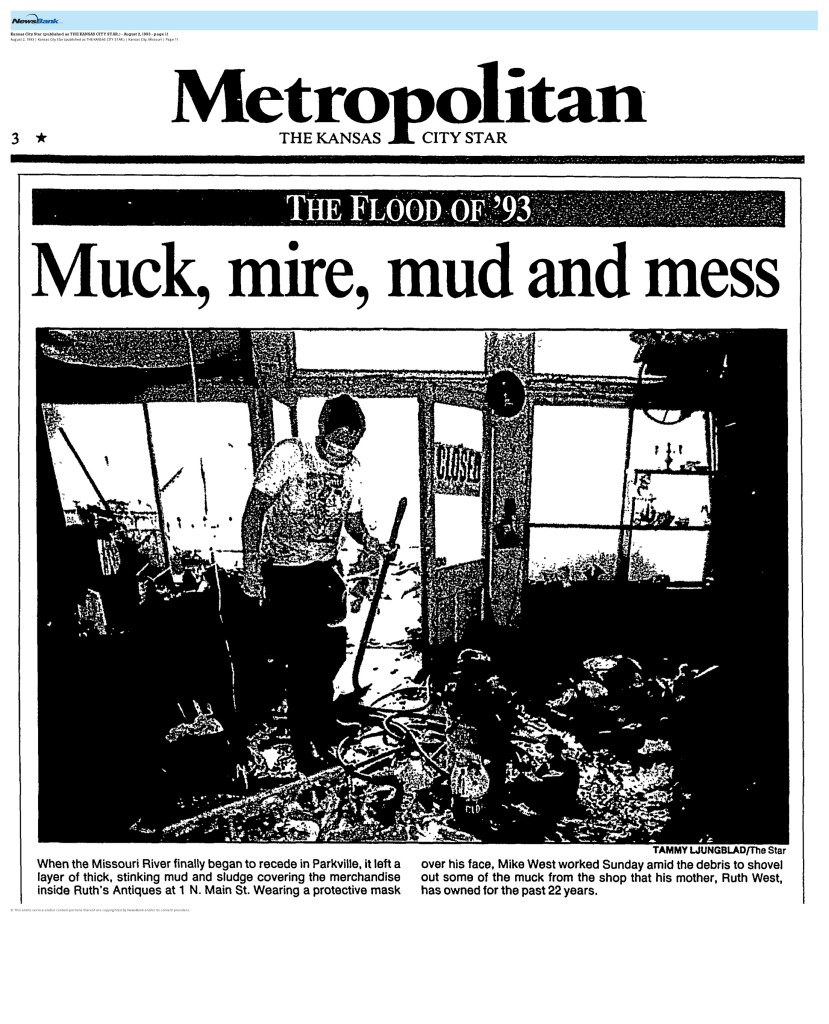
We were well into our cleanup as the water steadily receded. We felt it was safe for my mom and Nancy to assist, so we put them into some muck boots and helped them navigate through the slippery layer of mud on high ground. The city directed us to throw “trash” into the street, which remained covered by water; they would have a front loader scoop up the discards – the antiques that represented nearly a quarter century of Mom’s livelihood, and more importantly, something that gave meaning to her life.
She was surprisingly circumspect. When people expressed concern that she lacked flood insurance, she pointed out that she would probably have paid out more in premiums over the decades than she would have collected in losses due to the flood. She also admitted that, at 72, she had been contemplating closing the store and focusing on antique dolls, which she could trade out of the home.
As with most catastrophes, there are often inspiring and even humorous things that become more prominent in your memories as time creates distance. We were amazed at the number of people who simply showed up to help the city with cleanup – not just locals, but people who traveled from out of state . . . just to help. Angels, every one!
When my brother and I first went in, we were astonished that several large display cases filled with cut glass, china, and similar wares had apparently floated in the flood waters inside the shop and were gently laid down as the water had receded. These were heavy cases made of solid wood and glass, and the glassware contents displayed in them added to the weight. Most of the glassware was undamaged. But – and there’s always a but – the cabinets could not be opened without first picking them up. As we picked up each one, we discovered that the wood frames had completely deteriorated in the water, and no matter how carefully we tried, the cabinets would break apart, sending their contents crashing to the floor. Both fascinating and frustrating.

Mom had an old music box in the store. You placed a metal disk on a turntable, much like an album on a stereo turntable, and it would play music as small slots in the disk moved across what I can only describe as being one part of a tuning fork. The cabinetry was beautiful oak. After my experience with the display cases, I was confident that the cabinet would be deteriorated and the inside mechanisms damaged beyond repair. I carried it to the sidewalk and was preparing to heave it into the street when Mom stopped me, explaining that she wasn’t ready to give it up. My brother came by a short while later and, seeing the music box setting off to the side, picked it up to heave it into the street; Nancy stopped him, explaining that Mom wanted to keep it.
We salvaged what we could: washing quilts in bleach and hosing off what would hold together. Several weeks later, Mom had it all taken to auction where it was sold as “flood damaged” items. The music box wasn’t in the sale though; it was in the back of Mom’s station wagon. She arranged to meet a friend and fellow antique collector, along with her friend’s husband, at the sale, so her husband could inspect the music box for possible repair. As she waited, a man approached her and explained that he had been in the shop a few times, and he wondered if she had saved the music box. As a matter of fact . . . She took him to her car to see the music box. He inspected; he pondered; he asked if she would accept a thousand dollars for it! Sold! My take: both my brother and I almost threw a thousand-dollar bill into the flood debris on Parkville’s Main Street.
There was talk of building a levy in Parkville. I wouldn’t even pretend to be a civil engineer – all I know about floods is that they destroy property and make a hell of a mess to clean up – but in my estimation, adding levies exacerbates the problem. When a river is allowed to run its natural course, flooding spills out into a natural flood plain. When levies are built to control the river, it runs faster during flooding, and a much greater volume spills into a more restricted flood plain; hence, the river crested in Parkville about 11 feet higher than anticipated, based on previous experience and data.
The fundamental problem – again, in my opinion – is that we are attempting to control nature for our purposes rather than adapting our purposes to live in harmony with nature. Think for a moment about the power of water: the Grand Canyon is grand because a river carved it out of layers upon layers of rock.
When Lewis and Clark embarked from St. Louis on their famous expedition, the Missouri River was relatively wide, shallow, and slow moving. Levies and dams upstream have changed it. As weather patterns continue to change, as storms continue to accelerate in their virulence, we seem to play a dangerous game of catch-up to control nature. Perhaps that’s simply the price we are agreeing to pay to “civilize” nature.
One area of Kansas City – the Boulevard – is known for its collection of Mexican restaurants. It also was known for the extremely poor surface water runoff, and was prone to flash flooding. I recall a TV news interview with the owner of one of those restaurants, whose restaurant had been flooded for the third time in less than a decade. He complained that the most recent flooding was caused by another 100-year-flood. He cast an interesting spin on it: “Another hundred-year flood – that means I’m 300 years old!”
That restauranteur was not 300 years old. And the flooding in that area resulted from a confluence of factors: topography (it was a low-lying area, almost a trough); a poor (or virtually nonexistent) stormwater drainage system; expanding development elsewhere in the catchment area, replacing pervious surfaces with impervious ones, thus accelerating runoff; and abnormally frequent severe weather events, such as hundred-year rains.
Our lives occur in cycles, like seasons marking the passing of each year. Patterns exist which yield aphorisms like “March roars in like a lion and out like a lamb,” and “April showers bring May flowers.” Seemingly each spring as a kid, we were treated to Dorothy skipping down the Yellow Brick Road. Much as we consider Memorial Day as the unofficial start to summer, Wizard of Oz unofficially kicked off tornado season . . . and we grew up in tornado alley!
It might simply be my perception, but tornado alley seems to have shifted south and east. Yes, Oklahoma and Texas have a history of tornadoes, but I don’t recall the southeast getting hit so hard and so frequently. And our own cycles of dry and wet years seem to be changing more frequently: drought two years followed by flooding the third! Sometimes I think we’ve had so many hundred-year rains that I must be 300 years old . . . and occasionally I feel that way!
It seems that there’s some credence to my perception that the drought/flood cycle is changing. I found the following news articles on the same day: July 17, 2021. I suppose that the Great Salt Lake is evaporating and re-forming as torrential rains in Europe!


 Mike's Fountain Pen
Love this post. I feel soon you may be doing pop casts as well. Really well written and enjoyable to read.
Love you,
Nancy
________________________________
LikeLike
Another great post. I’m looking forward to your next one👍🏼😊🥂❗️
LikeLike
Thanks, Tom. I’m glad you’re enjoying the posts.
LikeLike