“I’m 300 years old”

My mom’s antique shop in Parkville, Missouri, was decimated by the flood of ’93.  I remember at the time monitoring how high the river was predicted to crest by the chalk marks the Army Corps of Engineers put on the building.  When the mark was raised to a point that predicted the flood waters would exceed the three-step threshold and enter the store, we decided that we could mitigate most of the damage to her “inventory” by raising all that we could off the floor.  We stacked things on cabinets and tables; we put hooks in the ceiling to hang chairs and anything else we could fit up there.

The Corps’ chalk mark was washed away, with the crest falling about a foot short of the shop’s 12-foot ceiling, and virtually everything was ruined.  My brother and I donned waders and began salvaging as soon as the water receded below waist-level.  Mud, debris, snakes swimming.  It was a mess.
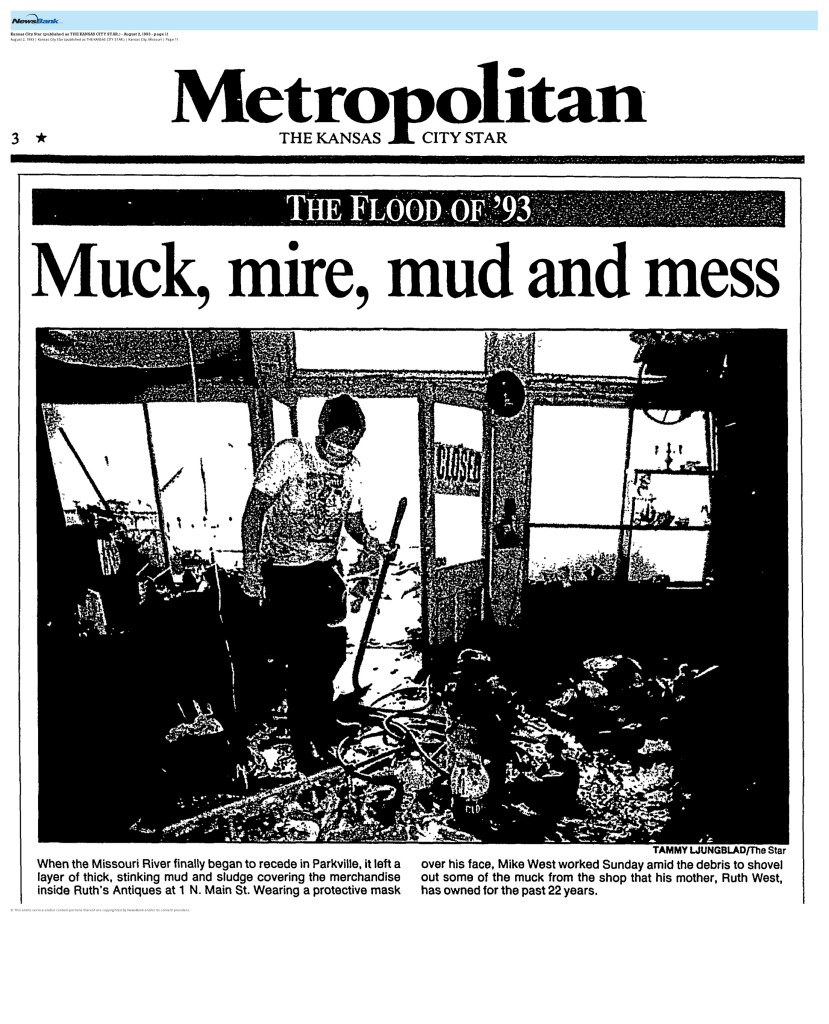
We were well into our cleanup as the water steadily receded.  We felt it was safe for my mom and Nancy to assist, so we put them into some muck boots and helped them navigate through the slippery layer of mud on high ground.  The city directed us to throw “trash” into the street, which remained covered by water; they would have a front loader scoop up the discards – the antiques that represented nearly a quarter century of Mom’s livelihood, and more importantly, something that gave meaning to her life.

She was surprisingly circumspect.  When people expressed concern that she lacked flood insurance, she pointed out that she would probably have paid out more in premiums over the decades than she would have collected in losses due to the flood.  She also admitted that, at 72, she had been contemplating closing the store and focusing on antique dolls, which she could trade out of the home.

As with most catastrophes, there are often inspiring and even humorous things that become more prominent in your memories as time creates distance.  We were amazed at the number of people who simply showed up to help the city with cleanup – not just locals, but people who traveled from out of state . . . just to help.  Angels, every one!

When my brother and I first went in, we were astonished that several large display cases filled with cut glass, china, and similar wares had apparently floated in the flood waters inside the shop and were gently laid down as the water had receded.  These were heavy cases made of solid wood and glass, and the glassware contents displayed in them added to the weight.  Most of the glassware was undamaged.  But – and there’s always a but – the cabinets could not be opened without first picking them up.  As we picked up each one, we discovered that the wood frames had completely deteriorated in the water, and no matter how carefully we tried, the cabinets would break apart, sending their contents crashing to the floor.  Both fascinating and frustrating.

Mom had an old music box in the store.  You placed a metal disk on a turntable, much like an album on a stereo turntable, and it would play music as small slots in the disk moved across what I can only describe as being one part of a tuning fork.  The cabinetry was beautiful oak.  After my experience with the display cases, I was confident that the cabinet would be deteriorated and the inside mechanisms damaged beyond repair.  I carried it to the sidewalk and was preparing to heave it into the street when Mom stopped me, explaining that she wasn’t ready to give it up.  My brother came by a short while later and, seeing the music box setting off to the side, picked it up to heave it into the street; Nancy stopped him, explaining that Mom wanted to keep it.

We salvaged what we could:  washing quilts in bleach and hosing off what would hold together.  Several weeks later, Mom had it all taken to auction where it was sold as “flood damaged” items.  The music box wasn’t in the sale though; it was in the back of Mom’s station wagon.  She arranged to meet a friend and fellow antique collector, along with her friend’s husband, at the sale, so her husband could inspect the music box for possible repair.  As she waited, a man approached her and explained that he had been in the shop a few times, and he wondered if she had saved the music box.  As a matter of fact . . . She took him to her car to see the music box.  He inspected; he pondered; he asked if she would accept a thousand dollars for it!  Sold!  My take:  both my brother and I almost threw a thousand-dollar bill into the flood debris on Parkville’s Main Street.

There was talk of building a levy in Parkville.  I wouldn’t even pretend to be a civil engineer – all I know about floods is that they destroy property and make a hell of a mess to clean up – but in my estimation, adding levies exacerbates the problem.  When a river is allowed to run its natural course, flooding spills out into a natural flood plain.  When levies are built to control the river, it runs faster during flooding, and a much greater volume spills into a more restricted flood plain; hence, the river crested in Parkville about 11 feet higher than anticipated, based on previous experience and data.

The fundamental problem – again, in my opinion – is that we are attempting to control nature for our purposes rather than adapting our purposes to live in harmony with nature.  Think for a moment about the power of water:  the Grand Canyon is grand because a river carved it out of layers upon layers of rock.

When Lewis and Clark embarked from St. Louis on their famous expedition, the Missouri River was relatively wide, shallow, and slow moving.  Levies and dams upstream have changed it.  As weather patterns continue to change, as storms continue to accelerate in their virulence, we seem to play a dangerous game of catch-up to control nature.  Perhaps that’s simply the price we are agreeing to pay to “civilize” nature.

One area of Kansas City – the Boulevard – is known for its collection of Mexican restaurants.  It also was known for the extremely poor surface water runoff, and was prone to flash flooding.  I recall a TV news interview with the owner of one of those restaurants, whose restaurant had been flooded for the third time in less than a decade.  He complained that the most recent flooding was caused by another 100-year-flood.  He cast an interesting spin on it: “Another hundred-year flood – that means I’m 300 years old!”

That restauranteur was not 300 years old.  And the flooding in that area resulted from a confluence of factors:  topography (it was a low-lying area, almost a trough); a poor (or virtually nonexistent) stormwater drainage system; expanding development elsewhere in the catchment area, replacing pervious surfaces with impervious ones, thus accelerating runoff; and abnormally frequent severe weather events, such as hundred-year rains.

Our lives occur in cycles, like seasons marking the passing of each year.  Patterns exist which yield aphorisms like “March roars in like a lion and out like a lamb,” and “April showers bring May flowers.”  Seemingly each spring as a kid, we were treated to Dorothy skipping down the Yellow Brick Road.  Much as we consider Memorial Day as the unofficial start to summer, Wizard of Oz unofficially kicked off tornado season . . . and we grew up in tornado alley!

It might simply be my perception, but tornado alley seems to have shifted south and east.  Yes, Oklahoma and Texas have a history of tornadoes, but I don’t recall the southeast getting hit so hard and so frequently.  And our own cycles of dry and wet years seem to be changing more frequently:  drought two years followed by flooding the third!  Sometimes I think we’ve had so many hundred-year rains that I must be 300 years old . . . and occasionally I feel that way!

It seems that there’s some credence to my perception that the drought/flood cycle is changing. I found the following news articles on the same day: July 17, 2021. I suppose that the Great Salt Lake is evaporating and re-forming as torrential rains in Europe!

And When I Die . . . Postscript

After posting the original essay on Friday, we left for the lake.  I had selected a novel to take that I intended to read several years ago:  The Loop by Nicholas Evans.  Evans is the author of The Horse Whisperer – an excellent book that I enjoyed immensely, except for the ending.

The Horse Whisperer was made into a movie starring Robert Redford and an excellent supporting cast.  Worth noting is that a young Scarlett Johansson in one of her early film roles was a pivotal character who, in my opinion, nailed it!  While the movie couldn’t plumb the depths of character that Evans could in the expanse of his novel, I was satisfied with the characters’ development.  And the movie was one of those rare examples of holding true to the book except for the ending.  I was thankful for the “Hollywood ending” in this case because I thought it was a much better resolution than the book’s.  But I highly recommend both the book and the movie.

The weather at the lake was beautiful.  I sat on the back of the boat with our dog lying beside me on the seat and my wife sitting on the other seat reading.  The temperature was in the low 80s.  A gentle breeze – one strong enough to deserve appreciative observation, but not enough to warrant “windy” consideration – blew across the boat with a pleasant cooling effect.  Wakes from boats in the distance had diminished into gentle waves that slowly rolled under the boat in a relaxing rocking motion.

I opened the book, read the acknowledgements, then found the following passage attributed to Black Elk, of the Oglala Sioux.  It seemed to capture the essence of the “circle of life” I referenced in the essay, so I thought I would replicate it for an additional post.

Everything the Power of the World

does is done in a circle.  The sky is

round and I have heard that the earth

is round like a ball and so are all the stars.

The wind, in its greatest power, whirls.

Birds make their nests in circles,

for theirs is the same religion as ours.

The sun comes forth and goes down

again in a circle.  The moon does the

same and both are round.  Even the

seasons form a great circle in their

changing and always come back again

to where they were.  The life of a man

is a circle from childhood to childhood.

And so it is in everything where power moves.

And When I Die

Steve and I go back about 60 years.  We’ve experienced a lot together and even more apart.  We meet for coffee about every other week.  Whether past, present, or future – sometimes fused in a common timeframe – we cover a lot of ground.  Fifty-two hours a year; time well-spent.

During a recent coffee, our conversation turned to the topic of death – our own.  But not in a morbid sense.  At 67, our discussion simply acknowledged that the cuckoo bird is going to announce only so many more hours.  (Personally, I’ve adopted the aphorism, “Life is like a roll of toilet paper:  the closer you get to the end, the faster it goes.”)

Some of our observations are quips.  Steve, an accounting and finance guy, has jokingly told his kids that if he has a nickel left when he dies, his calculations were off.  I like – I want my last check to bounce.

During that recent coffee conversation, we each reflected on our preference for cremation.  Steve’s parents were cremated, and their ashes are in a crypt in the same cemetery where my parents are buried.  Steve told his family that he didn’t care what they did with his ashes – though he has joked that he wants his wife to put his new knees on the mantel.  His son told him that he wanted Steve’s ashes placed in the same memorial as Steve’s parents because he visits his grandparents’ memorial.

I told Nancy that I would like to have my ashes spread in the mountains; or if she wanted to spread it out over two vacations, she could also put half in the ocean.  I admitted, though, that she and/or our son could choose whatever they wanted because I wouldn’t be able to complain.

Why cremation?  Certainly, “ashes to ashes, dust to dust” sounds biblical, but you won’t find it there; the closest is in Genesis when God is casting Adam and Eve out of the garden and he tells Adam that he was made of the dust and when it is time, to the dust he will return.  (I noticed, by the way, when I was verifying the verse, that Adam quickly blames Eve and, just as quickly, Eve blames the snake!)

Whatever the origin, the phrase certainly evokes the idea of the “circle of life.”  (Yes, I’ve watched The Lion King.)  The circle offers symmetry:  the planets, moons, and stars in all the galaxy are spheres; if we seek the path of least resistance, we go around objects, work around problems; and many dated a girl named Runaround Sue.

In addition to the sense of symmetry, the traditional burial has always gnawed at me a little:  you die, you’re embalmed so your body doesn’t decompose, you’re laid in a casket that would rival fine furnishings in a home, and that is put into a vault that it would take heaven and earth to move.  Not to diminish anyone’s grave – it’s the process we used for our parents and all our relatives – but it just seems like it’s a little too much for me.  Is the goal to preserve our society for archeologists in future millennia?

Somehow, as we have developed our knowledge and application of science, the prevailing attitude is that we are above nature, that we can control nature.  We are nature.  In my view, spreading my ashes in nature will be something of a return.

I also have some environmental concerns.  A grave is 20 square feet; and you would need to add a little for the space between graves.  The cemetery my parents are in is 45 acres.  That seems like a lot of space to take out of other uses.  On the flip side, cemeteries create green spaces.  Those green spaces can justly serve as sanctuaries, a place to quiet your mind, to allow yourself to settle into a calming peace, to commune with nature – a nature that includes those that have gone before us and who have returned to be part of nature.

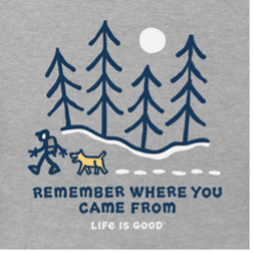
Note:  The t-shirt graphic for “remember where” is from Life is Good®.  I love their shirts and highly recommend them.  Quality materials and creative messages.

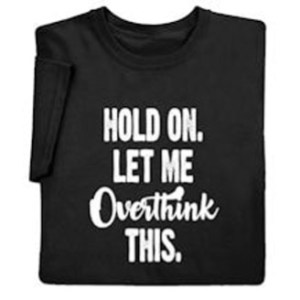
Note:  The “overthink” shirt is, I believe, is from Signals.com, which offers a cornucopia of shirts with different themes.

Free At Last . . . Well, Sort Of

There was a guy who lived in a town that was flooding, in danger of a complete breach of the dam higher in the valley.  As the flood water was lapping up against the foundation of his house, firefighters came through offering to help him evacuate.  He declined, saying God would save him.  The rising waters forced him to the second floor of his house; a rescue team came by and offered to help him evacuate, which he declined again saying that God would save him.  Finally, he was forced onto his roof.  A helicopter hovered above, and the crew pleaded with him to evacuate, offering to lift him up.  He declined, saying that God would save him.  Finally, the house was washed away by the flood and the man died.  When he got to Heaven, he asked God why He didn’t save him.  God said, “I tried three times – I sent a firetruck, a boat, and a helicopter.”

I’ll try to keep all the in-law relationships straight, but don’t worry if you don’t follow – that isn’t the point.  Kevin’s sister’s brother-in-law and his wife and the brother-in-law’s sister believe(d) the conspiracies about Covid, denied its existence, and refused vaccines at all costs.  The costs have been staggering:  the sister’s brother-in-law became sick with Covid and died.  His wife has been suffering near-death in the hospital for weeks and is not expected to survive.  To this day, the brother-in-law’s sister is posting conspiracy theories about the fake news of the pandemic and screeds vilifying the vaccine.  What doesn’t she get?

Last evening was beautiful – temperature in the 70s with a light breeze.  We gathered with some friends to enjoy the spring weather.  Jack asked four or five of us if we’d had the shingles vaccine; all of us had.  After a few descriptions of the debilitating pain friends and relatives had suffered from shingles, we encouraged him to get the shots.

Another person sitting on the periphery said that she had tried to get her shingles vaccine, but the doctor wouldn’t give it to her without also getting vaccinated against Covid.  She was quite upset – she wants to get the doctor fired.  She explained to the doctor that she didn’t want the Covid vaccine, that she was more afraid of getting shingles.  I wanted to ask why she suddenly feared shingles, which has been affecting people for longer than I know, and which only results in death in an extremely rare instance of developing a blood infection, yet she declined to be vaccinated for Covid, which can lead to severe illness and has caused more than 600,000 deaths.  But I didn’t.

A few days after that conversation, I read the following in an analysis by The Washington Post:

Covid-19 cases, deaths and hospitalizations have been declining in the United States. On May 26, the U.S. case rate, or seven-day average of new confirmed cases per 100,000 residents, was lower than at any point in the past 11 months.

The country’s declining covid-19 case rates present an unrealistically optimistic perspective for half of the nation — the half that is still not vaccinated.

Coronavirus vaccines are virtually perfect in preventing deaths, so the decline in deaths nationally hides the steady covid death rate among unvaccinated people.

“I hope this does not become a tale of two societies,” he said. “The people who are vaccinated and are protected can resume their lives, taking off their masks.

“The people who are not vaccinated are the ones who are not wearing a mask or washing their hands. Those are the very people who often times will socialize and be around similar like-minded people. You’re going to have the pandemic continue in those clusters.”

My wife and I ran into Ben, a young man who sold us some furniture prior to Covid.  He told us that his father died a couple of months earlier (from cancer, not Covid).  When he went to Florida for the funeral, his mother told him that she was going to wear a mask.  He thought that was great but warned her that she and he would be the only people wearing masks because the others were so conservative and susceptible to the conspiracies and false information.  She responded, “I may be conservative, but I’m not a fool.”

Ben’s sister, who has five children, doesn’t believe in the vaccines.  She posts on her Facebook page conspiracy theories about how the vaccines contain tracking microchips so “they” will know everywhere you go and what you do.  He parried that “they” already knew that because she’s posting all of it on Facebook.  She asserted that God would take care of her, to which he replied that God gave her abilities to use, including analysis of information to determine what is true.

I hope that when Ben’s sister gets to Heaven and asks God why He didn’t save her that He doesn’t tell her He tried three times:  Pfizer, Moderna, and Johnson & Johnson.

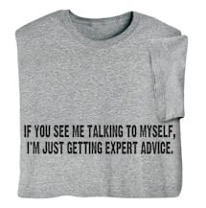
Note:  The t-shirt is from Signals.com, which offers a cornucopia of shirts with different themes, in addition to other merchandise.

Talking to Myself

Welcome to my blog.  This is a new journey for me.  I hope that you find it interesting and engaging and decide to join me along the way.  I have some ideas, but no grand plan for my blog.  I anticipate short essays on topics ranging from books and music to social, political, and economic topics; stimulated by, I suppose, anything that stimulates me to write:  t-shirts, bumper stickers, a song or TV show, the news, a conversation with a friend.  While I don’t have a set schedule for posting, I will try to do so frequently enough that neither you nor I loses interest.

The Year That Wasn’t

I admit I became a couch potato.  When the stay-at-home orders were issued in March 2020, I didn’t immediately assume a role as Mr. Potato Head.  Initially, I was awestruck by the sense of isolation.  This wasn’t like some monster snowstorm that prevented people from going out.  It felt more like a social apocalypse.

The stay-at-home orders should have fed right into my hobbies of reading and writing.  Nope.  I couldn’t finish a book; I couldn’t even get half through one.  Writing?  It was as if my pen was out of ink.  Day-in-and-day-out, I sat.  I watched the news to see full hospitals and empty streets.  I played Solitaire.  I streamed Netflix and Prime.  And I ate.  (I used to joke that the 19 in Covid-19 stood for the number of pounds you gained staying at home.  I’ve decided since that 19 is the average and I’m above average.  I wonder how long the stay-away-from-home orders will need to last for me to undo my “food baby”!)

My wife, Nancy, began spraying things that entered our house (mail, groceries) with alcohol.  My friend Steve said they left their mail in the garage for three days.  Several neighbors ordered meals from the subdivision’s clubhouse where the food runner, wearing mask and gloves, placed the food in the back of your car.  I generally have difficulty remembering passwords, but since my phone doesn’t recognize me with a mask, I’ve got that passcode down!

As disconcerting as the past year has been, and as bonding as it is to share reactions and changes, we cannot forget the number of people who have died – more than a half-million.  While that number certainly grabs my attention, it’s also somewhat abstract.  As the cases and deaths were rising, my wife began comparing the numbers by states.  Still abstract.  But when I began the succession of somebody I kind of recognize in the community to I know a guy’s whose cousin to a friend of a friend to friends and colleagues I’ve known for years, the abstractions faded quickly; it became personal.  My heart goes out to those who lost loved ones, who took them to the hospital never to see them again.

We continue to lose people to Covid, but the overall numbers are declining as the vaccines offer hope.  It’s spring.  Grass is turning green, flowers are blooming, trees are leafing out; the dark, dreary days of the past year are giving way to a sense of hope, of rebirth.

Many people have been asking – sometimes rhetorically, sometimes plaintively – when will we return to normal.  I and others contend that we never will return to our previous normal, but that we will have to discover our ways to a new normal.  I recently ran across a reference to a new podcast – “The New Abnormal.”  I’ve never listened to the podcast, but I like its title.  We’re dealing with a confluence of pandemic, economic crisis, domestic political dysfunction that already has led to violence and death, and international adversaries seeking to capitalize on our current quagmire.  Taken collectively, “the new abnormal” seems a fitting label for our times.

We can begin working our way through it, though.  Go outside.  Enjoy the sunshine.  Admire the beauty in nature from the flowers to the cheerful melodies of birds singing and breezes whispering through the trees.  Push “reset” on your mind, your emotions, your soul.  Assess what you missed most this past year and take the path forward to renew your life, emphasizing those aspects that you have determined by their absence to be most important to you.

If you feel like you were rolled over this year, you might enjoy a little pick-me-up with this cover of “Steamroller Blues.”  It’s a bluesy acoustic version with Casey Abrams on bass and vocals and Haley Reinhart accompanying on . . . well . .  . you’ll just need to listen.  Enjoy.

Note:  Both of these t-shirts are from Signals.com, which offers a cornucopia of shirts with different themes, in addition to other merchandise.

Precedented Times

“There are years that ask questions and years that answer them.”  – Zora Neale Hurston, Their Eyes Were Watching God

I stepped onto the boardwalk.  The street was empty.  Hot.  The wind vibrated as it ebbed between the clapboard buildings, carrying a fog of dust.  A tumbleweed skipped down the street.  Townspeople peered out their windows, anxiety clutching each one.  Mid-March 2020 and it felt like a set from a Clint Eastwood movie – I hear the flute followed by “wah wah wah” in my head.

January 2020 brought news of an unknown virus that shut down Wuhan China.  I watched in fascination as time-lapse videos showed a 1,000-bed hospital being built from the ground up in about ten days.  I watched in horror as videos of patients on respirators and increasing totals of deaths in Italy – a country we visited less than two years earlier – became the top story on the evening news.  We tracked the virus’s spread around the globe as it quickly breached the US borders – no wall could stop this.

In one month, New York state went from a single case on March 1 to more than 83,000 statewide and more than 2,300 dead on April 1. By April’s end, the virus would claim another 16,000 lives statewide. (MSN)

The news cameras took us inside the hospitals, showing people on ventilators as their beds were parked wherever space existed in the hospitals.  Nurses and doctors pleading for face masks, gloves, and gowns introduced me to an acronym I hadn’t heard – PPE.  Bodies of the deceased – of moms and dads, brothers and sisters, friends – found temporary resting places in freezer trucks as morgues were overwhelmed.

The economy virtually halted mid-March as the country began efforts to “stop the spread.”  Eerie, as if the country suddenly was populated by ghost towns, people peering out their windows for Eastwood’s no-name, serape-wearing character.  We were directed to stay home unless we were an “essential worker.”  In addition to the obvious medical personnel and emergency responders, I began to understand the essential work of grocery workers, gas station attendants, Amazon delivery drivers, and liquor distributors.  The list continued to grow.

“Stay at home” meant we were cut off from our friends and family members, and they from us.  I enjoy reading, yet no book could hold my attention.  Nancy pulled out a deck of cards for a few games of solitaire.  When she stopped, I took over the deck and began a marathon.  As the edges frayed, I found an online version – the keyboard and touchpad will never be the same!

Fortunately, we had our dog, Jude.  Unfortunately, he was 16 and his health was failing – going blind and the pain of arthritis.  But he was a trooper, giving us nearly three more months.  He was a great dog. We worked to comfort him in his final weeks and he provided comfort to us during this time of dramatic change in our lives.  His was a steady presence that Covid could not alter, and his love was unconditional.

As a society we talk about “getting back to normal.”  But collectively, our lives have been altered in previously unimaginable ways.  All of us experience changes – ups and downs in life – but the magnitude of 2020’s changes – well, I don’t know about you, but I’m not sure how “normal” will look.

Note:  The t-shirt graphics for the first two in this essay are from Life is Good®.  I love their shirts and highly recommend them.  Quality materials and creative messages.

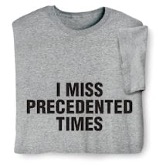
Note:  The “precedented times” shirt is, I believe, from Signals.com, which offers a cornucopia of shirts with different themes, in addition to other merchandise.  If it’s not from Signals, it’s from one (or more than one) of the numerous resellers of merchandise that you can find on multiple sites.

The Nature of Work

The Nature of Work

My brother sells real estate.  Throughout the pandemic, he was busy every time I talked to him, telling me he was on his way to a closing, or that he just got a contract for $23,000 more than the listing price.  He’s good, but he’s not that good!  How can that be, I wondered.  Millions of people were suddenly unemployed, and the number increased each week.  We’re supposed to stay at home; how are people out buying houses, and able to afford to pay a premium.

He explained that “the inventory of available housing” was low.  Builders had already cut back on new projects because the costs of construction were rising.  One builder told him in 2019 that a house he sold for $275,000 in 2018 would cost about 18% more to build a year later.  That was pre-pandemic!

The pandemic exposed many weaknesses in our economy’s supply chain.  In some industries, production has stopped due to unavailability of parts – for example, the local Ford plant is shut down until the supply of microchips resumes.  And I don’t know about you – I love Grape-Nuts, but not at up to $110 a box on the black market!  (CBS News noted the irony:  “Maybe it’s only fitting that a pandemic that rapidly brought on hoarding and shortages of toilet paper would eventually lead to one of America’s best-known high-fiber cereals disappearing from store shelves.”)

Another factor, it turns out, was the unseen employment.  Many of the suddenly unemployed worked in the service and hospitality industries.  I’ve been going to the same barber for nearly 40 years, but I began giving myself haircuts during Covid.  And while liquor stores became essential, bars became public health risks.  (Yes, I recall from my younger days that my inhibitions would sometimes relax with each new round, and that personal space boundaries diminished, particularly if you met new friends.  I’m just sayin’. )

While the obvious “essential workers” found sheets of plexiglass separating them from their customers, legions of workers who plowed the cube farms were simply sent home to work.  Why not?  If they spent the bulk of their work hunched over a computer, they could hunch more comfortably at home.  Over the last several years, as internet service improved in quality and speed, some companies had dipped the proverbial toe into remote work arrangements.  With the pandemic, it became the model virtually overnight.

The new work environment – home – changed the dress code for work.  Pajamas and sweatpants became common work wear.  Not only did working from home save time and money by not needing to buy new clothes for work and not doing laundry so often – three or four consecutive days in pajamas or sweatpants is doable – but think of the time and gas saved by not having to commute.  And all those “water cooler” conversations – gone!  These significant time savings provided much greater opportunities for Facebook and YouTube videos.

Remote work created some interesting changes in the geographic definition of “from home.”  If you could work from home anywhere, why not make home elsewhere.  Stories of technology executives and hedge fund managers renting exclusive villas in tropical locations – for rents I found staggering – began to make it to news outlets seeking new angles on life during the pandemic.  Buying homes in less congested areas – near mountains or forests or lakes – was another escape.  Small and mid-size city administrators and planners grew concerned about increasing demands for services and potential changes in community culture.  Were the moves permanent; were they buying second homes, or what would become primary homes?  Life after Covid is beginning to answer many of those questions.

Not all work from home can be done in isolation, however.  Zoom bailed us out.  It was the means for face-to-face meetings, whether the participants were a block away or a continent apart.  The problem:  not everyone was capable of transitioning from sitting around a conference room table to sitting at their own dining room table using video conferencing technology.  Stories of mishaps abounded:  every call begins with someone having difficulty logging in; a participant is talking while muted and everyone else is trying to convey that; kids, cats, dogs, spouses make unplanned guest appearances; a participant goes to the bathroom during a call (SNL spoofed that one); and some people have put moments of their very, veryvery personal lives on display under the mistaken impression that they were off the call!

Like it or not, it added a new dimension to the “workplace.”  And that dimension has added some good humor and fun to our work lexicon.  Here are a couple of Twitter memes I found funny as individuals displayed an ability to take themselves lightly.  I’m sure that you have some favorite stories of remote work.

Note:  The t-shirt graphics for all three in this essay are from Life is Good®.  I love their shirts and highly recommend them.  Quality materials and creative messages.