I’ve Been Thinking . . . About Time

There’s an old saying:  Life’s like a roll of toilet paper – the closer you get to the end, the faster it goes.

The saying resonates more with each passing day.  But the perception of time’s increasing speed is shared by many.  Let’s face it, 2020 was a lost year.  We kept better track of the number of Covid infections and deaths than we did the days and weeks and months.  It was a slog of a year.

But 2021 is different.  The differences began to emerge in the spring as more people were vaccinated, and they began venturing out more because they felt safer.  The days accelerated during the summer.  How many of you heard, or commented on date markers?  I can’t believe it’s already the 4th of July! or It’s Labor Day! What happened to August?! or Today’s Halloween!  I need to run to the store to get candy!

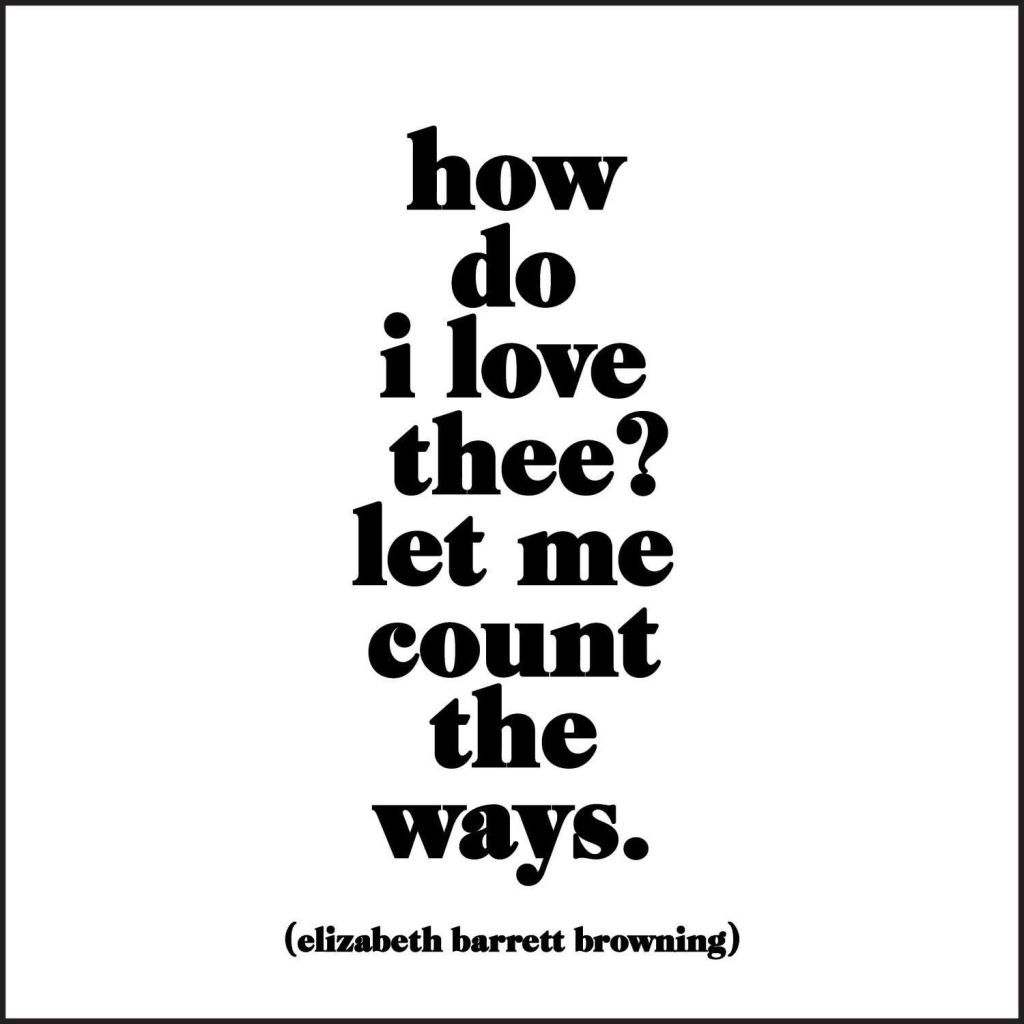
As I’m gorging on leftover Halloween candy, I ponder how we experience time?  The Victorian poet Elizabeth Barrett Browning asked and answered, “How do I measure time?  Let me count the ways.”  A slight misappropriation of the sonnet, but certainly counting is one way.  Sixty seconds in a minute; sixty minutes in an hour; sixty hours – oops! – twenty-four hours in a day; three-hundred-sixty-five days in a year.
There’s an anomaly in there, though.  Based on the orbit of the Earth around the Sun – the basis for the Tropical Year – each year averages 365.2422 days.  Yikes!  What to do?  In 45 BC, Julius Caesar ordered that the Roman calendar more consistently align with a Tropical Year, creating 365.25 days per year, with a leap day every 4th year to catch up on the ¼-day missing from each year.  Pope Gregory XIII made slight adjustments to the Julian calendar to account for the difference between Caesar’s 365.25 days and the approximate 365.2422 days in the Tropical Year.  The resulting Gregorian calendar is used throughout most of the world.

As humans, though, we measure time in many other ways.  How many Native American story renditions have you heard based on a Lunar calendar – “Many moons ago . . .”?  Indigenous people throughout North America and Europe associated each month’s full moon with the significant events in their lives.  For example, the Harvest Moon occurs in the fall and is associated with the harvest season.  Other full moons include the Strawberry Moon in June when the berries begin to ripen in North America.  Personally, I prefer January’s Wolf Moon because it gives me an excuse to howl.  A Blue Moon is not associated with a particular seasonal event; it is the 13th full moon of the year, which would make it a second full moon in a given month.  About once every 19 years, February has a Black Moon – no full moon – and January and March each have two full moons, causing two Blue Moons in that year.

When I was consulting, I traveled 100% of the time.  I frequently was in multiple time zones each week.  Once when I was on a project in Florida, I called one of my staff for an update on her project.  I was alarmed to learn that she still was at the hotel, so I began to grill her; finally, she pointed out that she was in Seattle, and that it was 6:30 in the morning there.  Oops!

If you wanted to “turn back the hands of time,” it was occasionally possible in the US before 1883 because we had 144 time zones in the continental US.  The differences weren’t a problem before the advent of telecommunications and faster rail travel; as trains became faster, some would arrive at the destination at a time that was earlier than their departure time.  Though use of the standard time zones began in 1883 to facilitate rail schedules, it was 1918 before the federal government officially established them into law.
I wasn’t on the project, but the consulting firm had one where the plant was rather large and straddled the Eastern and Central time zone boundary.  The company had to standardize shift time for its employees within its plant (or if I had worked there, I might have clocked in on Central time and clocked out on Eastern time!).  Which reminds me . . . Daylight Savings Time!

When I was traveling across time zones, I suffered from sleep deprivation, and that was before we talked about sleep deprivation.  I always estimated that it took me up to a week to adjust my body to a different time zone.  Daylight Savings Time has a similar effect on me.  I joke that I’m okay with the extra hour of sleep when we “fall back” – revert to Standard Time in November – but I don’t sleep longer; I wake up at the “new” 6:00 instead of the “old” 7:00.  Again, it takes me about a week to adjust.

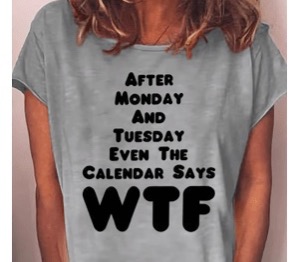
Seven days in a week.  The traditional workweek still is considered Monday through Friday.  I think it says a lot that we are so dissatisfied with our work that we are “Working for the Weekend,” as Loverboy pointed out in song.  TGIF – Thank God It’s Friday – became a rallying cry, and the name of a restaurant chain (I loved their loaded potato skins!).  Wednesday is “hump day,” as in over the hump in the middle of the week.  More people die of heart attacks on Monday – first workday of the week – than any other day in the US; by contrast, the greatest number of deaths due to accidents occurs on the weekends.  I suppose that if we survive Monday, we’re safer being at work than out having fun on the weekends!
While we measure life in hours, days, and years, that form of measuring is simply a way of chronicling.  Our lives are most importantly a continuum of experiences, and we can only truly experience them in the present moment.  H. G. Wells noted, “We must not allow the clock and the calendar to blind us to the fact that each moment of life is a miracle and mystery.”  Albert Einstein observed, “The only reason for time is so that everything doesn’t happen at once.”  

The esoteric nature of life as a movement through a series of present moments will surely show up in a future blog.

“Time is a sort of river of passing events, and strong is its current; no sooner is a thing brought to sight than it is swept by and another takes its place, and this too will be swept away.” ~ Marcus Aurelius
I’ve been thinking . . . about dogs

We recently adopted our seventh rescue dog – Lexi – over the past three decades.  I’ll share more about her in a future blog, but let me briefly explain that she is about three, and the first two-and-a-half years of her life – before we rescued her – she was intended to be breeding stock, not a pet.

Lexi hadn’t walked on a leash before we got her, but she is learning the nuances, e.g., if she becomes entangled in the leash, sitting and holding up her leg is much more effective than three backflips and a cartwheel.

When we are preparing for a walk, she studies me with great curiosity and a tad impatient.  She seems unable to fathom why my robe and underwear are not okay, why I need to stop and put on my walking shoes kept by the door, put on a jacket if it’s cool, a hat if it’s sunny, and grab an umbrella if it’s raining.  She’s ready as-is.  The only change in her attire is the leash she’s forced to wear.

This stimulated me to consider other human behaviors that must peak a dog’s curiosity.  Lexi is always curious about my daily ritual of entering a small room where it is raining.  Is this what the lady on TV is referring to as “isolated showers”?  Then I put on yet another set of clothes from the day before, just as the previous clothes were beginning to carry my scent.

The world is a dog’s toilet.  Their humans, by contrast, pee in a very limited number of fixed places in the house.  When the dog tries to give it a good sniff, as they would outside, they are admonished, “No!  No!”  And should they decide to pee in the house, as their humans do, they are bombarded with “BAD DOG!  BAD!” which is then followed by much scurrying, the awful smell of liquids sprayed on the carpet, with another “BAD DOG” or two sprinkled in while their human is on their hands and knees.  One more thing, hands and knees in this case is not a play position.

Humans don’t stick their heads out of open car windows.  How can they smell the world around them?  Don’t they realize how much they’re missing?

Humans have a strange form of greeting.  They would learn a lot more if they simply sniffed each other’s butts.  And for some reason they don’t like it when a dog sniffs the human’s butt.

Like peeing, humans have a specific place they sleep.  Dogs are comfortable on the floor, furniture, bed, the grass outside . . . .

Humans spend a lot of time preparing their meals.  Dogs get two bowls on the floor:  one for water, one for a cup of dry kibble.  Oh, and some humans don’t like to share their bounty, but steak can be smelled on a neighbor dog during a greeting.

Despite the human’s propensity for walking, they won’t chase anything – no squirrels, no rabbits – only the dog if the human happens to drop the leash.

Thoughtfully curious or not about the differences, dogs form an indelible bond with their humans.  Their tails wag and they’re happy to see us when we return home.  They share our joy when we’re happy and they comfort us when we’re sad.  They accept us as we are and for who we are.  They’re our best friends.

Heigh-ho, Heigh-ho

The middle-aged man walked from his car to the door of my Baskin Robbins.  I could tell by the way he approached that he wasn’t coming for ice cream.  The store was robbed five times in the eleven years I owned it.  He wasn’t there to rob the store.

He was wearing a suit, white shirt, and tie.  It wasn’t uncommon for a businessperson to stop for an ice cream cone during the workday; it was 2009 and suits were not yet uncommon attire.  But this man was not coming to buy ice cream.

Not a week went by without someone calling to solicit my business: “Would you like to advertise in . . . ?”  “Who does your payroll?”  “What insurance company do you use?”  These folks all carried a bulging portfolio with a collection of handouts; this man was carrying a single manila folder.

When he asked, I acknowledged that I managed the store.  His anguish and desperation were palpable as he handed the manila folder to me.  The manila folder contained his neatly typed resume.  He was there seeking a job.

All but one of my employees were high school or college students, and all were part-time employees.  For most it was their first job, and I started their pay at the minimum wage.  He explained that he was seeking a full-time position.  At $5.65 per hour, the annual compensation for full-time would be $11,752 – hardly a living wage.

This man was a casualty of the “Great Recession” that began in 2008.  His unemployment benefits exhausted, unable to find work despite his best efforts, his desperation had pushed him to apply for a job I didn’t have.  He was going virtually door-to-door in search of any work that could help stave off personal economic collapse for him and his family.

That was 2009.  The pandemic of 2020 brought even higher unemployment – 14.8% ­– yet with a different approach by workers.

On Labor Day, “Pocket” curated a reprint of an article that appeared originally in The Washington Post in September 2019.  The picture, which caught my attention as it always does, attracted me to the article.  I find the picture captivating for a couple of reasons: first, having a fear of heights, I sometimes shudder at the thought of sitting on that beam; second, it’s a symbol for me of the American spirit and the possibilities of growth.

Workers atop the 70-story RCA building in New York’s Rockefeller Center lunch on a steel beam overlooking the city in 1932. (Getty Images) (Bettmann/Getty Images)

The picture was taken at the depth of the Great Depression.  Although the photo often is seen as a symbol of American industriousness and the spirit to persevere, the Post article explains that it was posed with the intention of being a promotional piece for the skyscraper.  (I shudder even more thinking that the photographer had these guys moving around for different takes!)

If you interpret the picture as a symbol of Americans’ drive to overcome the economic – and to many, an emotional – depression, you might wonder where that drive is now.  We have high unemployment, and an even greater number of jobs that can’t be filled.  What’s up with that?

Some are quick to assign fault.  One economic school of thought is that people are inherently lazy, and that entitlement programs such as unemployment compensation foster such laziness; add the supplemental payments, and you hear cries that they refuse to go to work because they can make more on unemployment.

This claim merits some attention.  Certainly, it is true that some laid-off workers made as much or more than when they worked, particularly with the first supplement of $600 per week.  That amount alone – without their standard unemployment amount – equates to $15 per hour and annualizes to $31,200, which is more than many low-income workers make.

Some states whose leaders subscribe to the inherent laziness of their citizens ended the second round of unemployment supplements ($300/week) before the federal program expired.  An analysis of those states’ unemployment rates did not change significantly, relative to the rates of states that continued the supplement.

Something else must be at work here.  Actually, multiple something-elses are.  It simply isn’t possible to distill aggregate economic behavior to a single factor.  Any attempt to attribute a macroeconomic condition to this one thing is a fool’s game.  In June, Apple News curated a Wall Street Journal article that nicely addressed several of the something-elses.

The WSJ article notes importantly that the economic downturn we have experienced is not for economic reasons: “Past recessions typically resulted from a rise in interest rates or a decline in asset values that hurt output, income and employment, sometimes for more than a year. . . .  The damage to household finances and financial institutions after the 2007 housing crash led to lost demand that weighed on the economy for years.  The Covid-19 recession, by comparison, didn’t result from financial factors, but from a disruption akin to a natural disaster.”

The pandemic forced temporary closure of a number of businesses, most of which were in direct-facing customer activities such as restaurants and hospitality.  The article illustrates that the return of those business segments has been much faster than would be expected in a “normal” economic recession: “Widespread vaccination is containing the natural disaster by allowing consumers to spend more and businesses to reopen. In recent months, restaurant spending by vaccinated people has grown faster than that of the unvaccinated, according to market-research firm Cardify.ai.  As more people get vaccinated, hiring is picking up.”

Stalling vaccination rates are contributing significantly to the recent weakening in economic activity, as the unvaccinated are filling hospital ICUs after contracting Covid.  The resurgence of outbreaks and deaths has forced reimplementation of prevention techniques such as mask mandates, and even vaccinated people – including workers – are electing to stay home rather than risk breakthrough infections of the more virulent Delta mutation of the virus.  Many more are choosing to not reenter the workforce at this time.

It’s not because they’re lazy and are relying on unemployment – the supplemental payment has ended.  The large-scale inability to find enough workers for vacancies is forcing employers to raise wages.  Despite the political ping-pong about a $15/hour minimum wage, the need for workers is pushing employers in that direction.  One young woman I know, who is educated as a social worker, has gone to work full-time for a restaurant whose compensation package has been improved, along with adding benefits of health insurance, 401(K), and accrued paid time off.

But even with wages increasing, and in addition to vaccinated workers’ fear of returning to work during the unvaccinated surge, availability and consistency of childcare complicates the effort.  When schools went online in spring 2020, many working parents faced a conundrum:  how can I stay at home to help my child with school and maintain my job?  Many couldn’t.  Our niece was fortunate in that between Grandma and Grandpa and us (mostly Aunt Nancy), we could cover the childcare issue.

One of the many other factors affecting the imbalance in unemployment rates and available jobs is that a significant number of workers came to the realization that they hated their jobs.  In Kate Davis’s preview of Fast Company’s podcast, The New Way We Work, she interviews journalist Stephanie Vozza about the “Great Resignation”: “Vozza mentioned that the national quit rate dropped by half a percent in the spring of 2020. If you had a job then, you were likely hanging on tight in the face of so much uncertainty. In 2021 however, the quit rate shot back up and then some, with around 10 million people quitting their jobs by July 2021.  ¶ Although labor shortages in the service industry might be the most visible, Vozza pointed out that tech and healthcare have actually seen the most people quit in the last few months, and burnout has been one of the driving reasons.”  For example, 15 respiratory therapists have resigned in the past month from The University of Kansas Hospital.  They are being rode-hard-and-put-away-wet, and have been for the past 18 months; and they must risk their lives daily to care for patients who have denied the medical knowledge that underpins their work.

While I certainly understand burnout and working for a bad boss (another issue Vozza identified), I also question what those workers will do to find meaningful work in the future.  Apparently, though, many are striking out on their own – new business start-ups have increased significantly in recent months.  Again, the WSJ article summarizes this and provides some perspective: “New businesses are popping up at the fastest pace on record. The rate at which workers quit their jobs—a proxy for confidence in the labor market—matches the highest going back at least to 2000.”

How do we get beyond these challenges?  Car lots are nearly empty for lack of parts, yet autoworkers want to work.  Many restaurants have sections of their dining rooms closed due to inadequate staffing.  The local supermarket can’t make one of its most popular chicken “grillers” because they can’t get the spices they need.  The pandemic has pointed to problems inherent in sourcing (e.g., parts), outsourcing (e.g., labor), and distribution of goods to production and to market.

Just as there is not a this one thing we can fault for the economic turmoil, there is no one solution fits all for ending the turmoil.  Politicians need to quit politicking and instead provide leadership.  Collectively, they are in the best position to identify and implement comprehensive public health, social, and economic policies – they need to be the rising tide that raises all ships – if they can’t serve in that capacity, they need to be voted out; if they think the answer is simply less coordinating government direction; they need to reduce its size by resigning.

As citizens walking and driving through our towns and cities, we need to be more patient and slower to find fault, more empathetic and gracious, more understanding and less divisive, more appreciative of those around us who are working to provide goods and services needed by our friends, neighbors, and us.  In the meantime, look up to find the resilience, the will to stand on steel beams to build new structures into the blue sky of the future!

Nancy’s Images, 2021 🙂
Be careful, this is one of those addictive songs you can’t get out of your head. Nancy has been singing it since she watched the video.

Man’s Best Friend

A dog is man’s best friend.  If you don’t believe me, lock your wife and your dog in the trunk of the car, and let me know which one is happy to see you when you return.

We went to Nancy’s sister’s AirBnB to meet them for lunch.  I decided to take Lexi for a quick walk before I went in.  Four people walked out of a townhome across the street – a young man in his thirties, a middle-aged couple, and an elderly man struggling to get around even with the aid of a cane.  They asked about Lexi, and the two younger men each patted her; the elderly man tried two or three times, but each time he repositioned his cane to bend down, she was spooked and withdrew.

The elderly man remained after the other three walked on.  He was so intent on patting Lexi that he kneeled, which is not an uncommon approach to a skittish dog.  He layed down his cane on the sidewalk.  Then he proceeded to prostrate himself on the sidewalk, reaching one arm out to Lexi.  This was the moment that Nancy called and wanted to know where I was.  I couldn’t explain that I had an old man who had just laid down on the sidewalk to pat Lexi, so I simply said I would catch up with her shortly.

Fortunately, Lexi went to him.  I thought I might need to help him get up – it was an arduous process, but he made it, and I didn’t embarrass him or me by offering help.  As we chatted for several more minutes, he looked at me with all sincerity and said, “You know who my best friend is?  My dog.  He would save my life even if it cost him his own.”  This was a guy who had been around the block a few times – he even went to KU with Wilt Chamberlain! – and he was explaining that his dog is his best friend.  I believed him . . . and I understand why.

Research has shown that the number of dogs as pets has increased somewhat consistently, from about 68 million in 2000 to approximately 90 million in 2019.  These 90 million dogs are spread across 63 million households.

For perspective, the pet dog population is 90 million and the resident population is 331 million people.  Sixty-three million households have at least one dog, out of about 121 million households; slightly more than half of the households in the US have a dog!  Another interesting calculation I made is that there are about 25 dogs per square mile in the US (why did I even bother to calculate that – fun fact!).

The point being that dogs are very popular.  So popular that they have created their own pop-culture icons.  Think about Old Yeller, Rin Tin Tin, and Lassie.  (I once worked with a woman who was bumped from her first-class airline seat so Lassie could have it.  She couldn’t get upset – it was Lassie!)  Animated dogs include Pluto, Scooby-Doo, Clifford, and perennial favorite, Snoopy, who shows up every time Charlie Brown celebrates a holiday.  Movies have given us “Turner & Hootch,” “Marley & Me”; and who could forget, “Toto, I have a feeling we’re not in Kansas anymore.”

According to the American Kennel Club, “From Washington’s Foxhounds to Obama’s famous Portuguese Water Dogs, presidential pups are as traditional as baseball and apple pie. Almost all of our presidents have shared the White House with a dog.”  Many presidents had more than one dog:  George Washington’s 30+ hounds were the genesis for the American Foxhound.  “Franklin D. Roosevelt’s Scottish Terrier “Fala” reportedly received more fan mail than many presidents did.”  And his “Great Dane named ‘President,’ … made things confusing in the White House.”

In keeping with First Family tradition, “George [H.W.] Bush owned an English Springer Spaniel named Millie, who is the author of a dogobiography called ‘Millie’s Book.’”  While the elder Bush’s son – George W. Bush – was president, he “owned an English Springer Spaniel named ‘Spot’ [who was] daughter to Millie.”  (Did you know that there is a Presidential Pet Museum?  One of its interesting facts:  “Until the last administration it had been more than 150 years—since Andrew Johnson in the 1860s—that the White House was absent a pet.”  Hmm)

Time named rescue animals the “2020 Pet of the Year.  At the pandemic’s outset, as the economy was shutting down and millions of people were losing their jobs, animal rescue organizations feared that intakes would increase significantly, and adoptions would trend down.  The opposite proved to be the case.  Nancy volunteers one day a week at a local animal shelter, and every week she tells me about a dog who found its “forever home” that week.

People were suddenly required to stay-at-home.  They found that the paucity of social interaction created a void.  They filled the void by adopting pets.  The Times article told of one woman who quarantined following a Covid illness who adopted a dog she named Fauci “because ‘he has a white coat and was abandoned during COVID.’”  The increase in adoptions is “a trend that doesn’t surprise longtime pet owners like Caitlin McCarthy, who understands firsthand how comforting animals can be, especially in times of stress or isolation.”

The article explains that “the emotional support that pets can offer their owners is more crucial than ever in this moment, says Rachael Silverman, a psychologist specializing in couple and family psychology who often prescribes emotional support animals for patients. ‘With so much uncertainty and instability, animals provide people, especially children, with unconditional love, support, and comfort as well as serve as a distraction,’ she says.”

Our 16-year-old dog, Jude, was losing his eyesight, and his hips were getting so rickety that I carried him outside to the grass to save him the extra steps from the door.  Walks were out of the question.  But we discovered that our neighborhood was filled with dogs, and they were being walked like never before.  We developed a pattern that was a little strange, to say the least:  we set up lawn chairs inside the front door and watched people walking by with their dogs.  (We recognize more neighbors by their dogs than we do by the humans at the other end of the leash!)

Listen to “My Dog, Wonderdog” at https://youtu.be/POf_GCQzCIc

One rescue dog we met is named Chief.  His destiny was dark when the breeder discovered his deformity – his front legs were shorter than his hind legs – not a characteristic desired for any breed.  The neighbors who saved Chief from his dark destiny walked him past our house 3 or 4 times a day, usually looking to see if we were watching, and giving us a wave if we were.  Since they have stopped working from home and returned to their offices . . . and we are no longer sitting at the front door . . . we rarely see Chief.  In fact, we don’t see many of the dogs as often as we used to.

All of our dogs have been rescue dogs.  We’ve rescued four Keeshonds over the past three-plus decades.  You can’t find Keeshie rescues anymore, and puppies sell for $1,000 to $4,000, depending on breeders and “show quality.”  We loved our rescues every bit as much as we would have if we had bought them from a breeder.

Each of our dogs had a unique personality.  It was always so fun to see their differences in behavior and attitude.  Today, we think back to them and relish each memory that is triggered by something in our lives.  You’ll get to meet each of them in future posts.  But the constant among all of them is their capacity for love.  They were joyful in their greetings when you returned from any absence, whether a quick trip to the store or a long day of work.

Dogs have earned their place in our hearts.  As quoted above, Rachael Silverman said, “. . . animals provide people, especially children, with unconditional love, support, and comfort. . ..”  And we might add devotion, as the following video illustrates.

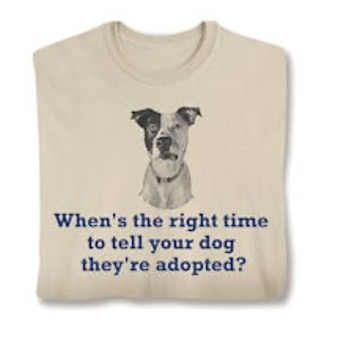
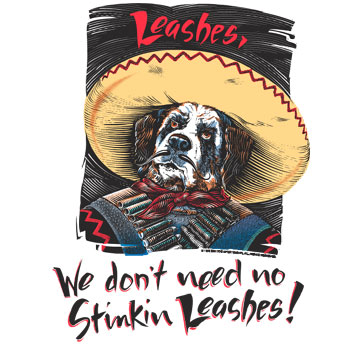
Note:  The t-shirt graphics in this essay are from Life is Good®.  I love their shirts and highly recommend them.  Quality materials and creative messages. This is not a paid endorsement . . . though I’m open to consideration! 🙂

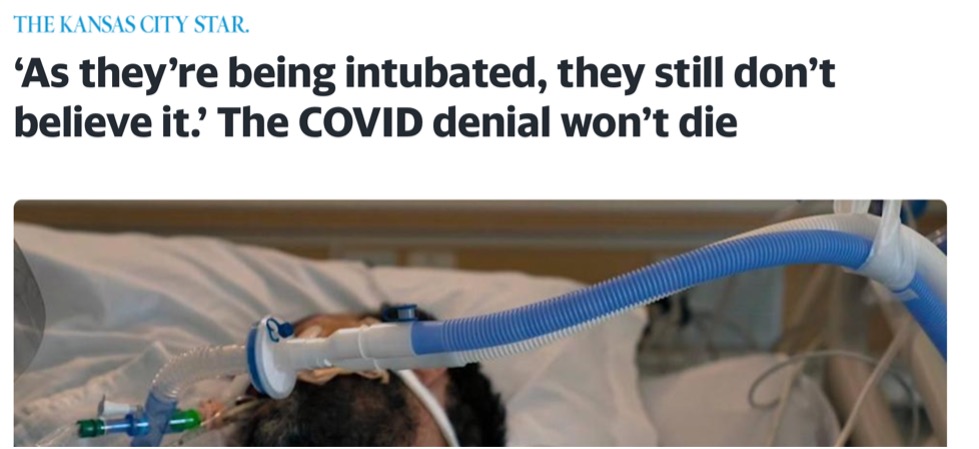
They Don’t Look Okay Anymore

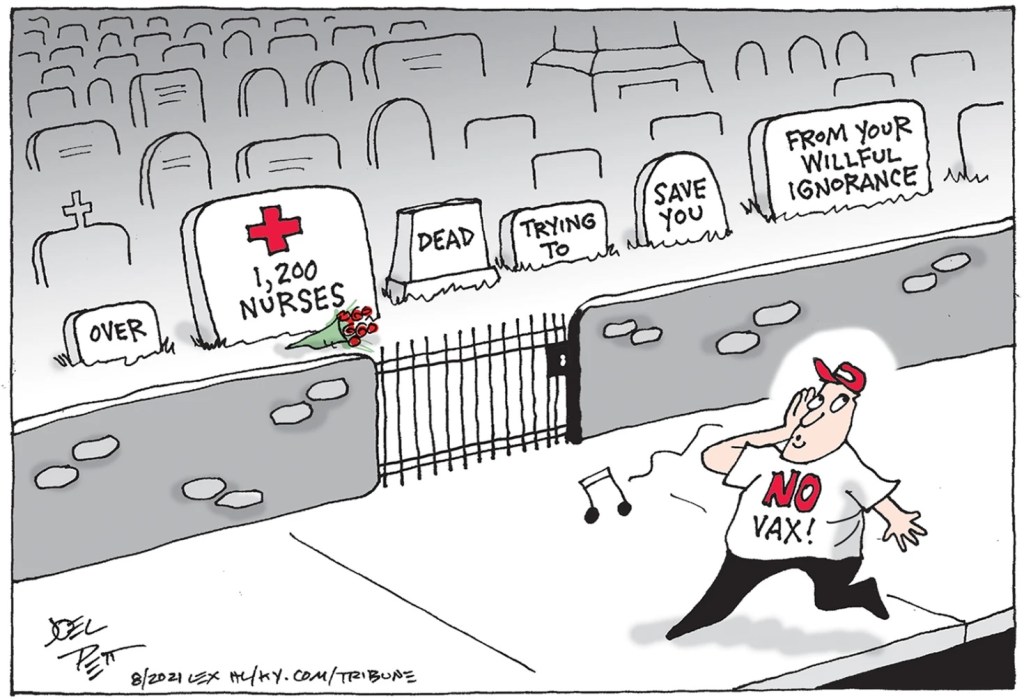
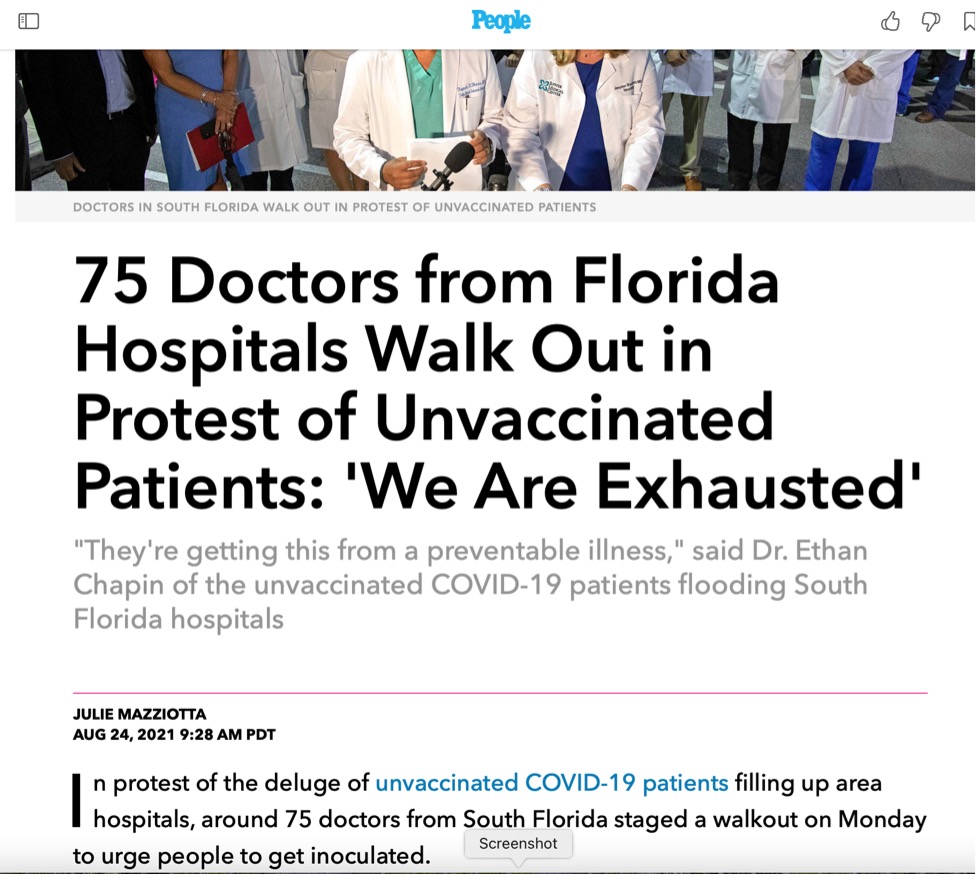
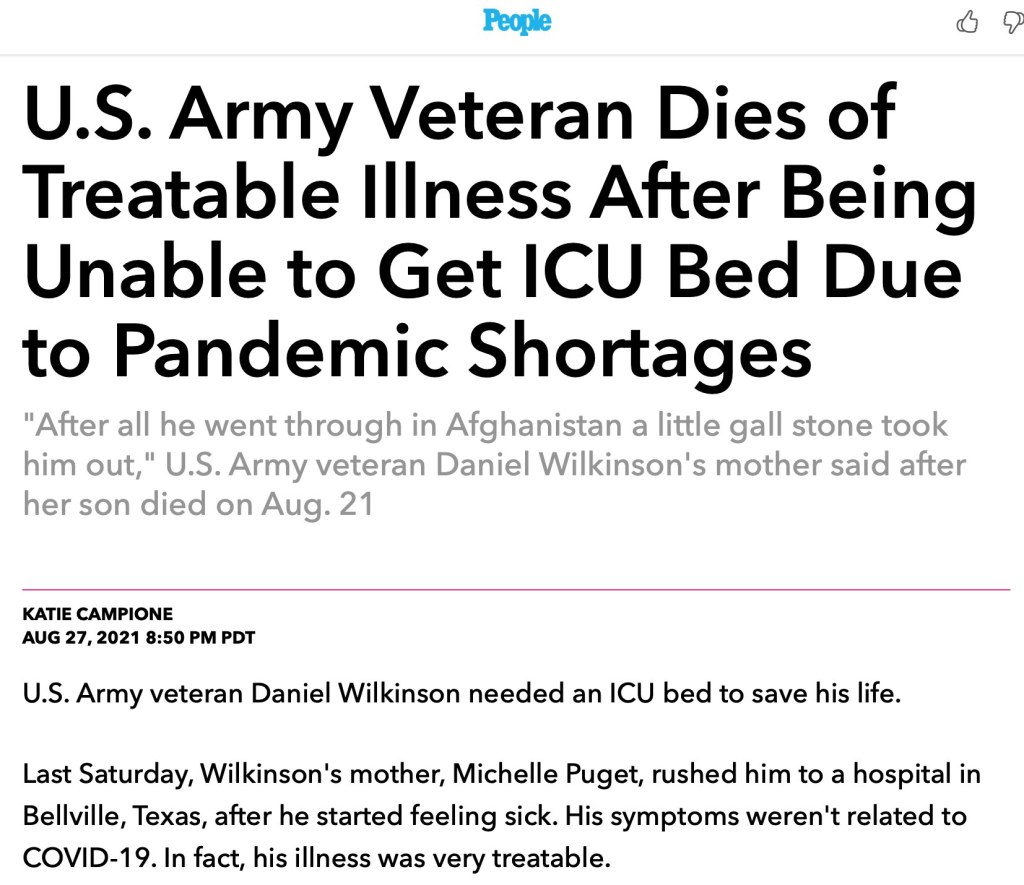
In my previous blog post, “They Look Okay,” I discussed the challenges facing nurses, particularly in the hospital setting, and I provided the statistics for the relatively high turnover rate in the profession. I added a comment about the tremendous increase in their workload due to the Covid virus and suggested that the unvaccinated consider getting vaccinated to help curb the surge in cases, hospitalizations, and deaths.

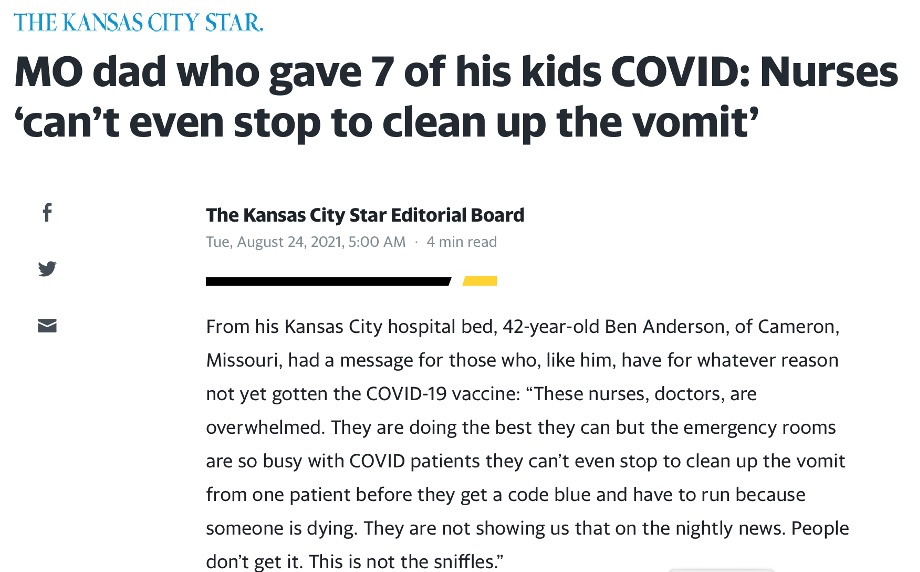
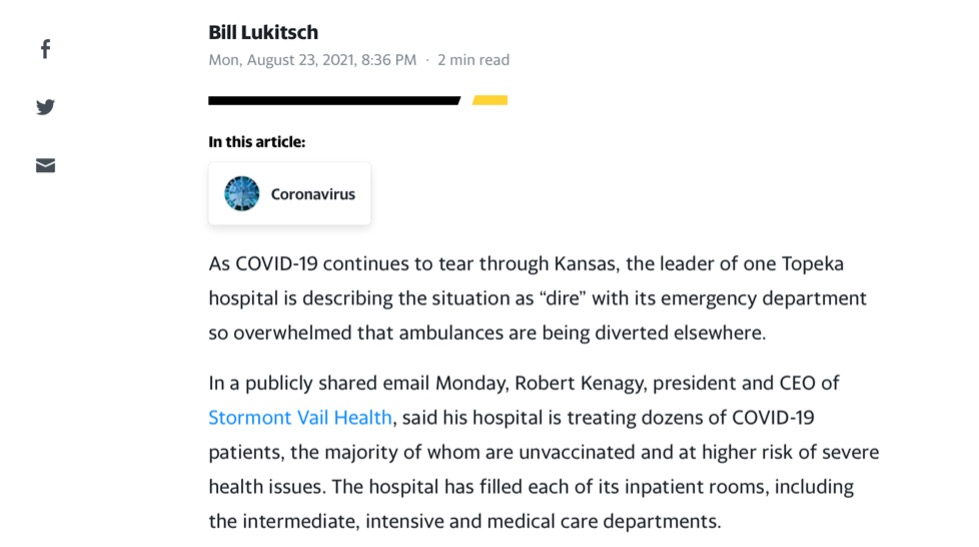
Within a day or two, I ran across several curated articles addressing the issue, and illustrating the magnitude and urgency with specific examples. I have hesitated to post any essays that directly addressed such flashpoint topics, but I believe it needs to be addressed.

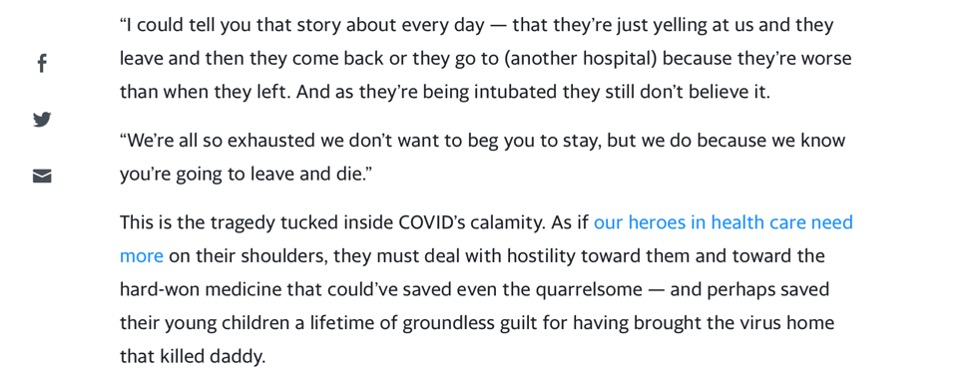
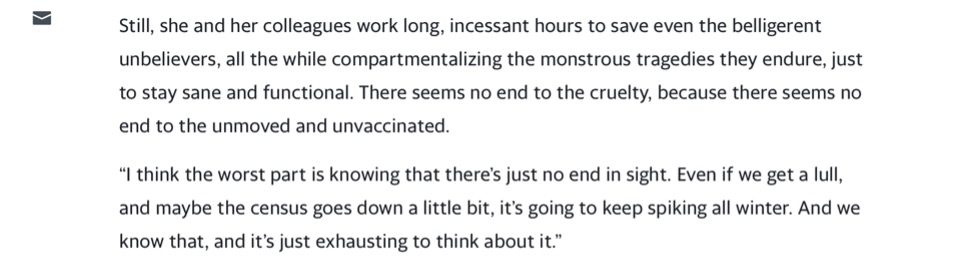
I am not adding any commentary, preferring to let the articles stand on their own. I have, however, provided the source – e.g., The Kansas City Star – and date so that you may read the full article if you choose to, as I have cut and pasted to hit the highlights.

They Look Okay

I remember as a kid, sitting in the doctor’s office.  The doctor had examined my wound, given some instructions to my mother, and told me the nurse would return in a few minutes.  The nurse walked into the adjoining room – I could see her through an open doorway, holding a syringe in front of her, asking where are you in a high-pitched sing-song voice like you might use to coax your dog or cat inside while you crouch behind the front door in your underwear.  She was to give me a shot.

It has dawned on me that it’s always the nurse will be in in a minute to give you the shot.  Honestly, I cannot recall ever receiving a shot from the doctor.  Is shot-giving not in the medical school curriculum?  Seriously.  It’s that way in the hospital, too.  No nurse has ever left the room explaining that the doctor will be in soon to give the shot!

I’m not bad-mouthing doctors because I certainly rely on their knowledge and expertise.  No, I’m actually earning some serious brownie points with my wife, the nurse, by explaining that nurses do a lot of the heavy lifting in health care, and part of it is by doing those tasks – like giving shots – that many of us prefer not to have done to us (who’s up for a catheter?).

Nancy has worked as a nurse her entire adult life.  She has taught nursing students for most of the time she’s been a nurse.  Between her own full- and part-time work experience, and her clinical experience with students, she has worked in a variety of clinical settings – from pediatrics to cardiac care to wounds to infectious disease.  And she knows a lot of nurses, having been involved in educating several thousand.

In one of those “it’s a small world” instances, we saw a couple at a mutual friend’s house.  Dan and I had been friends in high school, and his wife, Brenda, had worked with Nancy when Nancy first moved to Kansas City.  In subsequent social gatherings, Nancy and Brenda will ask things like whatever happened to; and remember unique patients, like the guy the urologist nicked during surgery . . . which reminds me of a joke:

A young nurse’s aide was given the task on her first day in the hospital of giving sponge baths to patients.  She went into one room where the male patient nodded his assent given his difficulty in talking with the tube down his throat.  She began by gently washing his arms, then pulled the sheet to the side to wash his legs.  As she did so, he asked her, “Do my testicles look okay?”  She wasn’t sure what to do, and after he asked again, she decided to pull up his gown to inspect.  Satisfied, she lowered his gown and reported that they look okay.  The patient indicated that he wanted a pen and paper.  On it he wrote, “I asked, do my test results look okay.”

For every humorous story of something that happened in the hospital, there are many that speak to the pain and suffering of so many patients.  Nursing is a tough career.  For example, Nancy earned her creds with the Burn Unit nurses when she didn’t get sick or faint during her orientation to the floor, particularly when they got to the burned babies.  It’s understandable that attrition among nurses is high:  one study noted that 18% of new nurses resign within their first year, and the number jumps to 1/3 by the end of their second year.

Hospitals and healthcare workers have been overwhelmed with critically ill patients for the past year-and-a-half.  Just as hospitals were returning to more manageable levels of Covid patients, the number of infected patients resurged with a vengeance.  Major medical centers, which commonly accept transfer patients from smaller, less equipped hospitals, have stopped accepting transfers – they’re already full to their previously expanded capacities.  Patients with other serious illnesses are finding it difficult to get in:  my brother-in-law recently was taken to a triage-type emergency center for a suspected heart problem, where he had to lay on a gurney for about 12 hours before he could be taken to the affiliated hospital for tests and treatment.

About 2-½ years ago our great nephew caught the virus from hell.  As a toddler in daycare, he was of course exposed to all the snotty noses you expect to find in daycare, and all that snot is a cesspool of germs.  (I know from experience – we had a son in daycare!)  Over the course of that Christmas week, 13 family members contracted the virus from hell from that sweet little toddler.  It was so bad that our niece asked Nancy for help.  Infectious disease mitigation kicked in!

Nancy and I showed up at their empty house with a basket load of cleaning supplies and trash bags.  Not having the appropriate garb, we wore small trash bags over our feet, and the largest garbage bags I’ve seen over our bodies, with holes cut at the appropriate places for head and arms.  We wore hats, face masks, and rubber gloves.  If any of the neighbors had seen us enter in the dark of night, they would probably have thought we were a low-bid hazmat team.

We cleaned every touch surface in that house.  We cleaned every toy we found with a bleach solution, took them outside into the freezing night temperatures, sprayed them, and left them out there to segregate them from the house.  We cleaned bathrooms.  We did laundry.  We sprayed the carpets and furniture with disinfectant, vacuumed and sprayed them again. We stripped off our clothes in the garage and put on fresh clothes for the drive home.  Our infectious disease garb went into two trash bags – one for our clothes that would go into our washer when we arrived home, and one for all the bags, paper towels, and other things we used in cleaning.  It worked.

Can you imagine the health care workers who do that for every infectious disease patient in the hospital?  Most of the time, a hospital wouldn’t have the number of patients equivalent to cleaning the entire house.  During the pandemic their ICUs were stuffed full of infectious patients, and the hospitals had converted other units to Covid ICUs to double, triple, and even quadruple the capacity.

There’s a lot in this world I don’t understand, but you can add to the list the aversion to a vaccine that has been successfully administered to a couple hundred million Americans, and millions more worldwide.  More than 90% of all new cases, and virtually all the deaths, are among the unvaccinated.

I looked it up – seven vaccinations/immunizations are required to attend public school in Missouri.  In 2014, the Missouri Senate unanimously passed a mandate requiring a meningitis vaccination for students who attended a Missouri state college – two college students had died, and the Senate worked quickly and collaboratively to stop it from happening to more.  As of August 20th, Missouri has reported 733,759 Covid cases, and 10,185 deaths.

In elementary school, I remember when doctors and nurses came to the school.  All of us had to eat a sugar cube with some medicine in it.  Polio had been a devastating disease for decades, and a vaccine had finally been developed.  As part of a national public health initiative, immunizations were being given in virtually all the schools.  It allowed us to achieve herd immunity in a very short time, and we have effectively eradicated polio around the world.  Personally, I didn’t understand the disease, nor care about the medicine; I was in it for the sugar cube.

The next time someone asks about getting vaccinated, tell them it’s like getting a sugar cube . . . and let them know that their testicles look okay, too.

Note:  The “stop your heart” t-shirt is from Signals.com, which offers a cornucopia of shirts with different themes, in addition to other merchandise.

Note:  The “I believe in science” t-shirt is from Life is Good®.  I love their shirts and highly recommend them.  Quality materials and creative messages.  This is not a paid endorsement . . . though I’m open to consideration! 🙂

Just the Nature of Things

As we stayed home at the outset of the pandemic, Nancy became increasingly stir-crazy.  We decided to take drives, to find unexplored roads.  An interesting discovery was a small farm not far from our house.  As we were making our way home from one of our sojourns, I took a quick right and said, “Let’s try this road.”  Within three blocks a suburban street transformed into a country road.  We passed a hand-painted sheet of plywood that announced, “Farm Fresh Eggs.”  We needed eggs, but didn’t want to go to the store, so I turned around.

A couple of cars were parked in front of the house, but there was no sign of life other than the dozens of chickens feeding on insects in a large, fenced area.  We walked into the small building for eggs; no one in there.  We looked around and discovered an old soft drink cooler with a glass door that had a handwritten sign giving the prices of eggs.  We picked one of the few remaining cartons and wondered how we were supposed to pay.  A sign on the wall said “Pay Here,” with an arrow pointing to the right.  We followed the wall to another “Pay Here” sign, with an arrow pointing down to a PVC pipe sticking out of the wall.  No credit cards, no change; we simply dropped our money down the tube.

We also developed a rather . . . hmm, shall we say peculiar? . . . behavior.  We moved our lawn chairs to the front entryway of our house so we could sit and watch people walk by with their dogs; and there were a lot of dogs.  Our poor old Jude was too old and immobile to walk, so we took our walks vicariously.

Jude crossed the Rainbow Bridge early in the pandemic. We had decided not to get a dog – at least for a while – with the expectation that we could travel. We didn’t get far! After nearly a year without a dog, we adopted one this spring. She’s a Mini Aussie, an active breed that delights in running and jumping. Neither of us does much running or jumping, so she got us on a much more regular walking routine, including greater distance.

,As we walk, Nancy frequently comments on just how pretty the area is. We live in a suburban community, but it looks and feels different. One of the important differences is what I refer to as nature-scape. The developer used small parcels that could not be developed, and rather than planting grass and calling it a “common area,” there are native grasses and wildflowers and trees. Some of the areas are no bigger than a few hundred square feet, yet they provide such refreshing breaks from the uniformity of the residential lawns surrounding them.

In his book, Common Ground, Rob Cowen would refer to these small natural spaces as “edge-lands.” Sometimes forgotten spaces, they harken to the past, before humans wrestled the earth into conformity; they exist in the present, yet they let us peer into their future, once we have ceded the match or moved on to new interests. Cowen previews the role in his introduction:

Nature was before us and it will be after us. Edge-lands attest to this like nowhere else. They record and replay our negotiation with it, bridging the gap and reminding us that to think of our existence as removed from the wider biosphere is nothing short of delusional. With this comes incredible payback. You begin to see that you can never be alone in nature. . . . There are riches in the wastelands and they’re yours to find.

The other day, I read a brief essay from Outside, that was curated by Pocket.  The opening paragraph introduced the point that an experience in nature can be an antidote to stress and worry:

Among the many studies linking time spent outside with health benefits, one of the more intriguing new areas of research is the role awe plays in our well-being. According to findings published in 2018 in the journal Emotion, the kind of amazement we experience during outdoor activities has a singular ability to predict lower stress and positive emotions like joy and contentment.

As the pandemic was “roaring in like a lion” in Spring 2020, I finished an essay titled “An Early Spring.”  The essay was about our connection with nature.  I chose to publish the essay below for a couple of reasons.  First, I like it.  Second, and more to the point of this post, is that in this time of Covid and “staying at home,” I realize again the importance of nature in our lives.

Note:  The t-shirt graphics in this essay are from Life is Good®.  I love their shirts and highly recommend them.  Quality materials and creative messages. This is not a paid endorsement . . . though I’m open to consideration! 🙂

Up On The Roof . . . Hmm

What You See Is What You Get

Well, WYSIWYG wasn’t quite what I got. The formatting looked right in the preview, but it got distorted in the email notification. So I went back and quickly (Hahaha!) edited the format. It now appears correct on the blog’s webpage. Sorry about that for the multitudes of you who are reading my blog.

P.S. This t-shirt is from Signals.com. Again, not a paid endorsement.

Up On The Roof

I traveled full-time when I was consulting years ago.  Being young and single, I occasionally stayed near my project rather than flying home for the weekend.  This was during the halcyon days of air travel, before deregulation.  Tickets were like currency.  If I arrived at the airport early and Delta had a flight to my destination, I could take it instead of waiting for my scheduled flight on a different carrier; Delta simply accepted my ticket and settled with the other airline.  If I exchanged my ticket to Kansas City for a ticket to Boston, and the flight to Boston was cheaper, the airline refunded the difference in cash . . . at the ticket counter!

It was just such an exchange – a ticket to KC for one to Boston – to visit my sister and her family for the weekend, and I think they refunded $32 and change to me.  I always enjoyed visiting my sister.  She’s seven years older, and growing up, was frequently assigned the task of watching her little brother.

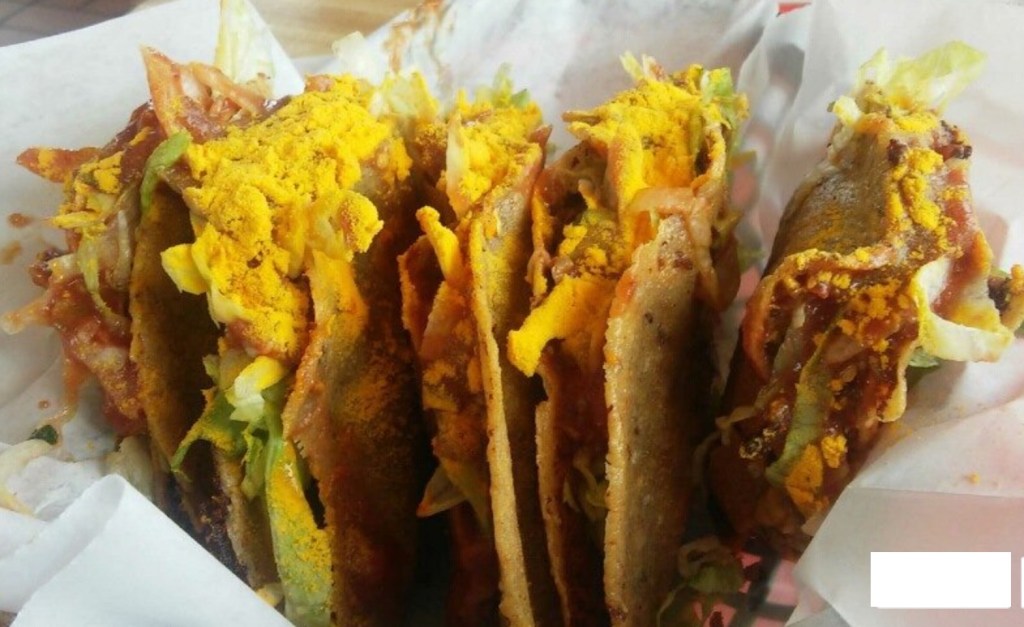
She introduced me to In-A-Tub in the early 60’s.  They were famous for their tacos, where the shell was fried with the meat in it (some call the technique “pinned tacos”).  After frying, they would pry open the shell, stuff in a little shredded lettuce, a little taco sauce, then cover it with an orange-colored powdered cheese.  They were an acquired taste, but if you acquired it, you kept it!

The original location was on the side of North Oak Trafficway.  Cars would pull up somewhat haphazardly to park, and you would walk up to a window to order.  As I realized later, when I was in high school, going to In-A-Tub wasn’t just for the tacos, but was also for seeing and being seen.  By then, the street had been widened to four lanes, and In-A-Tub had moved about a half-mile south, but the new building offered the same walk-up service; it had a gigantic parking lot, though, and the line to order must have gotten as many as a hundred people in it on busy nights.  Visiting with friends.  Seeing.  Being seen.

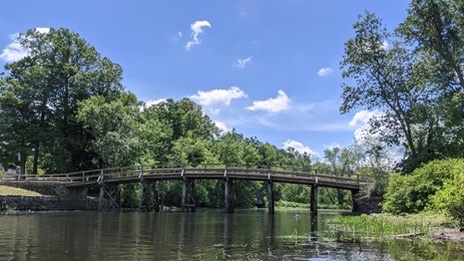
It was on these occasional visits to Boston to see my sister – ever the tour guide, but now staying upright behind the wheel – that I came to appreciate the area.  She lived in Concord, home to Ralph Waldo Emerson, Henry David Thoreau, Nathanial Hawthorne, and many others you were required to read in school; and you can visit Walden Pond, the Old Manse (where Nathaniel Hawthorne lived and wrote), and the Old North Bridge, starting place of the Revolutionary War, with what Emerson described as “the shot heard round the world.”

Old North Bridge

BY THE RUDE BRIDGE THAT 
ARCHED THE FLOOD,
THEIR FLAG TO APRIL’S
BREEZE UNFURLED,
HERE ONCE THE EMBATTLED
FARMERS STOOD,
AND FIRED THE SHOT HEARD
ROUND THE WORLD.

“The Concord Hymn” by Ralph Waldo Emerson

Boston, itself, was home to the Old North Church (one if by land, two if by sea), Boston Harbor, Union Oyster House, and Faneuil Hall.  Maneuvering the narrow cobblestone streets in a car was a test of skill and daring.  Owning a car in Boston is something of a disadvantage; my nephew and his wife rued the day her grandmother gave her car to them because they rarely drove it and had to pay to park it.  Boston is a very walkable city and has great public transportation.  (Kansas City, by contrast, brags about its streetcar route that stretches a whopping 2.2 miles!  The metro area has/had the most miles of highway per capita of any major metropolitan area in the US.  We drive everywhere.)

Boston scores high on walkability largely because it is so dense.  The historic places that mean so much to the early history of the United States are scattered among modern, vibrant high-rise office buildings towering above, sheltering the history that resides below.  The city also provides ample living spaces to accommodate the residents of the city.

During these weekend visits, I enjoyed Boston’s offerings as a vibrant city with historical significance.  It’s contrast to Kansas City’s sprawl captivated me, yet the brevity of my visits obscured the true density of life in the city – where did the people go when they simply wanted to “get away from it” for a few hours?  I could easily jump into my car and drive out of the city; heck, I could walk into my yard and have more greenspace than the typical resident in Boston.

One weekend, I met a co-worker and some of her friends for dinner and an evening visit.  The weather was glorious.  How could we fully capitalize on the beauty of the evening in the denseness of the city?  After dinner, we returned to the old “brownstone” she and one of her friends lived in, not to sit around the small apartment, but to go up on the roof.

The rooftops of some of these buildings provided outdoor living space to their residents.  Although only a few flights up, we were above the streetlights and had a wonderful view of the night sky with its twinkling stars and moon shining brightly, and a somewhat panoramic view of large swaths of the city.  The air somehow seemed fresher.  It was an escape – an island with its own tree and potted plants.  A respite from the denseness of the city below.

As I drive through Kansas City’s downtown – which has had a resurgence thanks in part to that 2.2-mile streetcar, and conversion of older buildings to lofts – I occasionally glance up looking for signs of a rooftop space, and I’m pleased when I spot a tree or two rising above the walls of the roof.  It’s not a walk in the woods, but it provides a connection to nature in a simple way.

Note:  The t-shirt graphic in this essay is from Life is Good®.  I love their shirts and highly recommend them.  Quality materials and creative messages. This is not a paid endorsement . . . though I’m open to consideration! 🙂