I’ve Been Thinking . . . About the Arts and Humanities

I subscribe to The New York Times. David Brooks is one of the opinion essayists I read more often than not. His essays sometimes cause me to question both of our sanity – his for writing it and mine for reading it. At other times, I appreciate his perspective and insight. I have grown to following into the latter category – that of learning and growing from his insights – as time goes on; I’m not sure if his or my perspective is changing – perhaps both.

I have included a copy of a recent essay he wrote on how the role of studying the Arts and Humanities can enhance our understanding of ourselves and the world we live in. I find this particularly interesting because I have considered good literature as helping us understanding the human condition. A suggestion I routinely made to my students when I was teaching management classes at the university was to read widely – including fiction – rather than simply in their particular field.

I might make a reference to an organizational situation as a Catch-22. From their vacant looks I could tell they didn’t know the reference. Upon questioning, I learned that some had a vague understanding, but not really. In explaining the reference, I emphasized that they might one day works with a colleague who makes such a reference, assuming that they know to what it refers; and if they don’t know, ask, as it could prevent a lapse in communication and a costly mistake. I encountered probably a half-dozen such examples each semester. Had they only read the book!

Brooks’ essay is more cogent and he includes more than literature. I encourage you to read it. If you are one of the friends to whom I previously sent a link, you can acknowledge to yourself that you read it, you can re-read it, or you can take this as a nudge that you should actually read it this time.

On a technical note, my subscription allows me to share up to ten articles per month; this is one. The official link to the article follows the article. Enjoy.

OPINION

DAVID BROOKS

How to Save a Sad, Lonely, Angry and Mean Society

Jan. 25, 2024

a photograph of a marble bust in a museum with a man standing behind it using his hands to explain something

Credit…Matthew Monteith

David Brooks

By David Brooks

Opinion Columnist

Recently, while browsing in the Museum of Modern Art store in New York, I came across a tote bag with the inscription, “You are no longer the same after experiencing art.” It’s a nice sentiment, I thought, but is it true? Or to be more specific: Does consuming art, music, literature and the rest of what we call culture make you a better person?

Ages ago, Aristotle thought it did, but these days a lot of people seem to doubt it. Surveys show that Americans are abandoning cultural institutions. Since the early 2000s, fewer and fewer people say that they visit art museums and galleries, go to see plays or attend classical music concerts, opera or ballet. College students are fleeing the humanities for the computer sciences, having apparently decided that a professional leg up is more important than the state of their souls. Many professors seem to have lost faith too. They’ve become race, class and gender political activists. The ensuing curriculum is less “How does George Eliot portray marriage?” and more “Workers of the world, unite!”

And yet I don’t buy it. I confess I still cling to the old faith that culture is vastly more important than politics or some pre-professional training in algorithms and software systems. I’m convinced that consuming culture furnishes your mind with emotional knowledge and wisdom; it helps you take a richer and more meaningful view of your own experiences; it helps you understand, at least a bit, the depths of what’s going on in the people right around you.

The novelist Alice Walker lamented that she lacked models. She wasn’t aware of enough Black female writers who could serve as exemplars and inspirations as she tried to perceive her world and tell her stories. Then she found the novelist and anthropologist Zora Neale Hurston, who, decades before, had pointed the way, shown her how to see and express, enabled her to write about her mother’s life, about voodoo, the structures of authentic Black folklore. Thanks to Hurston she had a new way to see, a deeper way to connect to her own heritage.

I’d argue that we have become so sad, lonely, angry and mean as a society in part because so many people have not been taught or don’t bother practicing to enter sympathetically into the minds of their fellow human beings. We’re overpoliticized while growing increasingly undermoralized, underspiritualized, undercultured.

The alternative is to rediscover the humanist code. It is based on the idea that unless you immerse yourself in the humanities, you may never confront the most important question: How should I live my life?

Ralph Waldo Emerson, for example, argued that we consume culture to enlarge our hearts and minds. We start with the tiny circle of our own experience, but gradually we acquire more expansive ways of seeing the world. Peer pressure and convention may try to hem us in, but the humanistic mind expands outward to wider and wider circles of awareness.

I went to college at a time and in a place where many people believed that the great books, poems, paintings and pieces of music really did hold the keys to the kingdom. If you studied them carefully and thought about them deeply, they would improve your taste, your judgments, your conduct.

Our professors at the University of Chicago had sharpened their minds and renovated their hearts by learning from and arguing against books. They burned with intensity as they tried to convey what past authors and artists were trying to say.

The teachers welcomed us into a great conversation, traditions of dispute stretching back to Aeschylus, Shakespeare, George Bernard Shaw, Clifford Odets. They held up visions of excellence, people who had seen farther and deeper, such as Augustine, Sylvia Plath and Richard Wright. They introduced us to the range of moral ecologies that have been built over the centuries and come down as sets of values by which we can choose to live — stoicism, Buddhism, romanticism, rationalism, Marxism, liberalism, feminism.

The message was that all of us could improve our taste and judgment by becoming familiar with what was best — the greatest art, philosophy, literature and history. And this journey toward wisdom was a lifelong affair.

The hard sciences help us understand the natural world. The social sciences help us measure behavior patterns across populations. But culture and the liberal arts help us enter the subjective experience of particular people: how this unique individual felt; how this other one longed and suffered. We have the chance to move with them, experience the world, a bit, the way they experience it.

We know from studies by the psychologists Raymond Mar and Keith Oatley that reading literature is associated with heightened empathy skills. Deep reading, immersing yourself in novels with complex characters, engaging with stories that explore the complexity of this character’s motivations or that character’s wounds, is a training ground for understanding human variety. It empowers us to see the real people in our lives more accurately and more generously, to better understand their intentions, fears and needs, the hidden kingdom of their unconscious drives. The resulting knowledge is not factual knowledge but emotional knowledge.

The novelist Frederick Buechner once observed that not all the faces Rembrandt painted were remarkable. Some are just average-looking old people. But even the plainest face “is so remarkably seen that it forces you to see it remarkably.” We are jolted into not taking other people for granted but to sense and respect the immense depth of each human soul.

Image

Rembrandt’s “The Return of the Prodigal Son.”

Rembrandt’s “The Return of the Prodigal Son.”Credit…Fine Art Images/Heritage Images, via Getty Images

When I come across a Rembrandt in a museum, I try to train myself to see with even half of Rembrandt’s humanity. Once in St. Petersburg, I had the chance to stand face to face with one of his greatest paintings, “The Return of the Prodigal Son.” He painted this one at the end of his life, when popular taste had left him behind, his finances were in ruins, his wife and four of his five children were in their graves. I have seen other renderings of that parable, but not one in which the rebel son is so broken, fragile, pathetic, almost hairless and cast down. The father envelops the young man with a love that is patient, selfless and forbearing. Close observers note the old man’s hands. One is masculine, and protective. The other is feminine, and tender.

Though this painting is about a parable, it’s not here to teach us some didactic lesson. We are simply witnessing an emotional moment, which is about fracture and redemption, an aging artist painting a scene in which he imagines all his losses are restored. It is a painting about what it is like to finally realize your deepest yearnings — for forgiveness, safety, reconciliation, home. Meanwhile, the son’s older brother is off to the side, his face tensely rippling with a mixture of complex thoughts, which I read as rigid scorn trying to repress semiconscious shoots of fraternal tenderness.

Experiences like this help us understand ourselves in light of others — the way we are like them and the way we are different. As Toni Morrison put it: “Like Frederick Douglass talking about his grandmother, and James Baldwin talking about his father, and Simone de Beauvoir talking about her mother, these people are my access to me; they are my entrance into my own interior life.”

Experiences with great artworks deepen us in ways that are hard to describe. To have visited Chartres Cathedral or finished “The Brothers Karamazov” is not about acquiring new facts but to feel somehow elevated, enlarged, altered. In Rainer Maria Rilke’s novel “The Notebooks of Malte Laurids Brigge,” the protagonist notices that as he ages, he’s able to perceive life on a deeper level: “I am learning to see. I don’t know why it is, but everything penetrates more deeply into me and does not stop at the place where until now it always used to finish.”

Mark Edmundson teaches literature at the University of Virginia and is one of those who still lives by the humanist code. In his book “Why Read?” he describes the potential charge embedded in a great work of art: “Literature is, I believe, our best goad toward new beginnings, our best chance for what we might call secular rebirth. However much society at large despises imaginative writing, however much those supposedly committed to preserve and spread literary art may demean it, the fact remains that in literature there abide major hopes for human renovation.”

Wouldn’t you love to take a course from that guy?

How does it work? How does culture do its thing? The shortest answer is that culture teaches us how to see. “The greatest thing a human soul ever does in this world is to see something, and tell what it saw in a plain way,” the Victorian art critic John Ruskin wrote. “Hundreds of people can talk for one who can think, but thousands can think for one who can see.”

Ruskin intuited something that neuroscience has since confirmed: Perception is not a simple and straightforward act. You don’t open your eyes and ears and record the data that floods in, the way in those old cameras light was recorded on film. Instead, perception is a creative act. You take what you’ve experienced during the whole course of your life, the models you’ve stored up in your head, and you apply them to help you interpret all the ambiguous data your senses pick up, to help you discern what really matters in a situation, what you desire, what you find admirable and what you find contemptible.

Another way to put it is this: Artistic creation is the elemental human act. When they are making pictures or poems or stories, artists are constructing a complex, coherent representation of the world. That’s what all of us are doing every minute as we’re looking around. We’re all artists of a sort. The universe is a silent, colorless place. It’s just waves and particles out there. But by using our imaginations, we construct colors and sounds, tastes and stories, drama, laughter, joy and sorrow.

Works of culture make us better perceivers. We artists learn from other artists. Paintings, poems, novels and music help multiply and refine the models we use to perceive and construct reality. By attending to great perceivers, the Louis Armstrongs, the Jorge Luis Borgeses, the Jane Austens, we can more subtly understand what is going on around us and be better at expressing what we see and feel.

When you go to the Museo Reina Sofía in Madrid, you don’t just see Picasso’s “Guernica”; forever after you see war through that painting’s lenses. You see, or rather feel, the wailing mother, the screaming horse, the chaotic jumble of death and agony, and it becomes less possible to romanticize warfare. We don’t just see paintings; we see according to them.

Image

People viewing Picasso’s “Guernica.”

Picasso’s “Guernica.”Credit…Emilio Parra Doiztua for The New York Times

This process of refining and expanding our internal mental models is not a dry, purely intellectual process. If we’re lucky, and maybe only in rare moments, it can be gut-wrenching and intoxicating, a fusion of the head and the heart. As my friend Arthur Brooks writes, “Think of a time when you heard a piece of music and wanted to cry. Or recall the flutter of your heart as you stared at a delicate, uncannily lifelike sculpture. Or maybe your dizziness as you emerged from a narrow side street in an unfamiliar city and found yourself in a beautiful town square; for me, it was the Piazza San Marco in Venice, with its exquisitely preserved Renaissance architecture. Odds are, you didn’t feel as if the object of beauty was a narcotic, deadening you. Instead, it probably precipitated a visceral awakening, much like the shock from a lungful of pure oxygen after breathing smoggy air.”

In this kind of education, you are lured by beauty and deeply pierced by myths that seem primeval and strange. Once in college, I was reading Nietzsche’s “The Birth of Tragedy” in the library. I don’t know what happened next. The book, with its fevered prose and savage genius, sucked me into a trance. I eventually looked up and it was four hours later. I had traveled in time back into some primeval world of bonfires, dancing and Dionysian frenzy, and it left a residue, which I guess you would call a greater awareness of the metaphysical, the transcendent. Life can be much wilder than it seems growing up on a suburban street.

The philosopher Roger Scruton argued that this kind of education gives us the ability to experience emotions that may never happen to us directly. He wrote: “The reader of Wordsworth’s ‘Prelude’ learns how to animate the natural world with pure hopes of his own; the spectator of Rembrandt’s ‘Night Watch’ learns of the pride of corporations, and the benign sadness of civic life; the listener to Mozart’s ‘Jupiter’ symphony is presented with the open floodgates of human joy and creativity; the reader of Proust is led through the enchanted world of childhood and made to understand the uncanny prophecy of our later griefs which those days of joy contain.”

Your way of perceiving the world becomes your way of being in the world. If your eyes have been trained to see, even just a bit, by the way Leo Tolstoy saw, if your heart can feel as deeply as a K.D. Lang song, if you understand people with as much complexity as Shakespeare did, then you will have enhanced the way you live your life.

Attention is a moral act. The key to becoming a better person, Iris Murdoch wrote, is to be able to cast a “just and loving attention” on others. It’s to shed the self-serving way of looking at the world and to see things as they really are. We can, Murdoch argued, grow by looking. Culture gives us an education in how to attend.

The best of the arts are moral without moralizing. Dostoyevsky’s “Crime and Punishment” is an inquiry into the knowledge of right and wrong, told through the eyes of one who suffers, with all the pity and sorrow that involves.

The best of the arts induce humility. In our normal shopping mall life, the consumer is king. The crucial question is, do I like this or not? But we approach great art in a posture of humility and reverence. What does this have to teach me? What was this other human being truly seeking?

A man observing a large painting on a wall in a museum.

The San Fernando Royal Academy of Fine Arts Museum in Spain.Credit…Emilio Parra Doiztua for The New York Times

One of my heroes is Samuel Johnson, the essayist, playwright, poet, dictionary compiler, one of the greatest critics of all time. He was something of a mess as a young man — lazy, envious, unreliable. Over the decades, he read, wrote and felt his way to greatness. He read with astounding sensitivity. Once at age 9 he was reading “Hamlet” when he came to the ghost scene. He was so terrified he ran to the front door so that he could look out at the people in the street, just to remind himself that he was still in the land of the living.

He wrote biographies of his moral exemplars. He wrote essays, poems and plays about the great works of the Western tradition, and especially about his own sins as if he were trying to beat it out of himself through the scourge of self-examination. (Johnson had a special weakness for envy, and so dozens of his essays in his periodicals mention the sin of envy.) His awareness of human depravity led to humility, self-restraint and redemption. And it worked. By the end of his life he was lavishly generous, a man who had the ability to see the world with absolute honesty and sympathetic perception. Johnson socialized with artists and statesmen, but he invited society’s outcasts to live with him so that he could feed and offer them shelter — a former slave, a doctor who treated the poor, a blind poet. One night he found a woman, most likely a prostitute, lying ill and exhausted on the street. He put her on his back and brought her home to join the others. Johnson was a somewhat tortured Christian. These radical moments of welcome are the essential Gospel-like acts.

When he died, his eulogist observed that he left a chasm in national life that nothing could fill up. He embodied that old humanist ideal. He had become a person of taste, a person of judgment, a person of culture. He died a wonderful man.

The Times is committed to publishing a diversity of letters to the editor. We’d like to hear what you think about this or any of our articles. Here are some tips. And here’s our email: letters@nytimes.com.

Follow The New York Times Opinion section on FacebookInstagramTikTokX and Threads.

David Brooks has been a columnist with The Times since 2003. He is the author, most recently,  of “How to Know a Person: The Art of Seeing Others Deeply and Being Deeply Seen.” @nytdavidbrooks

I’ve Been Thinking . . . About What Is and Was

Theodor Geisel was born in Springfield, Massachusetts.  Ted, as he was called by his friends in Springfield, grew up sketching the animals on trips to the zoo with his father.  In college, he wanted to become a writer, and he began writing for a college humor magazine.  He ultimately wrote some of the most memorable, and best-selling, children’s books under his pen name, Dr. Seuss.
Studies in the mid-1950s pointed to the problem of waning reading interest and literacy among school children.  Geisel – by the late-1950s, an accomplished author of children’s books – was tasked with writing a book, not using more than 225 words (he used 236).  The objective was to create a book that would make reading fun and engaging for those children.  The result: The Cat in the Hat.  He was next tasked – allegedly in the form of a $50 bet with his publisher, Bennett Cerf – to write a book using only 50 words.  The result was a book with 49 single-syllable and one multi-syllable words: Green Eggs and Ham.

_____________________________

I enjoy writing, which is why I started this blog.  For whatever reason, I have been distracted and derelict in my efforts.  The distractions have come from a variety of places, none of which warrant a lack of effort on my part.  That’s where the dereliction comes into place.

This being New Year’s Day, a resolution seems necessary.  I’m not particularly big on resolving to do or accomplish things that I’m likely to forget before January 2nd.  In this case, however, I resolve to write and post blogs more consistently in 2024.  I will not, however, commit to a number or frequency; just more consistently.

How can I possibly not express a goal – a specific number – a specific frequency of postings?  My life has been filled with setting goals.  As a manager, I knew that if I didn’t have measurable goals, I could not adequately plan the actions necessary to achieve the goals, nor would I be able to assess what I accomplished.  As a college management professor, I preached/taught the gospel of goal-setting.

But writing this blog is avocational – not vocational – and I write for my enjoyment, and hopefully for yours.  Writing and posting more consistently is my avocational goal, and I’ll know if I have achieved it if I feel I have achieved it.  As I begin the new year, I will resist the urge to discuss the concept of time in favor of a review of things that were.

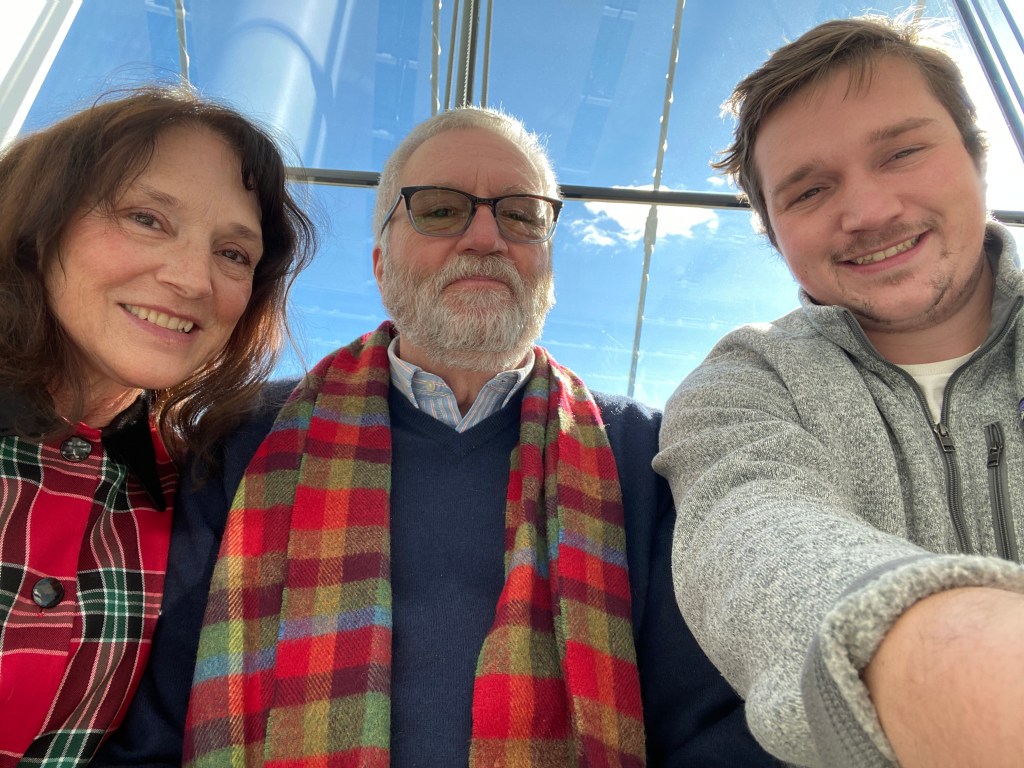
I’m beginning with a full circle.  The picture on the left is of my wife, son, and I in 2022, waiting in the lobby of the Kauffman Center for “The Nutcracker”; the right is of us in 2023, following the Christmas Eve Candle Lighting service at church.

There was no real opportunity for a New Year’s picture.  For example, last evening, Nancy and I were discussing changing to our pajamas and the likelihood of making it until the ball drop in New York City when Michael left to go to a friend’s New Year’s Eve party.  It won’t be too many more years when we go to the senior buffet at Golden Corral, then to bed after the celebration in Paris or London!

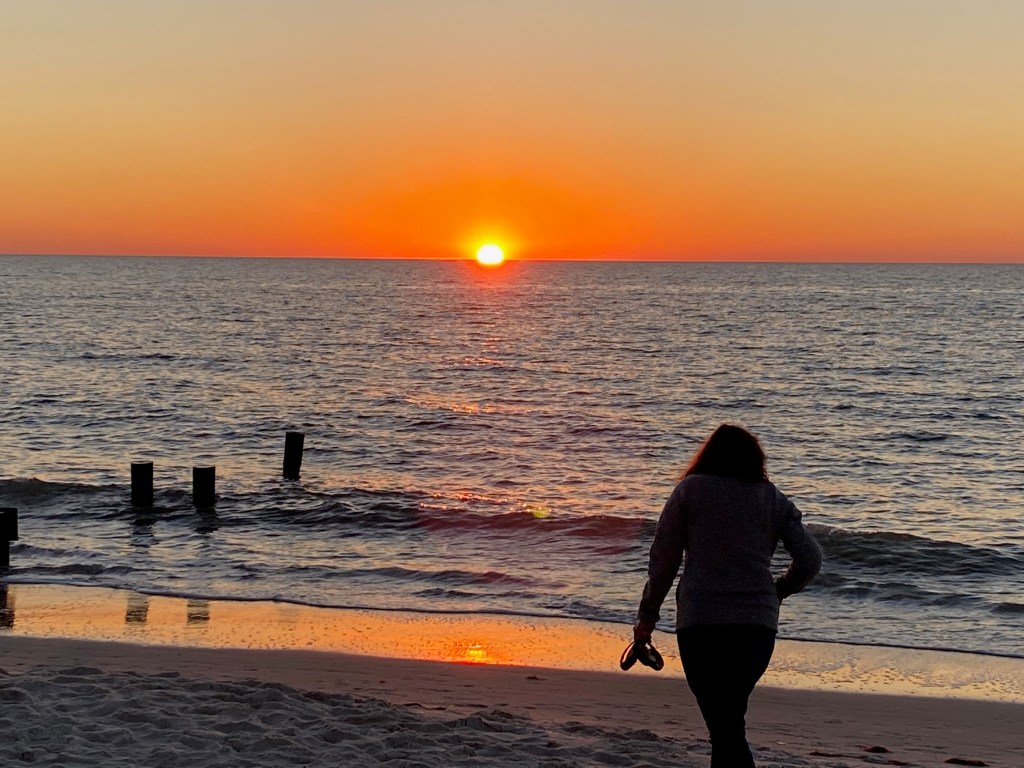
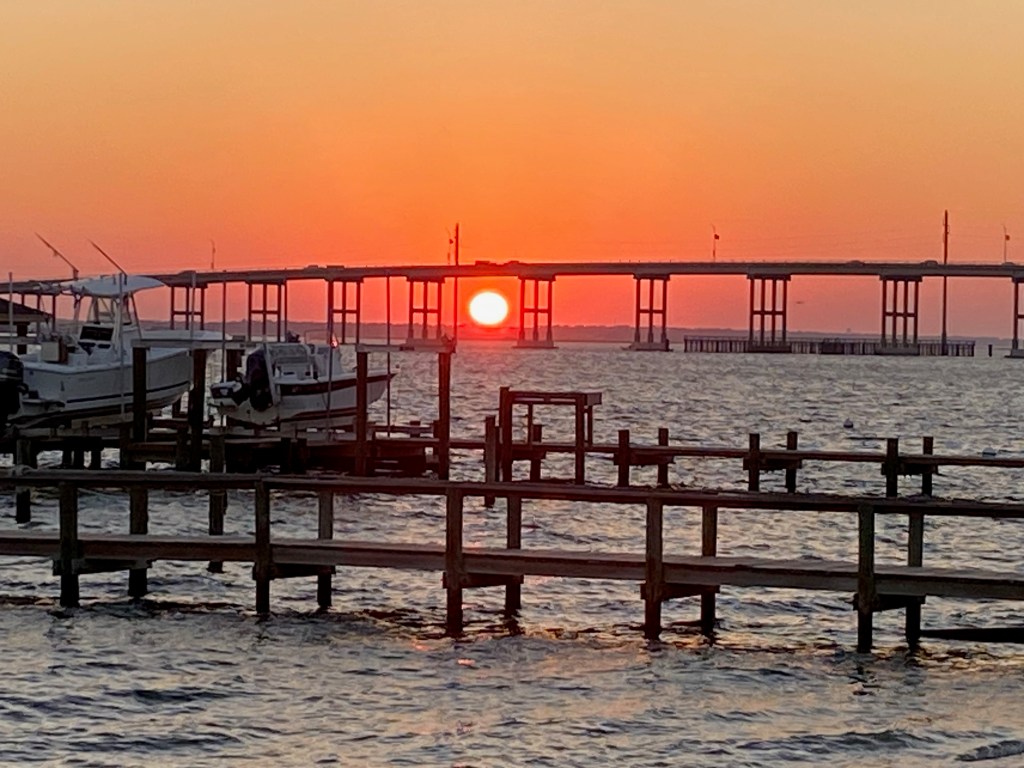
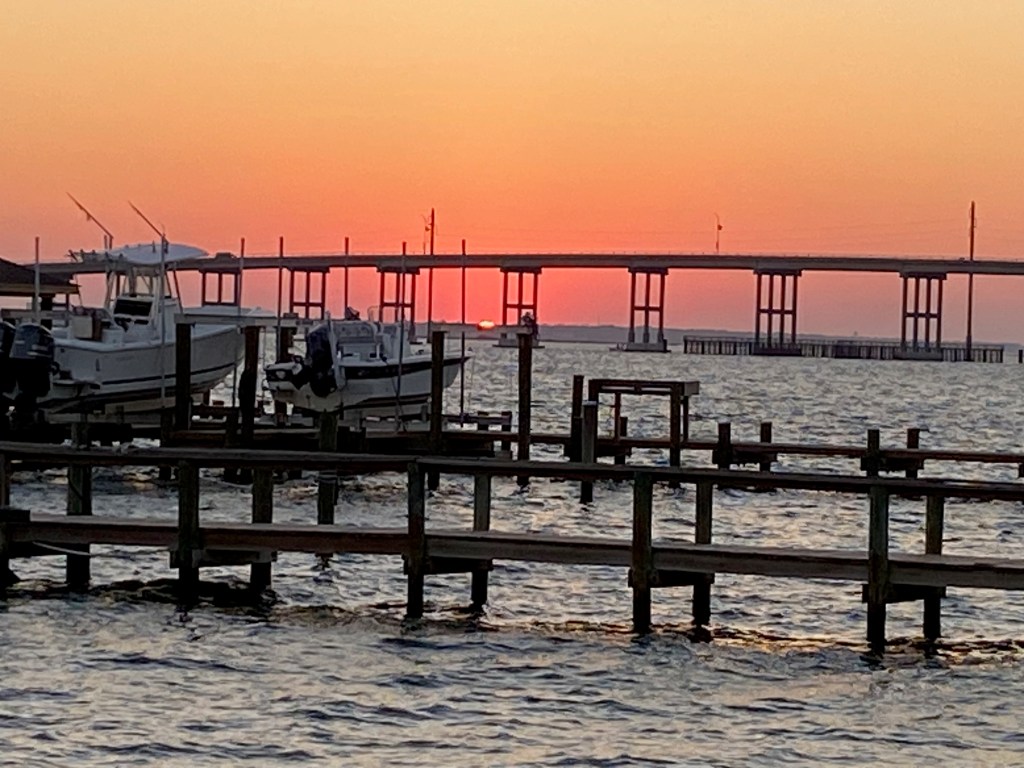
We love going to the ocean.  We have gone to Naples, FL, the past three winters to enjoy the warm temperatures and sunshine.  The pictures on the left were taken there.  The pictures on the right were taken in Morehead City, NC, when we visited friends. 

I’m not quite sure what it means that I take a lot of pictures of sunset.  I suppose one reason is the sheer beauty of the sun setting over a vast expanse of water.  Metaphorically, perhaps I recognize the beauty of the end of the day as depicting the expanse of a life well-lived. 

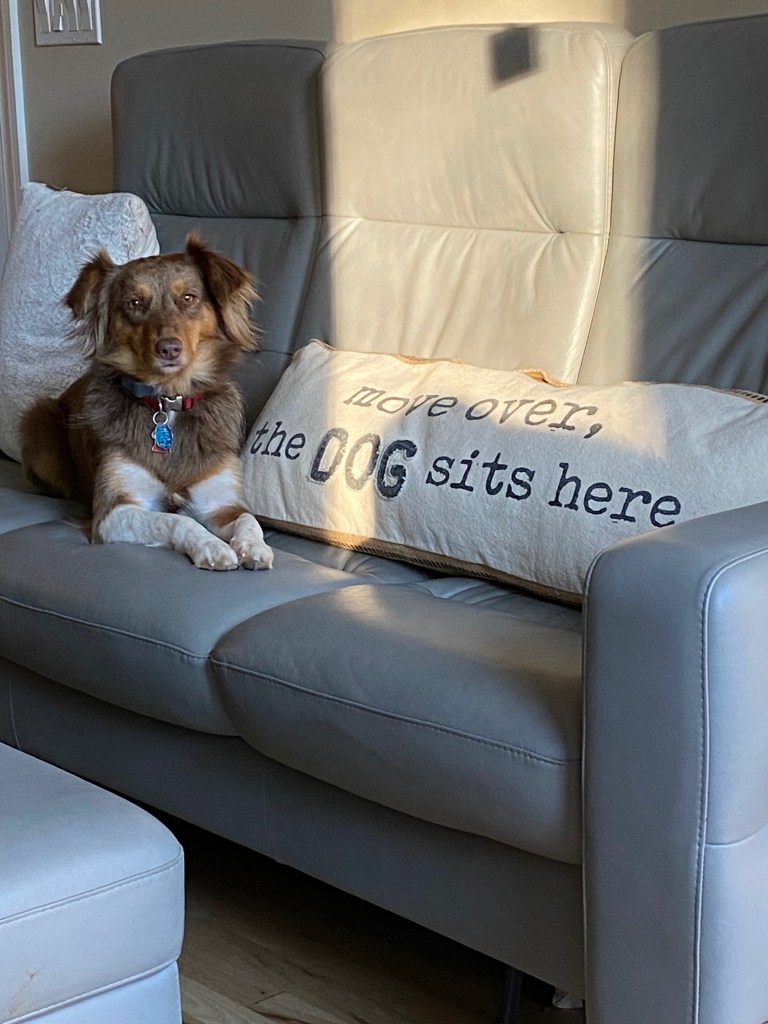
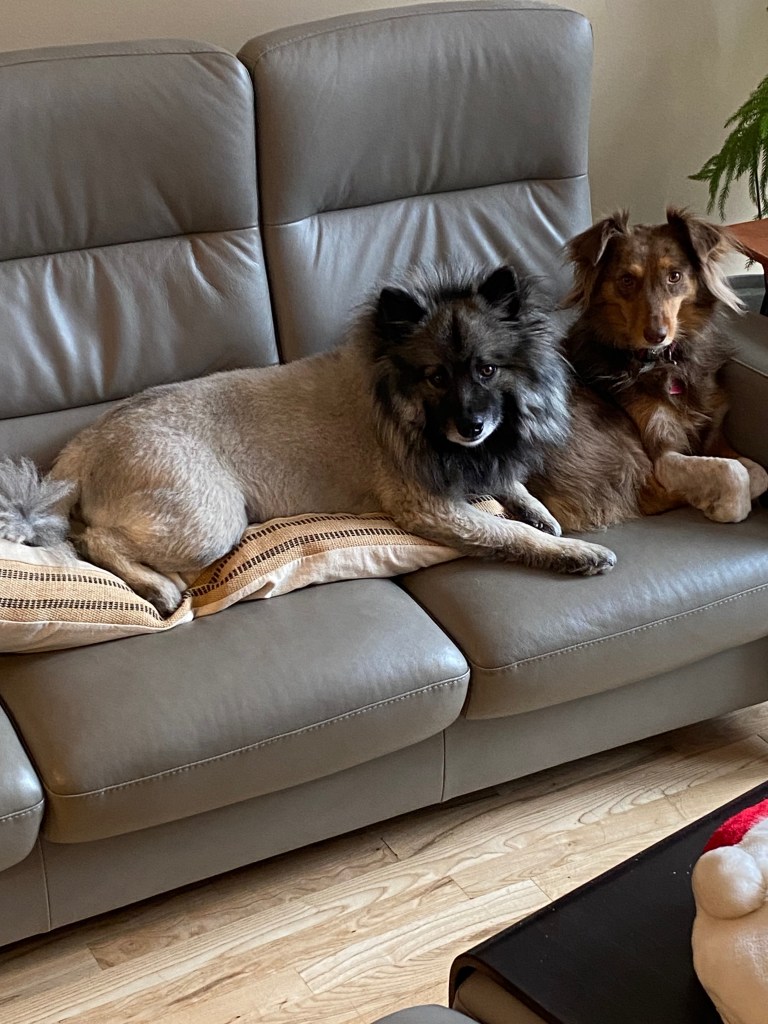
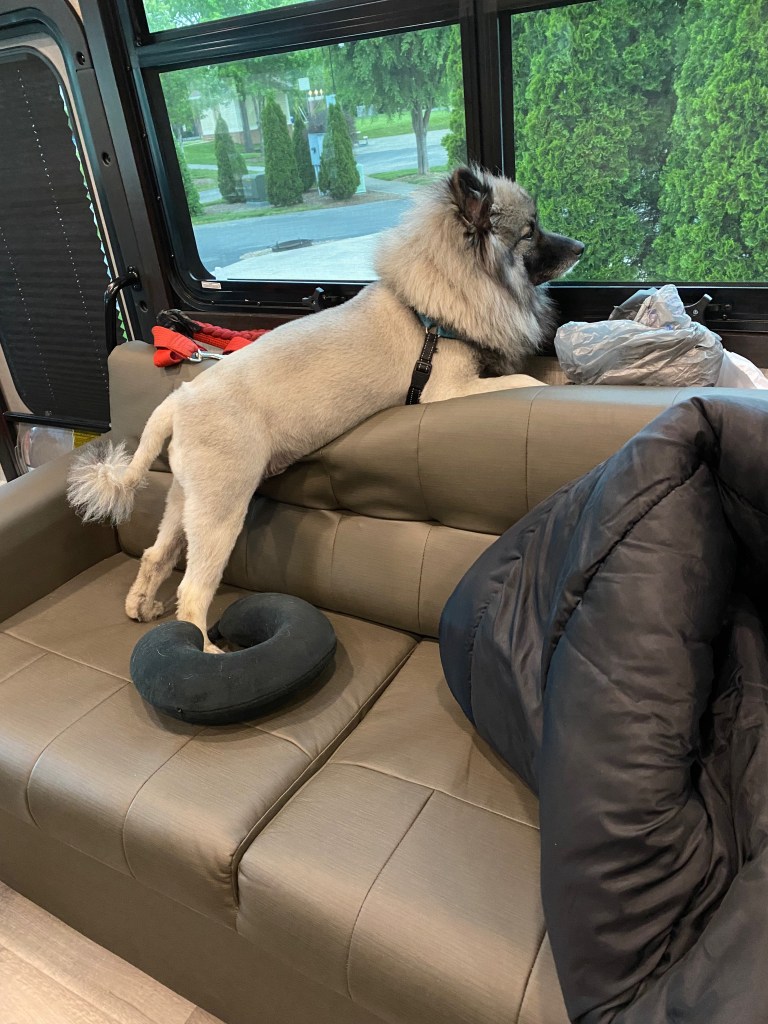
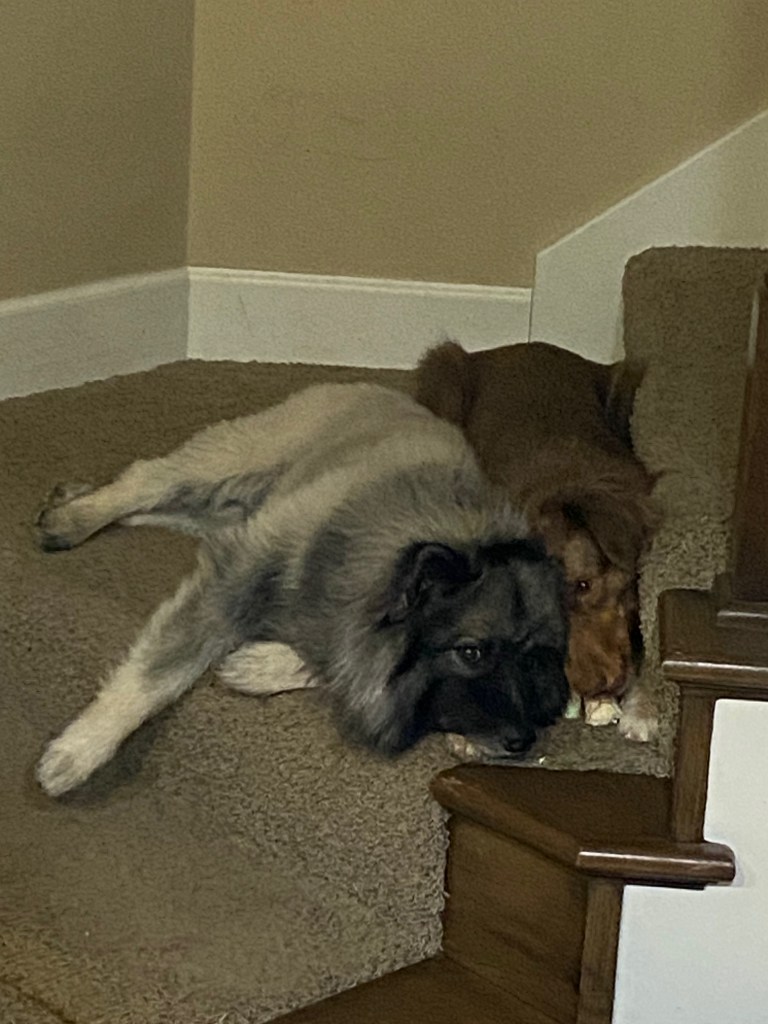
We love our dogs, Lexi, a Mini Australian Shepherd, and Bear, a Keeshond.  They bring a lot of joy to our lives.  They demonstrate unconditional love for us, and to each other.  Bonus: they love to go in the RV!

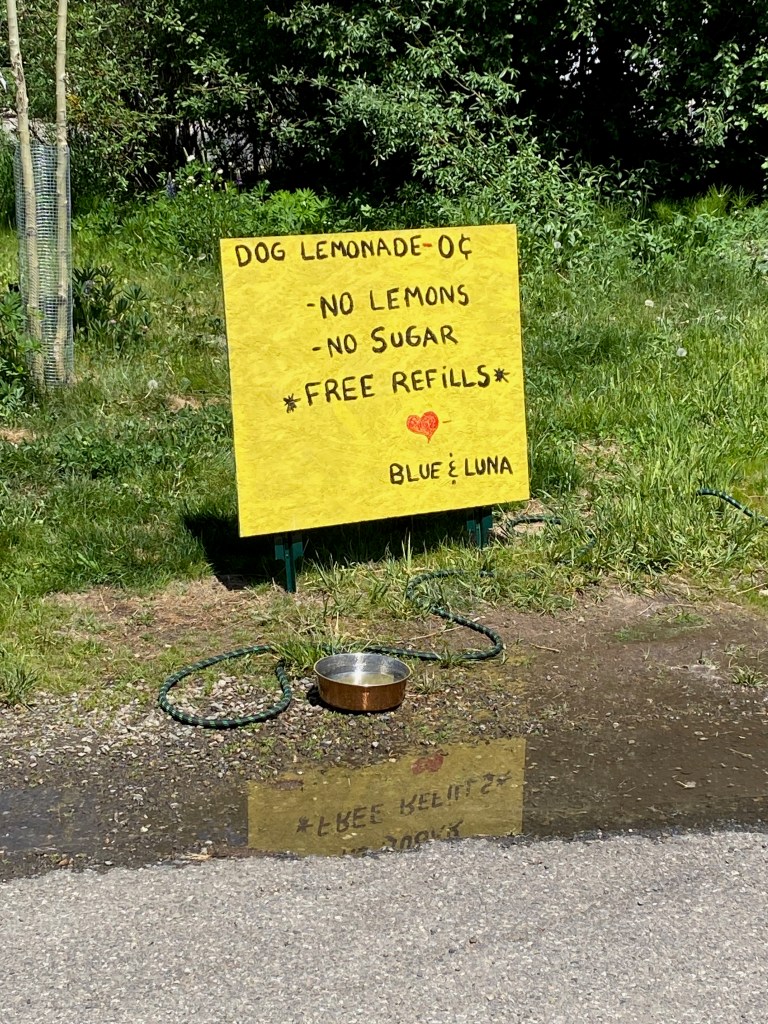
On our trip to Colorado, Nancy and I were riding bikes and we found the sign below, with a hose leading to a water bowl.  They like their dogs in Colorado.

It reminded me of a story, and I found the following version online:

An old man and his dog were walking down a dirt road for quite some time when they finally came to a beautiful marble wall with a golden gate. The person standing guard was dressed in a white robe and said:

“Welcome to Heaven”. It was then the old man realized he and his dog were dead and traveling down Eternity Trail. They both were hot and very thirsty as they had been walking for a long time. The old man was so happy to be at Heaven’s gate.

He started to enter with his dog following him but the gatekeeper stopped him and said: “I’m sorry, but dogs are not allowed in Heaven so he can’t come in with you”, as he gestured towards the man’s dog.

The old man replied: “But my dog has been my faithful companion all his life. If my dog can’t come in with me, then I will stay out too. I will not desert him now, not even to enter Heaven.” 

The gatekeeper replied: “Suit yourself, but I must warn you, the Devil’s on this road and he’ll try to sweet talk you into his area. He will promise you anything to get you to enter. So if you don’t leave your dog now and come in, you will spend eternity on this road hot and thirsty or end up in Hell.” But the old man still refused to enter and continued walking along the dirt road with his dog.

After walking a long way further, the man and his dog came upon a rundown fence with no gate. He saw a man dressed in old, ragged clothes just on the other side, standing next to a large shady tree. The old man called out to him saying: “Excuse me Sir. My dog and I have been on this road all day and are very hot and thirsty. Would it be okay if we took a much-needed rest under your shady tree?”

“Of course”, the other man replied. “There’s some cold water under the tree too. So please come in and help yourselves.”

The old man asks: “Are you inviting my dog too, because I won’t come in without him. In fact, that’s why I chose not to go to Heaven because I was told dogs are not allowed.”

The man smiled and said, “Welcome to Heaven, and bring your dog!”

The old man exclaimed, “You mean this is Heaven? And dogs are allowed? How come that fellow down the road said they weren’t?”

“That was the Devil and he gets all the souls who are willing to give up a lifelong companion for a few small comforts. Those who choose that route soon find out their mistake but it’s too late. The dogs always find their way here and the fickle people who abandoned them stay in Hell, for eternity.”

“You see my friend, GOD would not allow dogs to be banned from Heaven. After all, He created them to be man’s companions in life, so He would never separate them in death.”

We enjoy the mountains in the summer.  Just as we like to go south in the winter to enjoy sunshine and warm weather, instead of winter’s cold and dark gray clouds that seem like they could drop on you at any time; we like the fresh, crisp air and blue skies of the mountains instead of the oppressive heat and humidity of a midwestern summer.

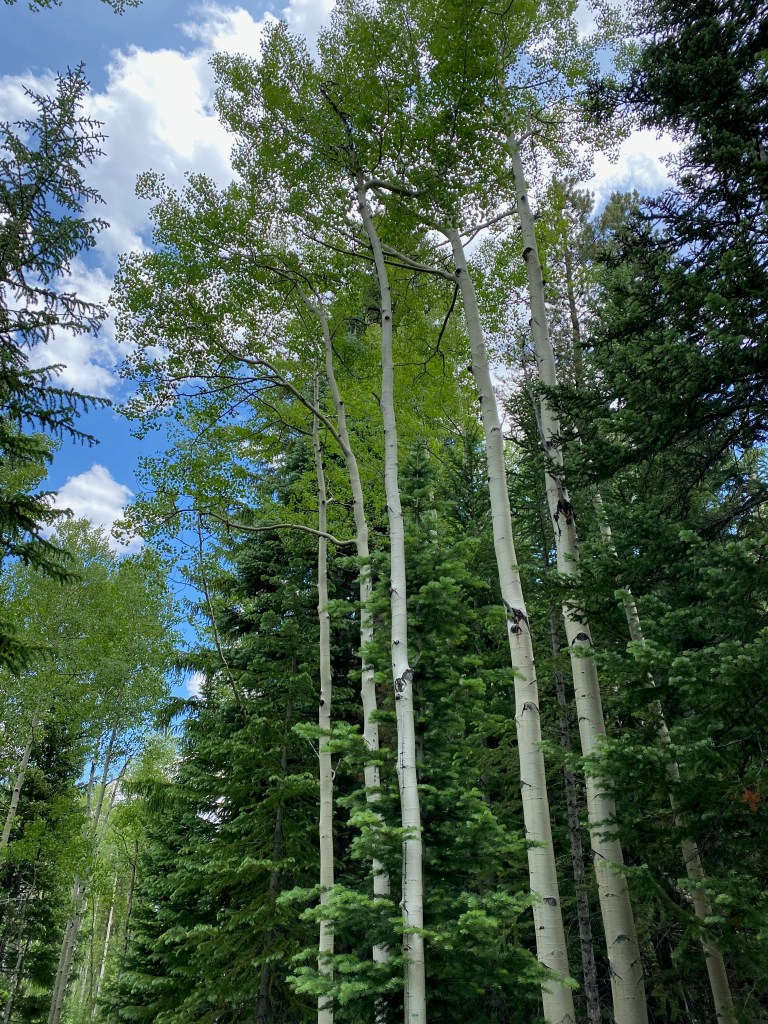
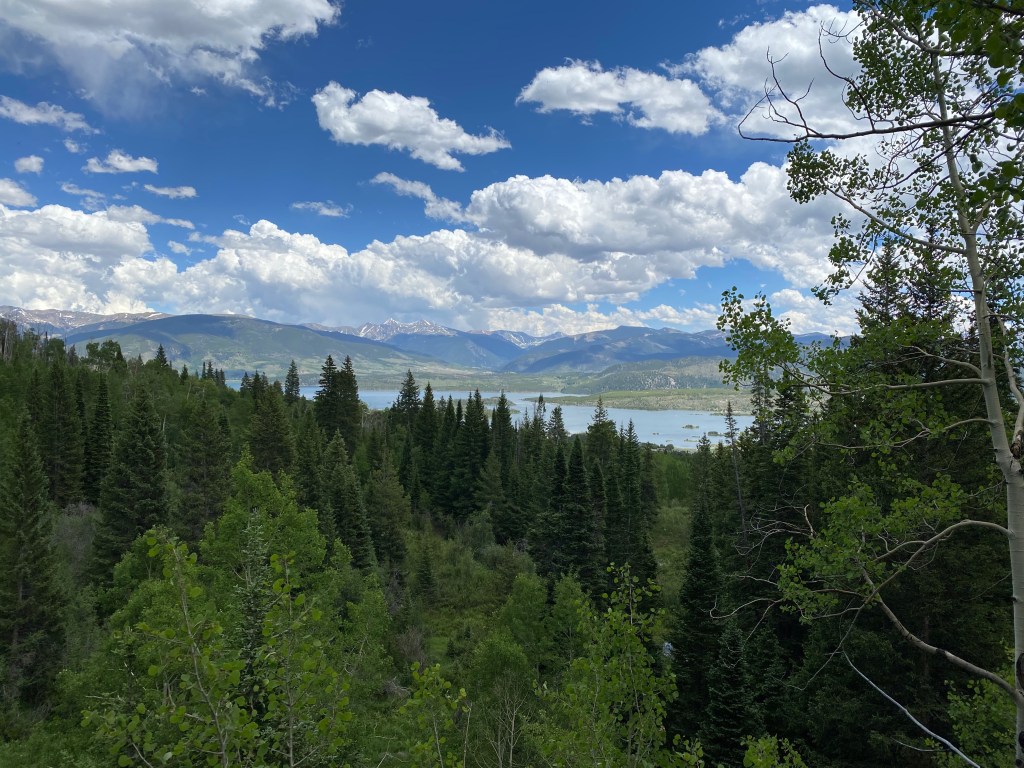
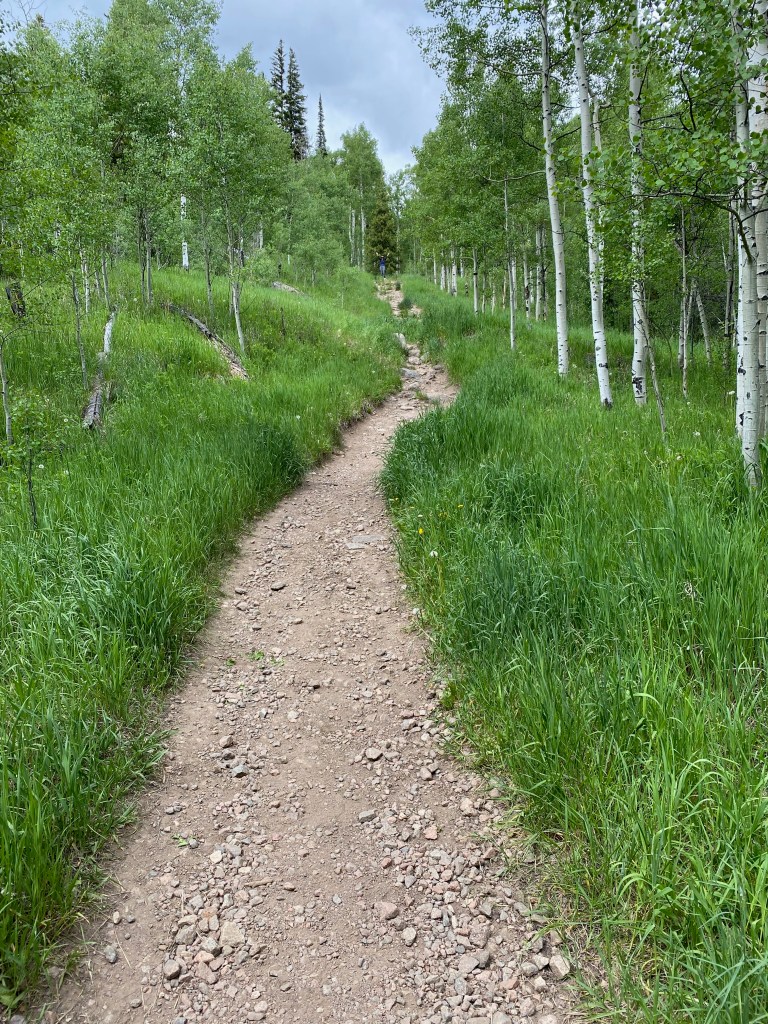
As we wander along the serpentine trails carved out of the trees and the contours of the rocks, I look in awe at the panoramic views from the higher elevations.  I gaze up through the trees, watching them sway gently to the whispering songs of the wind.  The sky’s expanse, the white of the clouds contrasting with the blue, stills me in place.

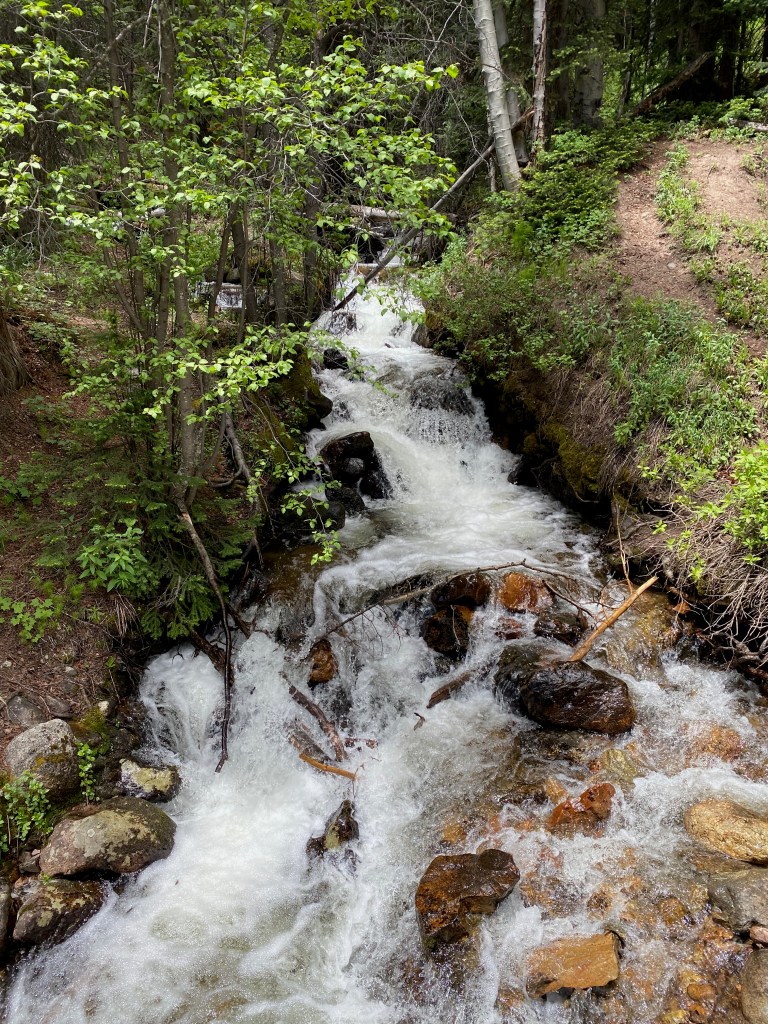
The hikes take us along mountain streams and rivers, fed by the melting snow that accumulated over the winter, and by the showers that frequently pass through in the afternoons.

The water has a song of its own: sometimes a roar as it cascades over steep rocks; sometimes a gurgle as it bobs through the eddies that create a bountiful haven for trout.  Whatever its song, the water is always playing; the water is always moving toward the ocean where it can reflect the beauty of the setting sun.  It is always running toward its convergence, changing as along its way.

The ancient Greek philosopher, Heraclitus, said it best: “No man ever steps in the same river twice, for it is not the same river and he is not the same man.”

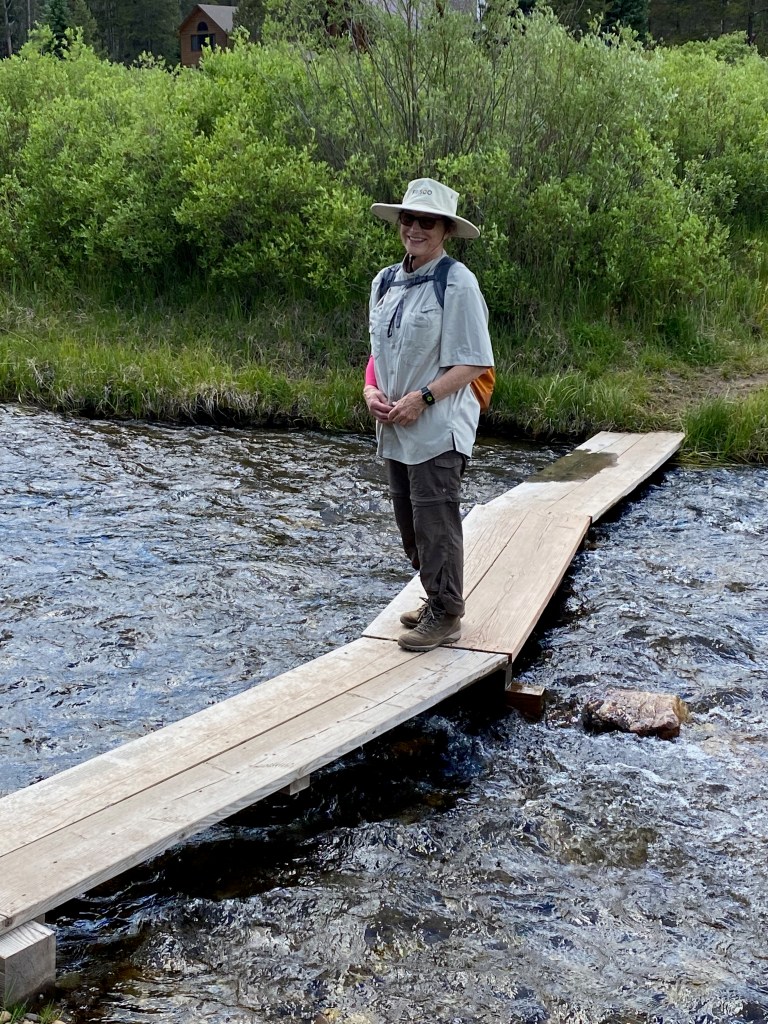
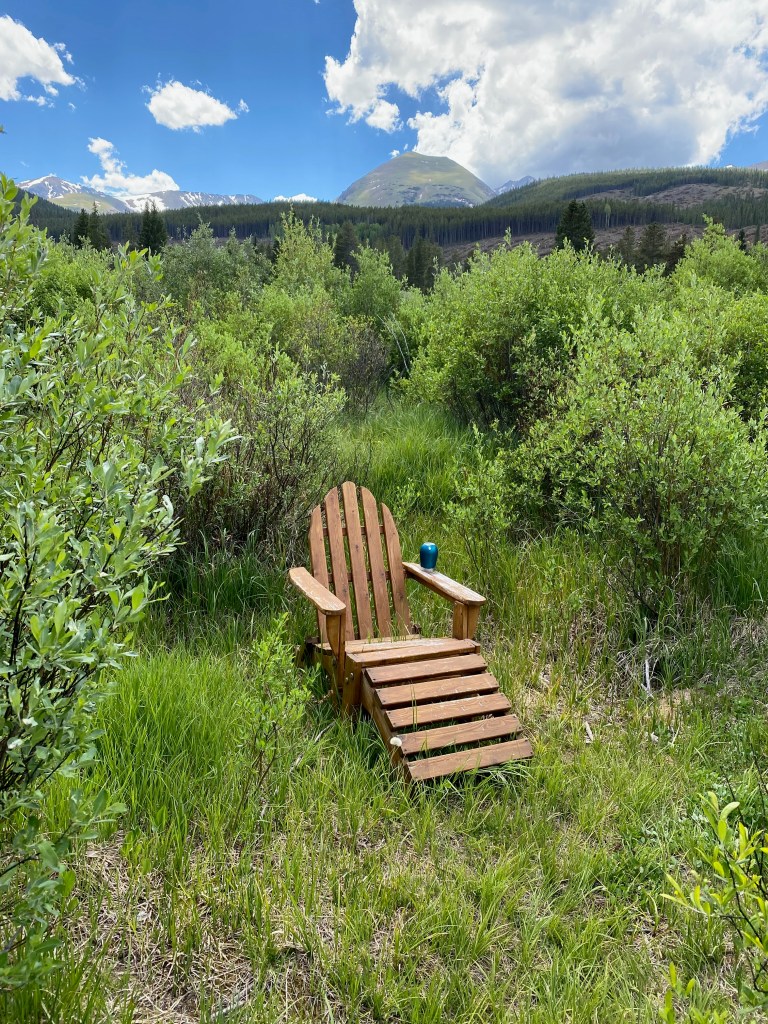
On one of our hikes through the low-lying land of the Blue River Basin, in the space of the “Y” near the juncture of a small stream joining the Blue River, someone had positioned an Adirondack Chair, visible from only a short stretch of trail, yet able to hear the songs of the stream and the Blue River.

The chair harkens back to the Adirondack Mountains in New York. The mountains are sometimes referred to as “new mountains from old rocks” – the rocks date back a billion years, yet the mountains continue to grow and change.
The Adirondacks became a place of escape, a respite from all the noise and congestion in one’s life; the chair a place to sit, listen to nature’s songs, and gaze at the gates of Heaven above.

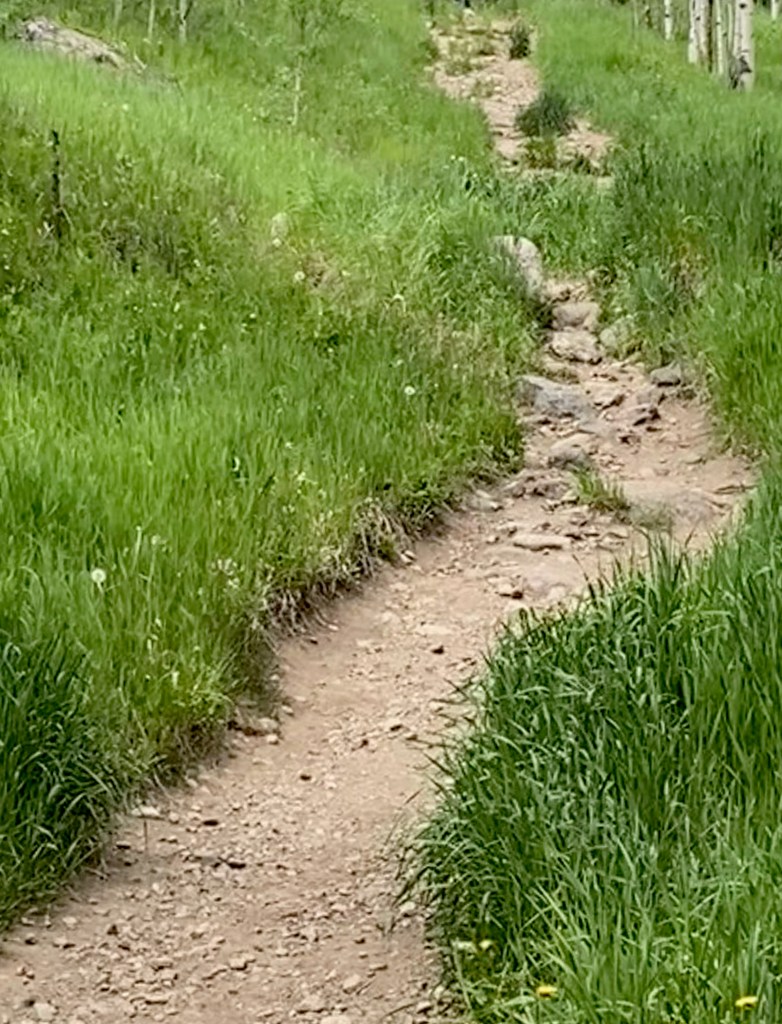
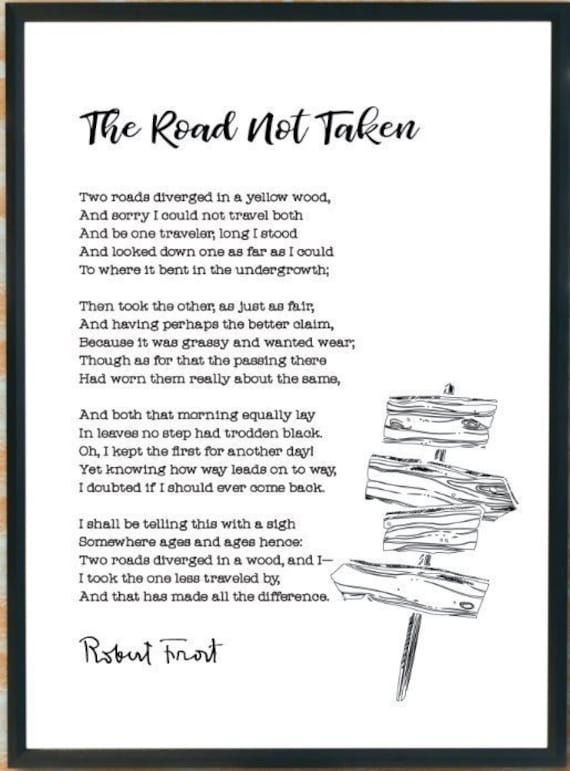
The “road less traveled” refers to a choice the narrator makes in “The Road Not Taken,” a famous poem by Robert Frost.  The road less traveled metaphorically refers to a sense of independence, of embarking on a path that is less defined, and making one’s own way.  Another interpretation of Frost’s poem is that the narrator is looking back on choices made and interpreting those choices in light of their current situation.

It’s tempting to look back on one’s life and think, “If only I had . . . chosen a different college major . . . accepted the other job offer . . . and any number of major and minor choices we made through our lives.”  I might occasionally look back at some of those junctures – those diverging paths – but I don’t dwell on them.  I can never know if the “other” choice would have resulted in some better outcome, nor if I would consider it a better outcome in its own context.  Every interpretation would be shaped by all that has happened since the choice was made.

While we might consider chance occurrences serendipitous in the present moment, we still must live our lives from this point forward, from where we are now.

______________________________

According to a brief biography of Theordor “Dr. Seuss” Geisel, he “showed his determination early on when he faced a whopping 27 rejections from book publishers for his first children’s book And To Think That I Saw It On Mulberry Street. One day, when he was walking down the street, he literally ran into an old classmate who happened to work for Vanguard Press — and the book was published in 1937. ‘That’s one of the reasons I believe in luck,’ he said, according to Seussville. ‘If I’d been going down the other side of Madison Avenue, I would be in the dry-cleaning business!’”

I’ve Been Thinking . . . About Small Towns, Blizzards, Farms, Jobs, and TV and Musical Representations

I had never snow-skied before, but Nancy liked it and wanted to go.  We made reservations and headed toward the Rockies in my fancy little sports car – two-seater, all black with tan leather interior, and t-tops – a sweet ride.  Our progress slowed dramatically the farther west we got, so that by west-central Kansas, we were in a single line of cars crawling through blizzard-like conditions.  Occasionally, a car would speed past the line in the “passing lane,” only to be seen in the median a short distance later.

Eventually, the blizzard-like conditions were deemed to be an actual blizzard and the interstate was shut down.  We were directed to the exit for Oakley, Kansas.

Oakley is a typical town in rural Kansas – a small nucleus of population, with a variety of small shops and a few restaurants, surrounded by expanses of farmland.  The population peaked at 2,343 in 1980, and we were stranded when the town had the most going for it.  The population has declined by 297 people since then.

As one might expect of a small town in a smattering of small towns along I-70, Oakley had very limited motel space.  By the time we arrived, there was no room at the inn!  We found shelter in a church with more than 200 people, 40+ dogs, and a handful of cats.  We slept on the vestibule floor, where we were awakened frequently throughout the night as people went out to smoke, and we shivered under the blast of cold air each time the door was opened.  (I was a smoker at the time; I never got up during the night to have cigarette!  Not that night, nor any other night.)

Our sleeping arrangements resulted in an early morning.  We snagged a booth at the local restaurant, where we began hearing reports from the night before: unable to find shelter, people slept in their cars, some with their engines on, others afraid to do so; the Pizza Hut ran out of dough.  We decided we would leave in whichever direction the highway opened first.  A few hours later, we were eastbound toward home.

Returning home was almost certainly the best option for us.  It’s a “small world”: I was talking to an acquaintance a few weeks ago and mentioned our recent stay at an RV park in WaKeeney, Kansas.  She said she was familiar with WaKeeney because they passed it and had to stop in Oakley due to a blizzard as they were going on a ski trip to Colorado.  Comparing notes, we concluded that we were stranded in Oakley during the same blizzard, but they were ahead of us, made it to the second Oakley exit, and got one of the last motel rooms in town.

While we proceeded east, they proceeded west when I-70 finally reopened in that direction.  The roads in Denver consisted primarily of ruts of packed snow and ice where the succession of cars passed – something reminiscent of the ruts carved into the dirt throughout Europe as Roman chariots moved toward new conquests – and those ruts in Denver, no doubt, were something that my fancy little low-to-the-ground sports car would not have been able to navigate.  And if chains were required in the mountains, as they are now under such conditions, we would not have been allowed to proceed – that might have resulted in another night on the floor of another church!

Oakley’s decline in population over the past 40 years (from a peak of 2,343 in 1980 to 2,046 in 2020*) is symbolic of a pattern that many rural communities have experienced.  Residents, particularly young adults, are leaving for metropolitan areas where greater job opportunities and cultural attractions beckon them.  Family farms are struggling to survive, while farm bills and economies of scale create advantages for corporate farms.

Myth of the Family Farm

If the acquisition of family farms, and their conversion to corporate farms weren’t enough, billionaires are buying land at a record pace.  Axios.com reports:

The wealthy are often buying the land from “asset-rich, cash poor” small farmers whose families have owned the land for decades. The purchases put money in the farmers’ pockets as many struggle with tough times. . . Compared to other luxury assets, land can be enjoyed without losing its value.

  • 100 families own about 42 million acres across the country. The amount of land owned by these families has jumped 50% since 2007, reports the New York Times.
  • Businessman John Malone owns the most landin the U.S. with 2.20 million acres —  most of it is ranch land.
  • Media giant Ted Turner owns 2 million acres spread across Montana, Nebraska and other states.  [He also has the largest privately owned buffalo herd.]

According to multiple sources, Bill Gates owns more acres of farmland than any other individual in the United States – “as in, about 270,000 acres.”*  Chinese acquisition of land in the United States has drawn an increasing amount of scrutiny.  Such concern is warranted in those instances where land is near military installations.  In total, however, Gates’ total acres of farmland is nearly 75% of the total number – 380,000 acres – owned by Chinese interests.

Work in a Small Town

I was consulting during the time of my excursion in the blizzard in Kansas.  When I would tell people how much I flew for that work – one flight attendant noted that I flew more than she did! – they frequently equated it with glamorous trips to major metropolitan areas, where I could visit the many cultural and historic attractions.  Wrong.  I was working long hours, and if I saw something of significance, it was as we drove past on the way between the hotel and the project site.

I occasionally went on projects in cities, such as New York, where I was able to attend New Year’s Eve on Times Square (one-and-done on that experience; glad I got to do it, but never plan to do it again!). A majority of my projects, however, were in smaller communities, where our clients had production and distribution facilities.

I received a speeding ticket in Marshall, Minnesota, that I ignored.  Not realizing Minnesota had reciprocity with Missouri, my driver’s license was suspended, and I learned about it when I was shopping for new insurance.  I spent a couple weeks in a rendering plant in I-don’t-remember-where.  The smell of blood oozed from my pores for weeks.  Seeing the way hot dogs were made would make you think I would never eat them again, but served fresh in the plant’s cafeteria, they proved to be quite tasty.

With some projects spread across Texas, I saw the diversity of the state’s geography and industry.  Two of my projects – one in Olney; one in Brownfield – were in north central and west Texas.  The land was flat!  I used to say I could lay face-down in the dirt and see for 200 miles.  I wasn’t in the middle of nowhere, but I could see it from there.

On the first project, after I could finally get a line at the motel to call my boss, I asked what I had done to piss her off.  She didn’t believe it could be as desolate as I described.  I appropriated a phone book from the motel and sent it to her.  It was about 100 5×8 pages, including Yellow Pages.  I noted that it included not one, but 13 communities, and that the communities were as much as 75 miles apart.  I told her to look under restaurants in the Yellow Pages; there she would find 12 restaurants – one of which was closed – listed for those 13 communities.

One of the plants processed bleach.  It was located several miles from town because of the odor and somewhat potentially dangerous nature of a spill of thousands of gallons of bleach.  The other plant processed rubber – such as old tires – that were being shredded for reuse.  The work was nasty-dirty.

The rubber company had three plants, each of which was in an equally desolate part of the country.  Their placement was essential to their strategy of finding workers.  Most of the workers were farmers.  They struggled to support their families with their farms.  They were accustomed to hard, dirty work.  They appreciated the opportunity to have steady pay from the plant, then spent the rest of the daylight hours and scratching the dirt on their farms.

I am almost certain that both of those plants in Texas have closed in the 40 years since my projects, but I think they illustrate the struggles of the family farm in rural areas.  If I grew up watching my father work his ass off in that rubber plant, then helping him when he came home to scratch the dry land of the Texas plain, I would sell the family farm in a heartbeat when Jeff Bezos wanted to accumulate 400,000 acres for his space station.  Then I would move to the city.  With my family’s size, the population in that small town would decline by three people and two dogs!

Rural Life on TV

Beverly Hillbillies was one of the most popular shows during its run from 1962 to 1971: “ranked among the top 20 most-watched programs on television for eight of its nine seasons, ranking as the No. 1 series of the year during its first two seasons . . . .”*  I watched as Jed, Granny, Elly May, and Jethro lived according to their homespun way of life borne of the Ozark Mountains in rural southwest Missouri.  The line that existed between their simple way of life in the backwoods and the sophistication of Beverly Hills created many points of humor: they called their swimming pool the “cement pond”; they hunted on their expansive property; Granny’s moonshine was her special elixir for whatever ailed you; and one of the funniest episodes was when Granny kept mistaking a kangaroo that had escaped the zoo for a giant jackrabbit (that moonshine will do it to you).

The immediate and overwhelming success of Beverly Hillbillies led to Petticoat Junction, which took place in Hooterville, a very small town in the same area of the Ozark Mountains that gave us the Clampetts in Beverly Hillbillies.  Petticoat Junction is the stop on the railroad spur that was cut off from the main line.  Hooterville was so removed from the mainstream that the residents went to Drucker’s General Store to use the telephone.

Nancy grew up on a farm in a relatively small town in southeast Kansas.  Its somewhat diverse economy included a manufacturer of quality workwear, a label making manufacturer, and the headquarters for an insurance company.  But the lifeline was the railroad.  When it ceased stopping there, a gradual economic decline began.  The good railroad jobs disappeared and those who worked on the railroad were forced to move to retain their jobs.  As those good-paying jobs left, demand for goods and services declined, reducing workforce demand.  Families, particularly young ones, began a slow exodus.

Beverly Hillbillies portrayed the lives of people who moved from the backwoods of America to the sophisticated metropolis.  The tension between the simple ways of the hills and the complexities of modern society was used masterfully for comedic effect.  Petticoat Junction retained the setting of rural America, virtually cut-off from “civilized” life – a disconnected railroad spur and one phone at the general store.

Green Acres was a spinoff of Petticoat Junction.  Its context was one of taking Oliver Wendell Douglas, a successful Manhattan attorney, and having him pursue his dream of a life connected to the earth; and, of course, he took his Hungarian immigrant wife who longed to remain a New York socialite.  The farm he unwittingly bought was as decrepit as the Clampett’s mansion was grand.  Green Acres’s context was the opposite of Beverly Hillbillies.  

Mr. Douglas was a phone pole away from contact with “civilization” – he had to climb the pole to get to his phone.  He wore three-piece suits to work on the farm; the folks in town thought he was sullying their reputations and insisted that he should wear overalls.  In keeping with high society’s civility, he and Mrs. Douglas referred to their neighbors formally: Mr. Drucker, Mr. Haney, Mr. Ziffel, and so on.  Oh, and Fred and Doris Ziffel had a “son,” Arnold, who was a pig who carried his book bag to school and loved to watch TV westerns while sitting on the sofa.

Despite their continued popularity, CBS canceled its trio of rural comedies in the early 1970s.  “CBS at the time was under mounting pressure from sponsors to have more urban-themed programs on its schedule. To make room for the newer shows, nearly all of the rural-themed shows were cancelled, later known as the ‘rural purge,’ of which Pat Buttram [who played Eustace Haney on Green Acres] said, ‘CBS cancelled everything with a tree – including Lassie.’”*  It seems the network was following the population migration to the city.

Small Town Life in Music

Small town life has been depicted in music, in addition to the many television shows and movies.  Country music is the genre that most frequently is associated with the simpler, more virtuous life of rural living.  Perhaps it’s a revisiting of our agrarian roots, when families worked hard to eke out a living:  growing crops and worrying about the weather; raising cows and hogs for slaughter; milking cows . . . from sunup to sundown, seven days a week, 365 days a year.

John Mellencamp began his music career as a rock artist named John Cougar; but he reclaimed his roots as a product of a small town and took back his real name.  One of his many hits is a song that celebrates his small-town roots, appropriately called “Small Town.”  As an expression of his concern for the family farms that were being bought and converted to corporate farms, he performed the hit at the Farm Aid concert in 1987.  John Mellencamp, Live at Farm Aid, 1987:  “Small Town”

In the three-and-a-half decades since, as a nation, we have become increasingly polarized – culturally, politically, economically, and socially.  This polarization also is expressed in music.  The most recent example is Jason Aldean’s #1 hit, “Try That in a Small Town.”  Its lyrics have been interpreted as supporting violence and vigilantism against any people whose values you disagree with, of symbolically glorifying racial discrimination.

The ultimate contradiction of “Try That in a Small Town’s” message seems to be missed by his fans and others who share the underlying sentiments of the song: strip away the freedoms for others to live their lives as they have chosen; instead, demand that they adhere to your concept of the world.  He rants about cancel culture as he systematically attempts to cancel others’ cultures as invalid – “if you’re not with us, you’re against us!”

In the essay, “Bruce Springsteen and John Mellencamp can teach Jason Aldean a thing or two about small towns,” David Masciotra opines, “One of the many absurdities of present political discourse is that the people who most obnoxiously declare their love for America hate most of its institutions, people and traditions.”

Masciotra contrasts the approaches taken by Mellencamp and Aldean, and casts them in something of a political divide and lack of understanding: “The left too often dismisses patriotism as naïve or central to destructive right-wing politics of hatred and exclusion. But people have a healthy desire to feel proud of their homes and heritage. Mellencamp’s thoughtful love for his ‘small town,’ as opposed to Aldean’s reactionary tantrum, provides an artistic model for how to balance patriotism and protest.”

A Renaissance?

I recently had lunch with a couple of my economic development friends.  Among other things, I asked Jeff, who analyzes virtual mountains of data state and national trends, what he was seeing, particularly as it related to rural areas.  Interestingly, he reported increases in rural populations during Covid.  He wasn’t talking about those towns with views of mountain vistas or clear lakes and rivers, where highly compensated workers bought second homes; he was referring to small towns next to no place.

It seems that as technology has spread to the rural communities, and given the opportunities for remote work during Age of Covid, people began the return trip home.  People might have initially left for cultural and career opportunities in the urban areas, but their hearts are still connected to “home” in those small towns.  Mellencamp wonderfully captures the sentiment of “home” in a small town.

Acoustic Version of “Small Town”

No, I cannot forget from where it is that I come from
I cannot forget the people who love me
Yeah, I can be myself here in this small town
And people let me be just what I want to be

I know that Nancy harbors a special connection to her hometown.  We’re fortunate to live close enough to make a day trip for visiting her relatives and friends, attending weddings and funerals and reunions, and to simply drive around town observing what has changed and what has remained the same.  When she and her sister, or her hometown friends get together, they exchange updates of those they knew as they review the family trees of everyone from the town.  As Gary Portnoy and Judy Hart Angelo penned in the lyrics of the theme song for “Cheers,” “Sometimes you want to go where everybody knows your name.”

I’ve Been Thinking . . . About Life Off the Interstate

Brown. . . .  Dirt.  My son and I were engrossed in a rousing game of “I spy with my little eyes.”  Tan. . . .  Tumbleweed.  It was the fourth Wednesday of November.  We were on our way to Boulder to join my wife, his mother, for Thanksgiving.  Western Kansas in November . . . not a lot of color, not a lot to see.

More recently, Nancy and I were making one of our almost-annual trips to the Colorado Rockies.  Another, more recent trip across western Kansas, I texted our son, Brown; his immediate reply, Dirt.

I don’t know how far we had driven.  The mile markers seem to click toward infinity, without any discernable progress toward our destination.  But each of us, at this point along the way, needed to find some relief – i.e., pee!  It was a several miles, but I took the next exit.

I anticipated it was a small town, but small doesn’t begin to describe its scale.  What someone might refer to as the hub of the city were buildings flanking the road for three- or four-hundred yards, just off the interstate.  The buildings appeared to be oriented toward business uses – storefronts, offices, some with second and third floors – but there was absolutely no sign of activity, not a stray dog or cat, not a tumbleweed, no cars, no people, nothing. 

The buildings didn’t appear to be in the sort of disrepair I would expect as the result of abandonment; no swinging saloon doors hanging by one hinge. But I envisioned it as some sort of ghost town: no gas station, no convenience store, no sign of current human population.

We continued driving until we found a Catholic cemetery with a field of a couple acres conveniently located next to it.  After completing our relief visit in the field, we decided to stretch our legs and cross the field for a stroll through the adjacent cemetery.

The road into the cemetery was straight and narrow, just as the path any good Catholic should be on (sorry, I couldn’t resist the metaphor). It effectively split the graveyard in half.  Many of the headstones on the north side had been replaced with new stones and markers; most of the markers on the south appeared to be the originals.  We couldn’t discern a reason, but the demarcation of the road seemed significant.

We also noted an inordinate number of deaths around 1920, give or take a couple years.  At first puzzled, we then connected it to the Spanish Flu. This town that seemed to have outlived its usefulness was not far from Junction City, where the Army’s Big Red One infantry division is headquartered. It’s unclear the genesis, but the Big Red One was associated with the early spread of the Spanish flu, whether they exported it to Europe during the first world war, or imported it as they returned.

As we have made these trips to Colorado over the years, I’ve often wondered about the small towns along the fringes of the Interstate. Billboards promoted such captivating tourist attractions as the world’s largest ball of twine, a five-legged cow, a two-headed snake, even the yellow brick road. Honestly, I’m surprised no one saw an opportunity for bus tours. Okay, not honestly.

I admit I found two things captivating. One is an eight-mile stretch of Interstate 70. It has an official highway sign designating it as the first section of the United States Interstate Highway system to be completed. It had to be somewhere, but I can’t pretend to understand why it was there.

President Eisenhower, who initiated the Interstate system was from Kansas, but it’s not particularly near his birthplace and home in Abilene. You can’t really peg it to the state capitol in Topeka because, well, you just can’t. It’s not close enough to the Big Red One base. It’s not close enough to Kansas State University, the state’s Land Grant university. It simply is not near anything that makes sense. Why? Don’t know. Perhaps the bus tour guide will explain on the way to that big ball of twine.

Coincidentally, the other thing that captivated me was near that eight-mile stretch – a zebra was grazing in a field along the highway. Yes, a zebra!  In Kansas.  After seeing it again on our return home, I did some research. I wasn’t hallucinating.  Some rancher had a zebra that he occasionally let out to graze.  I never saw the zebra again, though I search the fields on each trip as we pass.

I’m not alone in my assessment of vast expanse of Kansas.  I recently ran across the following descriptions.  
In Christopher Leonard’s book, Kochland, he describes what it was like when Senate investigators flew into Wichita to depose Charles Koch, and others, about consistent and significant underreporting of oil taken from Indian reservations.In an article in The Atlantic, Peter Brannen describes riding across Kansas with geologist PhD candidate Jonathan Knapp, as Knapp is taking Brannen to see a 250 million year-old geological formation.  Knapp, who has been researching the area, has a much greater knowledge of objects along the highway that aren’t brown or tan.
“It is almost awe-inspiring to fly into the Wichita airport. During the daytime hours, airplane passengers can look out the window and see the Kansas Prairie stretching away toward the horizon like an impossibly long tabletop covered in green. Wichita itself seems miniscule and stranded within this wide expanse, a small jewel of white buildings surrounded by residential neighborhoods and factories. Outside the city limits, the emptiness looked like the far edge of America.” (p. 27)Western Kansas is crushingly boring to drive across, but a little less so when you realize its flatness belies a former life at the bottom of the Cretaceous Interior Seaway, an inland ocean filled with 50-foot-long killer mosasaurs. Knapp can convincingly hold forth on virtually anything you point at—which is exactly what I did as we drove through the long, drawing board-flat monotony of the heartland.    “Natural gas compression station,” he said, as I pointed to an anonymous facility in the distance.     “Natural gas pipeline transfer station,” he said, when I indicated another.     And another.     “Unconventional well pad,” he said. “It probably goes down a mile and then goes over two miles.”

Despite the historical significance of that eight-mile stretch of highway – sort of the Interstate origin story – it is an arduous trek to the mountains.  Personally, I recommend a fast rail system. 

That I would dream of a fast train to cross Kansas underscores a socioeconomic problem that has slowly been sounding the death knell for small towns throughout the country.  

As the Interstate system has woven itself into the fabric of travel, it allows travelers to speed past the small towns that existed along the old highways and byways.  As more people took to the Interstates, fewer rode the train, slowed by the many stops along the journey.  As rail ridership began drying up, so did the number of those stops.  Eventually, routes were cut.  A significant lifeline for small communities was disappearing.

The growth of air travel, with its hubs scattered around the country’s perimeter, has exacerbated the problem, relegating the heartland a cluster of flyover states.  The states even damaged their reputations among air travelers by applying their states’ liquor laws to planes flying through their airspace (for example, Kansas restricted the sale and consumption completely, and for some odd reason South Dakota restricted flight attendants from serving alcohol to “spendthrifts”).

In The Atlantic, Brannen begins to see the value of the flyover states, and the essential role they play in our lives and society:

In the hubbub of a New York City or San Francisco one gets the intoxicating sense that the city streets and skyscrapers are where the business of the country is conducted—that that’s where the action is. But driving around the heartland with an oil geologist you realize these glitzy coastal diversions are a facade. The unassuming, diffuse infrastructure of flyover land is, in fact, the country’s circulatory system: unmarked metal boxes on the side of the highway, inscrutable pipes and polished valves behind fences at the edge of the prairie. This is the inconspicuous hardware that delivers the glowing screens and cheap meat of modernity.

The road trip reminded me that the coasts are separated by a sea, just as they were a hundred million of years ago, but this one is made of corn and soy rather than seawater. These amber waves of grain are fed by fertilizers synthesized from fossil fuels. The artificial bounty is then transformed into the millions of cows crowded on the vast, sweeping feedlots of western Kansas and eastern Colorado that we passed along a 150-mile stretch of road that smelled like shit, even with the windows rolled up. In some of these roadside tableaus the entire modern life cycle was in view, with oil pumpjacks bobbing up and down in the middle of the vast cattle multitudes, whose farts account for a more than a quarter of US methane emissions. Knapp noted that the road we were driving on was made of asphaltene, the heaviest component of crude oil. Food, livestock, electricity, pharmaceuticals, roads, plastics—it’s fossil fuels all the way down.

Kansas City is a good place to live.  But we generally express the feeling that, in order to get anywhere we want to be on a vacation, we have to drive 600 miles.  And during those drives, as I admitted, I often wonder about the towns marked by the exits; and about the unmarked towns farther away.

Books have been written about life on the road.  Indeed, one of the most famous is Jack Kerouac’s On The Road. Interestingly, his first novel, The Town and the City, was set in a small rural town and a large city.  John Steinbeck wrote Travels with Charley, about his road trip to discover America as he was confronting his own death.  Published as nonfiction, it has widely been considered fiction, as writers and critics have analyzed the journey.

“The die was probably cast long before [Steinbeck] hit the road, and a lot of what he wrote was colored by the fact that he was so ill. But I still take seriously a lot of what he said about the country. His perceptions were right on the money about the death of localism, the growing homogeneity of America, the trashing of the environment. He was prescient about all that.”[7]

Blue Highways, by William Least-Heat Moon, is one that captures in flowing and descriptive prose, his journey through the afterthoughts of America.  In his introductory quote, he explains what he sets out to see.

“On the old highway maps of America, the main routes were red and the back roads blue.  Now even the colors are changing. But in those brevities just before dawn and a little after dusk — times neither day nor night — the old roads returned to the sky some of its color. Then, in truth, they carry a mysterious cast of blue, and it’s that time when the pull of the blue highway is strongest, when the open road is a beckoning, a strangeness, a place where a man can lose himself.” 

Now that we have an RV, our road trips will take us to new places.  Though I imagine most of our miles will be accumulated on the highway, we plan to stop more often; and I anticipate that these stops, and the people we meet, will provide us with new insights.

Already, we spent a night at the Cedar Valley RV Park near Guthrie, Oklahoma.  Guthrie, we learned, was the starting point for the Land Rush of 1889, when 10,000 people decided to make it their home; it was created a couple years earlier as a railroad stop.  Once the city was incorporated, it was designated as the state capitol.  The population of Oklahoma City mushroomed after it became a rail hub, and they successfully lobbied to become the capitol after winning a statewide vote.  A representative from Oklahoma City retrieved the state seal from Guthrie, despite a restraining order.

A storm was hurling across southern Oklahoma and northern Texas that night.  We decided that Guthrie was the best stop at balancing the competing objectives of getting north of the storm yet stopping early enough to set up our RV before the rains started.  It worked.  And we had the good fortune of a thoughtful park manager.  Without asking, she looked us up and found that we are Good Sam members and applied their discount.  She also selected a site that she said should provide us with the most protection if the winds were strong.

The next morning, we knew we chose well.  Just the light rain and wind on the fringes of the storm during the night.  A thoughtful campground manager.  The sun was shining and the sky was blue as we made our way through a surprisingly delightful small town just off the interstate.

I’ve Been Thinking . . . About Cursive

I sat at my desk near the back of the room.  The desks were lined side-by-side, three across on each side of the center aisle.  We were practicing our printing, the letters along the top of the chalkboard:   A a B b C c D d . . . and so on until Z z.

One of my classmates, sitting three rows in front of me, was using a unique pencil.  It was, like all of ours, a wooden number 2 pencil.  Unlike ours, which were the standard baby-poop yellow, hers was a vibrant purple.  It glimmered in the light streaming through the windows.  I wanted a pencil like that.

She lay the pencil down and asked to go to the bathroom.  Seeing my chance, I slipped to the floor and slid on my belly, each elbow and forearm pulling farther under desks, next to the feet of my classmates as my body twisted with pull of each arm, all the way to her desk.

As I stretched to seize my prize, shoes.  A woman’s shoes.  Mrs. Klute was standing with a most curious look: What is he doing? as I asked myself, What am I doing?!  I was mortified before I knew what mortified was!

Not just Mrs. Klute – Mary Klute.  My neighbor, Mary Klute.  My admonishment was more embarrassing than painful, though I had to make a trip to Mr. Snyder’s office all the same.  Mary, of course, reported the incident to my parents, but she also covered for me, explaining that she had taken care of my punishment, and no reinforcement was necessary from my parents.

All this because I coveted that beautiful, unique purple pencil.  What was I thinking?! Did I think my classmate wouldn’t notice her pencil was missing?  And that it suddenly appeared in my grasp as I practiced my printing?  And what about the other classmates whose feet I had slithered by?

First grade.  First offense.  First effort to use a writing instrument that was “unique” among my peers.  I suppose, as a six-year-old, I was only thinking of that pencil. I suppose it became my first lesson in critical thinking . . . before I knew what critical thinking was.

I got my first fountain pen when I was in junior high school (back then, it was junior high, not middle school).  It was a cheap pen, even in the context of late-sixties prices.  The price reflected the quality.  The barrel that held the ink cartridge was plastic and translucent ruby in color.  God only knows what the nib was made of.

I used that pen in writing a series of stories for Mrs. Swatter’s eighth-grade English class.  She loved those stories – always grading them as an A- or A – and she encouraged me to continue writing.  (Oh, if she could only see me now!!!  Still using a fountain pen.  Haha!)  Interestingly, in an out-of-character act, my mother held on to those stories.  They were fun to read so many years later.  Bereft of a true literary quality, but not bad I suppose for a 14-year-old.

My favorite fountain pen, which I got when I went to college, is a brushed stainless-steel barrel and cap.  I loved the extra fine stainless-steel nib.  I still have the pen, though it is unusable: the plastic that holds the nib finally broke with age and an unnatural pressure from writing with it after losing what seemed like an inconsequential aluminum ring.  I tried gluing it without success, but I hold hope of one day repairing it so I can use it again.

That pen seemed to give me superpowers in college.  My roommate, Jeff Littlejohn, who grew up across the street from me and was my friend since we were five or six, used to get annoyed, almost to the point of anger.  He would work on papers for days, sometimes weeks.  I would sit down with my superpowered pen the night before a major paper was due, write most or all of the night, and never received less than a B.

I used that fountain pen through college because typewriters were relatively expensive, and consequently, undergraduates were rarely required to submit typed papers.  At the time, virtually everyone wrote in cursive.  It was faster, and certainly more stylish than printing on a Big Chief tablet!

Imagine my dismay when I recently read an article about the inability of Millennials to read cursive.  I learned cursive writing in second grade.  I’ve used it for decades.  Now it’s some form of hieroglyphics to Millennials!  (Before I cast aspersions, I must admit that I cannot type with my thumbs on my phone!)

I found the article interesting.  When I read some of the letters in response, it prompted me to address the topic.  Rather than slicing and dicing the information, I decided to include the brief essay in its entirety, followed by the letters in response.

A word about The Atlantic:

I encourage you to explore the magazine. It admittedly has a more liberal perspective, but it includes many articles that are apolitical, such as the one that follows. Its first edition in 1857 included writings from Ralph Waldo Emerson, Harriett Beecher Stowe, Henry Wadsworth Longfellow, and Oliver Wendell Holmes.

It was a good book, the student told the 14 others in the undergraduate seminar I was teaching, and it included a number of excellent illustrations, such as photographs of relevant Civil War manuscripts. But, he continued, those weren’t very helpful to him, because of course he couldn’t read cursive.

Had I heard him correctly? Who else can’t read cursive? I asked the class. The answer: about two-thirds. And who can’t write it? Even more. What did they do about signatures? They had invented them by combining vestiges of whatever cursive instruction they may have had with creative squiggles and flourishes. Amused by my astonishment, the students offered reflections about the place—or absence—of handwriting in their lives. Instead of the Civil War past, we found ourselves exploring a different set of historical changes. In my ignorance, I became their pupil as well as a kind of historical artifact, a Rip van Winkle confronting a transformed world.

In 2010, cursive was omitted from the new national Common Core standards for K–12 education. The students in my class, and their peers, were then somewhere in elementary school. Handwriting instruction had already been declining as laptops and tablets and lessons in “keyboarding” assumed an ever more prominent place in the classroom. Most of my students remembered getting no more than a year or so of somewhat desultory cursive training, which was often pushed aside by a growing emphasis on “teaching to the test.” Now in college, they represent the vanguard of a cursiveless world.

Although I was unaware of it at the time, the 2010 Common Core policy on cursive had generated an uproar. Jeremiads about the impending decline of civilization appeared inThe AtlanticThe New YorkerThe New York Times, and elsewhere. Defenders of script argued variously that knowledge of cursive was “a basic right,” a key connection between hand and brain, an essential form of self-discipline, and a fundamental expression of identity. Its disappearance would represent a craven submission to “the tyranny of ‘relevance.’ ”

Within a decade, cursive’s embattled advocates had succeeded in passing measures requiring some sort of cursive instruction in more than 20 states. At the same time, the struggle for cursive became part of a growing, politicized nostalgia for a lost past. In 2016, Louisiana’s state senators reminded their constituents that the Declaration of Independence had been written in cursive and cried out “America!” as they unanimously voted to restore handwriting instruction across the state.

Yet the decline in cursive seems inevitable. Writing is, after all, a technology, and most technologies are sooner or later surpassed and replaced. As Tamara Plakins Thornton demonstrates in her bookHandwriting in America, it has always been affected by changing social and cultural forces. In 18th-century America, writing was the domain of the privileged. By law or custom, the enslaved were prohibited from literacy almost everywhere. In New England, nearly all men and women could read; in the South, which had not developed an equivalent system of common schools, a far lower percentage of even the white population could do so. Writing, though, was much less widespread — taught separately and sparingly in colonial America, most often to men of status and responsibility and to women of the upper classes. Men and women even learned different scripts — an ornamental hand for ladies, and an unadorned, more functional form for the male world of power and commerce.

The first half of the 19th century saw a dramatic increase in the number of women able to write. By 1860, more than 90 percent of the white population in America could both read and write. At the same time, romantic and Victorian notions of subjectivity steadily enhanced the perceived connection between handwriting and identity. Penmanship came to be seen as a marker and expression of the self — of gender and class, to be sure, but also of deeper elements of character and soul. The notion of a signature as a unique representation of a particular individual gradually came to be enshrined in the law and accepted as legitimate legal evidence.

By the turn of the 20th century, the typewriter had become sufficiently established to prompt the first widespread declarations of the obsolescence of handwriting. But it would be a long demise. In 1956, Look magazine pronounced handwriting “out-of-date,” yet cursive still claimed a secure place in the curriculum for decades.

Given a current generation of students in which so few can read or write cursive, one cannot assume it will ever again serve as an effective form of communication. I asked my students about the implications of what they had told me, focusing first on their experience as students. No, most of these history students admitted, they could not read manuscripts. If they were assigned a research paper, they sought subjects that relied only on published sources. One student reshaped his senior honors thesis for this purpose; another reported that she did not pursue her interest in Virginia Woolf for an assignment that would have involved reading Woolf’s handwritten letters. In the future, cursive will have to be taught to scholars the way Elizabethan secretary hand or paleography is today.

I continued questioning: Didn’t professors make handwritten comments on their papers and exams? Many of the students found these illegible. Sometimes they would ask a teacher to decipher the comments; more often they just ignored them. Most faculty, especially after the remote instruction of the pandemic, now grade online. But I wondered how many of my colleagues have been dutifully offering handwritten observations without any clue that they would never be read.

What about handwriting in your personal lives? I went on. One student reported that he had to ask his parents to “translate” handwritten letters from his grandparents. I asked the students if they made grocery lists, kept journals, or wrote thank-you or condolence letters. Almost all said yes. Almost all said they did so on laptops and phones or sometimes on paper in block letters. For many young people, “handwriting,” once essentially synonymous with cursive, has come to mean the painstaking printing they turn to when necessity dictates.

During my years as Harvard president, I regarded the handwritten note as a kind of superpower. I wrote hundreds of them and kept a pile of note cards in the upper-left-hand drawer of my desk. They provided a way to reach out and say: I am noticing you. This message of thanks or congratulations or sympathy comes not from some staff person or some machine but directly from me. I touched it and hope it touches you. Now I wonder how many recipients of these messages could not read them.

“There is something charming about receiving a handwritten note,” one student acknowledged. Did he mean charming like an antique curiosity? Charming in the sense of magical in its capacity to create physical connections between human minds? Charming as in establishing an aura of the original, the unique, and the authentic? Perhaps all of these. One’s handwriting is an expression, an offering of self. Crowds still throng athletes, politicians, and rock stars for autographs. We have not yet abandoned our attraction to handwriting as a representation of presence: George Washington, or Beyoncé, or David Ortiz wrote here!

There is a great deal of the past we are better off without, just as there is much to celebrate in the devices that have served as the vehicles of cursive’s demise. But there are dangers in cursive’s loss. Students will miss the excitement and inspiration that I have seen them experience as they interact with the physical embodiment of thoughts and ideas voiced by a person long since silenced by death. Handwriting can make the past seem almost alive in the present.

In the papers of Oliver Wendell Holmes Jr., I once found a small fragment with his scribbled name and his father’s address. Holmes had emphasized the significance of this small piece of paper by attaching it to a larger page with a longer note—also in his own hand—which he saved as a relic for posterity. He had written the words in 1862 on the battlefield of Antietam, where he had been wounded, he explained, and had pinned the paper to his uniform lest he become one of the Civil War’s countless Unknown.

But sometimes handwritten documents tell stories that their creators neither intended nor understood. James Henry Hammond maintained a ledger in which he kept scrawled records of the births and deaths of the enslaved population on his South Carolina plantation. Because he included the names of the newborns’ parents and often some additional commentary, it was possible for me to reconstruct family ties among generations of people forbidden to keep their own written history. At one point, Hammond purchased an 8-year-old boy named Sam Jones to work in the house, changing his name to “Wesley” in the process. Nearly three decades later, Hammond recorded the birth of a son to Wesley—a child to whom Wesley had given the name “Sam Jones.” As he recorded the baby’s birth, Hammond was in all likelihood unaware of Sam/Wesley’s act of memory and resistance. More than a century and a half later, we can still say Sam Jones’s name.

All of us, not just students and scholars, will be affected by cursive’s loss. The inability to read handwriting deprives society of direct access to its own past. We will become reliant on a small group of trained translators and experts to report what history—including the documents and papers of our own families—was about. The spread of literacy in the early modern West was driven by people’s desire to read God’s word for themselves, to be empowered by an experience of unmediated connection. The abandonment of cursive represents a curious reverse parallel: We are losing a connection, and thereby disempowering ourselves.

On the last day of class, a student came up to me with a copy of one of my books and asked me to sign it. I wrote an inscription that included not just his name and mine, but thanks for his many contributions to the seminar. Then I asked, a little wistfully, if he’d like me to read it to him.

This article appears in the October 2022 print edition with the headline “Cursive Is History.” When you buy a book using a link on this page, we receive a commission. Thank you for supporting The Atlantic.

Drew Gilpin Faust is a contributing writer at The Atlantic, and a former president of Harvard University, where she is the Arthur Kingsley Porter University Professor. She is the author of six books, including This Republic of Suffering: Death and the American Civil War.

Cursive Is History

Gen Z never learned to read cursive, Drew Gilpin Faust wrote in the October 2022 issue. How will they interpret the past?


Drew Gilpin Faust’s article on students’ inability to read cursive reminded me of a similar lack of knowledge that I encountered years ago, when I was teaching at the University of Colorado. I had assigned my students timed presentations. There were no clocks in our classrooms (supposedly too distracting), so I brought in a portable analog clock. To my surprise, none of my students could read it—they only told time on their cellphones.

Naomi Rachel
Boulder, Colo.


As a professional calligrapher, an advocate for the continued practice of cursive, and a lover of handwriting, I share the wistfulness Drew Gilpin Faust expresses over the decline of cursive. And while I admit that in a practical sense, writing is a technology, I must add that it’s an art form too, a thing of beauty regardless of skill level or perfection of form. It’s a wondrous visual reminder of individuality and adds an element of artistry and humanness to everyday life.

Recently, I was scribing gift notes at a retailer in New York City and a teenage boy watched over my shoulder curiously as I used an oblique dip pen and inkwell. I was shocked when he asked what language I was writing in: I realized that to kids who haven’t learned script, I may as well be writing in cuneiform. Perhaps there’s a future for me in antiquities translation.

Rita Polidori O’Brien
Staten Island, N.Y.


Like Drew Gilpin Faust, I too will grieve the loss of the art of cursive writing. I was a third-grade teacher, and one of the goals of that grade was to transition the students from printing to cursive. The lessons started in September, and by January all schoolwork was to be in cursive.

By spring, a wee little miracle always occurred. Despite the rote instruction each child received, every student organically stylized their own penmanship. Some wrote in concise, blocky letters; others were more florid and ornate. By May, an unsigned test or report was easily recognizable by the student’s penmanship and returned to the owner, like a note passed secretly between friends.

The loss of cursive will be a loss of individuality that today’s students won’t even know they’ve suffered—but I will.

Rebecca Lee
Rocky River, Ohio


When I was in grammar school in the 1950s, we were taught cursive in the third grade, after having learned the ABCs in caps and lowercase during the two years before. Bad penmanship was admonished, and corrected. We practiced.

Today I work as a lawyer, and I always have two lines for signatures—the signed name and the printed name below. This is because 100 percent of the time the former is illegible.

Recently I had to examine old land transfers in the New York City deeds records. The books, dating from the 1940s, had handwritten records of titles, names, and land-lot numbers. I was struck by the sureness of the clerks’ script, the clarity of their handwriting—it was quite beautiful. Line after line of exactitude and symmetry. And this just to record the ordinary.

Stephen M. Zelman
New York, N.Y.


Drew Gilpin Faust replies:

I am grateful for the surprising outpouring of responses to my article—in letters to the magazine, on social media, and in my own email box—because they underscored my sense that cursive’s decline marks a meaningful generational divide and cultural transition. The messages could provide material for an article of their own—touching stories of early pedagogical encounters sent by students and teachers alike, tales of the joy of mastery and artistry involved in learning cursive, and comments from dissenters ready to bid farewell to cursive with no regrets. One of my favorites of those came from a father who noted that, after all, his son hasn’t learned to churn butter. But the many moving tributes to cursive leave me convinced that it is far from dead, and not going quietly.

I’ve Been Thinking . . . About Pajama Man

I raised the end of one of the blinds to see if the coast was clear.  No, Pajama Man was out there.

It was our second winter in Naples, Florida.  Our first had been spent in an Airbnb three or four blocks away.  The woman who owned the house was a delightful host.  She lived on the ground floor; her second floor, where we stayed, had been converted into a two-bedroom Airbnb apartment.

We were hopeful of returning, but she didn’t allow pets.  At the time I contacted her, we didn’t have a dog, but we certainly anticipated that we would.  No, she wouldn’t allow pets; one of her regulars was highly allergic and the host had committed to a no pets policy for the regular guest’s sake.  Hard to argue with that; in fact, it was admirable.

In retrospect, it’s best that we didn’t stay there.  Being on the second floor would have required us to bring the dog down every time it needed to go out.  Now I certainly could benefit by a few extra trips up and down a flight of stairs, but considering the physical arrangement, we decided it would be awkward to be entering and leaving her house with greater frequency.  We realized further that we had felt a little awkward when it was just us, without a dog, though the host never did or said anything to make us feel that way.

We found a duplex for our second year.  It was a one-bedroom, and the floor was tile throughout.  A washer and dryer were conveniently located between the units, we were located on a canal with a sizeable deck, and we had access to the saltwater pool in the small complex next to us.

By the time we arrived we had not one, but two dogs.  One was a not-quite-three-year-old Miniature Australian Shepherd named Lexi, a rescue dog with a severe case of PTSD.  Poor thing had an acute distrust of people because of the abuse she had suffered.  We enlisted the aid – not kidding – of a “dog whisperer.”  We also consulted with a veterinarian who specialized in animal psychology and behavior.  Lexi was on a daily dose of Paxil, plus Clonidine and Trazadone as needed.

The second dog was a three-month-old bundle of energy and fur named Bear II, a Keeshond.  During our married life we have rescued four Keeshonds and one Lab/Border Collie mix.  Bear II was the first dog we ever bought.  We loved the Keeshond breed, but despite searching for more than a year, we couldn’t find a rescue.  After more searching, we found a breeder and bought Bear II, or Bear for short.

The duplex should have worked for us, but it didn’t.  It quickly seemed too small.  Despite being kenneled at night, between a puppy and an Aussie with PTSD, they would wake me.  After boarding them one night, we decided to let them sleep in the truck.  Neither had an accident; and if they didn’t sleep through the night, I didn’t hear them.  I would, however, hear them in the morning when I was waking, and they wanted up and out.  I think they set their alarm clocks!

That brings us back to Pajama Man.  He and his wife were staying the small complex adjacent to our duplex.  They had two dogs, one of whom was coincidentally named Lexi.  I had visited with Pajama Man several times – extremely nice.  He even understood and tolerated our Lexi’s sometime aggressive behavior toward his and other dogs.  Honestly, just a nice guy – one I would have enjoyed knowing better if our time in Naples were longer.

He came to be referred to as Pajama Man because of behavior I thought was a little quirky.  When he would walk the dogs first thing in the morning, he wore his pajamas and a robe, sort of a formal pajama and robe look like you might have seen in old TV shows: “Ozzie & Harriett,” “My Three Sons,” “Father Knows Best,” and so on.  I didn’t know the guy’s name, yet I needed something to refer to him, so he became Pajama Man.  It wasn’t disrespectful, just distinctive.

While I enjoyed our brief conversations, I didn’t like the chaos that would likely occur if I was outside first thing in the morning while he also was out with his dog (for some reason he tended to walk them one at a time).  Thus, I would peek out the window to see if he was out there.

The process worked well until one morning when I heard Lexi in our truck barking like a crazy dog (which in some ways she was!).  I also heard Pajama Man frantically calling out “Lexi!  Lexi!”  As I ran out in the sleep shorts and t-shirt the constituted my pajamas, I discovered that the ruckus did not involve our Lexi other than that she was barking because his Lexi had gotten loose and ran by our truck.

Pajama Man was in full panic mode.  He would alternate between frantic calls for Lexi and frightened statements about what his wife would do if he didn’t find Lexi: “She’ll kill me!  She’s going to kill me if I’ve lost Lexi!”  “Lexi!  Lexi!” he would call.

I tried to assuage his fear.  “Look, she couldn’t have gone far and there’s no major street in this direction.  I’ll help you look.  We’ll find her.”  We did.

I don’t know why, but the experience caused me to somehow feel closer to Pajama Man.  I don’t know if it was rushing to his aid in a time of crisis for him, the fact that we had been searching the neighborhood in our pajamas, or what.  But a couple days later, I had the opportunity to visit with him as we were floating around in the saltwater pool.

He is a successful entrepreneur who was in his mid-seventies, both of which surprised me.  He had essentially transferred his first business to his son when he decided to cut back and move to South Carolina to be closer to his wife’s family.  He was still running his second business but was turning over more of the operating responsibilities to his employees so he could spend more time with his wife who was struggling with a form of cancer that was not getting better.  It was his wife who had chosen to get Lexi, which was the underlying source of his fear when Lexi ran off, that his wife would be heartbroken, not mad at him.

That conversation in the pool helped me understand him so much better.  I could relate to him in more meaningful ways.  Like him, I had owned a business.  Like him, I had lived through a major health issue with my wife.  For some unknown reason, I am slow to open-up in meaningful conversations with people; yet, every time I do, I experience a greater sense of humanity, that we’re all on journeys of existence and sometimes they parallel each other.  Lessons exist in understanding the separate actions on parallel journeys, and deep understanding grows from the uniqueness in our journeys.

I learned a valuable lesson from Pajama Man – that it’s okay to be yourself.  I don’t know if he ever considered that others might think it a little odd for him to walk the dogs every morning wearing his pajamas and robe; but that was simply him.  He wasn’t trying to garner attention.  He simply was walking the dogs before he took care of himself – showering, dressing, or whatever other activities prepared him for the day.

I’m not suggesting that each of us can act in self-indulgent ways that trample on others in the name of living out our individual ways – we must, after all, exist in a respectful society – but I learned that it’s okay to live out aspects of our individuality.  And, yes, I now feel free to take out the dogs and trash in my robe and whatever “pajamas” I’m wearing; and I extend friendly greetings to neighbors out for a morning walk and to those driving past on their way to work.  More importantly, though, is that I’m more comfortable with not quite fitting the tight parameters of behavior I imposed on myself.  And I also appreciate and respect those little expressions and actions – those little quirks – of others that I see and meet.

Maybe some people just aren’t meant to be in our lives forever. Maybe some people are just passing through. It’s like some people just come through our lives to bring us something: a gift, a blessing, a lesson we need to learn. And that’s why they’re here. You’ll have that gift forever.

Danielle Steele
This quirky behavior might be a little over the top! Warning: do NOT try this in your hayfield!

I’ve Been Thinking . . . About Radar Love

As I accelerated down the entrance ramp onto I-70, I looked at the highway to assess traffic and plan my merge.  There was one car – a highway patrolman.  Darn the luck.  I slowed my acceleration and merged onto the highway behind the state trooper.

He was driving at 55 mph, which meant I was driving 55 mph instead of the 70 or 80 mph I would normally have been cruising at.  Unfortunately, the speed limit at the time was 55 mph.

The OPEC nations quadrupled their prices and placed an embargo on oil sales to the US and western European countries in 1973, in response to the West’s support of Israel in the Yom Kippur War.  I recall the dramatic change at the gas pump: the price shot up seemingly overnight, long lines formed to buy gas, and stations often ran out before all of those in line could fill up.  Some areas implemented emergency rationing, such as, cars with license plates ending in even numbers could buy gas on even days, and odd numbers on odd days.

The US Congress passed a law in late 1973 setting the speed limit on federal interstates at 55 mph to save gas.  The embargo pushed the country into a recession, and the intent was to reduce the impact of the rapid rise in gas prices.  (Count me among those who resisted the law, but I admit now that reducing your speed improves your gas mileage.)  The law was finally repealed about a decade-and-a-half later.

So, there I was, in the summer of 1976, stuck behind a state trooper driving at 55 mph!  I stayed behind him for several miles, expecting him to exit so he could turn around to patrol in the other direction.  He continued as he was.

I began to wonder how long this was going to last when I noticed he had uniforms hanging from the hook in the back of his patrol car.  Oh no!  He was on his way to Kansas City for the Republican National Convention.  That meant another hundred miles of this!

Cars began lining up behind me.  Drivers would begin to pass, see the patrol car in front of me, then fall into a line behind me.  I decided on a technique that had worked for me in the past.  I pulled into the left lane and increased my speed to about 56, maybe bumping against 57 occasionally (cruise control at the time was the steady pressure of my foot on the accelerator).  My intent was to pass him at a speed that would not warrant a ticket, and as I created some separation, I could gradually increase my speed.

An important part of the ploy included not looking at him, as if I simply were driving along at this comfortable ever-so-slightly-over-the-limit speed and he was just another car going down the highway.  After a couple miles I could tell from peripheral vision that he still was beside me and I was not gradually gaining separation.

I hazarded a glance to the side.  He was looking directly at me.  When he saw me look, he held his right arm across his body, hand to the window, opened it fully twice as a signal that the speed limit was 55.  I looked at my speedometer, feigned surprise, and pulled back in behind him.  Others tried their versions of my tactic to no avail.  Eventually I was a dozen or more cars back.  Drivers continued to approach from behind, then fall in line when they realized the reason for the “slow” traffic.

Occasionally I would check my rearview mirror to assess how long the line of cars was growing.  At one point, based on the distance between a couple of small hills, the line had grown to at least two miles.  Frustrated, I considered exiting just so I wouldn’t have to drive this slowly.  Before the next exit, however, a woman with Ohio tags on her car, probably heading to Kansas City for the convention, blew past the line of cars, including the state trooper. The trooper hit his lights and surged after her.

It was as if the green flag was dropped in a race, with this 2+ mile procession of cars using this distraction as the opportunity to move beyond the trooper.  As I was accelerating past him, I saw the cop jump out of his car, slam the door, and stomp toward the woman from Ohio.  He was pissed.  I said a quick thank you and considered that each of us should throw out a dollar to pay her fine as we passed.

Fast forward, thirty-five years after the speed limit law was repealed.  I was driving through southern Georgia on my way to Florida.  I saw the sign: “Speed Controlled by Radar.”  I smiled at the irony: my wife and son grouse that I now drive the speed limit (and occasionally a little below), yet here I was averaging about 85 mph simply to stay with the flow of traffic.  Radar was not controlling my speed nor anyone else’s this day; but that highway patrolman all those years ago – the guy not using radar – was!

There is a balance when traffic is moving this fast because of the variations in speed of the drivers – some would pass me at a pretty good clip, while I came upon others who wouldn’t or couldn’t keep up the pace.  I’m not one who likes to clog up the passing lane, so I generally wait until I’m positioned to smoothly merge to pass, then merge back once accomplished.

As I was coming up on a semi-truck, I was stymied by a cluster of cars in the passing lane.  I waited for an opening, checking my side-view mirror every second or two, looking for a gap I could safely merge into.  I suddenly realized a physical sensation of slowing down, compared with the inertia of my body in motion.  I was closing in on the semi, but not quite ready to quit my cruise setting.  I looked at my speedometer; my speed had dropped several miles per hour and was still dropping.  After my could’ve-had-a-V8 moment, I remembered that our van has a radar speed control that will override the cruise control setting as the van approaches another vehicle.  I had forgotten – as I almost always do – to reduce the distance setting.

(Initially, I had been frustrated by this feature, though not enough to read the manual to learn how to turn it off.  The more experience I have with it, the more tolerant I have become; I might even come to fully appreciate it someday!)

Once I was able to pass the truck and return to my set speed, I recalled the sign: “Speed Controlled by Radar.”  The joke was on me, as my speed actually was controlled by radar – the radar built into the van.

Hmm.  I looked at the map on the van’s display – a global positioning system (GPS) could identify where I was and portray my movement.  My Chevy truck had OnStar® that similarly provided GPS locations; if one wanted to pay for premium service, an OnStar® operator could report your vehicle as stolen, provide police with its location, and shut down the engine so the perpetrator could not proceed.

Double hmm.  What about that phone in my pocket?  It’s a veritable Swiss Army Knife in digital form!  Like the vehicle GPS, my phone knows where I am; and because my phone knows, so does my wife; the weather app knows; the camera knows; Fitbit knows; both Apple and Google Maps know; even Uber knows and I haven’t used Uber more than three or four times in my life.  Not only does my auto insurer know where I am and how fast I was driving to get there, it knows where I was, and the posted speed limit along the way!

Siri is always listening.  For example, I was explaining to my son one day the time value of money, in which two 25-year-olds invest at the same monthly rate, but one begins at 25 and stops at 35 whereas the other begins at 35 and continues until 65.  The next day, he received an ad that had that example in it!

I don’t know about you, but I’m keeping my house stupid for as long as I can.  No Alexa.  No wifi cameras.  No wifi thermostats.  Siri doesn’t need any help!

My wife and I refer to each other as Sugarmomma and Sugardaddy (the sobriquets date back to our first rescue dog). When I come in, it’s not uncommon for her to greet me, Hey, Sugardaddy.  Siri is not particularly responsive to my wife but would occasionally and spontaneously respond to my wife’s greeting to me by saying, “I don’t know who your father is.”  Eventually, Siri took it up a notch: “I don’t know who your father is, and for that matter, I don’t know who you are.”  Fortunately, we know the answers to both questions!

I’ve Been Thinking . . . About Resolve

So, did you make any?  Have you broken one yet?  Two?  More?  Said, “Oops, I forgot”?  Given one or more a hearty “Forget about it”?  Of course, I’m talking about resolutions.  And fair warning, January 19th is just around the corner!

We were at some friends’ house the other evening.  She proclaimed that her resolution this year is to “get everything done.”  Seems rather ambitious to me, but then, I didn’t make any resolutions.  Seriously – I’m tired of lying to my Fitbit.

“The ancient Babylonians are said to have been the first people to make New Year’s resolutions, some 4,000 years ago. They were also the first to hold recorded celebrations in honor of the new year—though for them the year began not in January but in mid-March, when the crops were planted,” according to History.com.  The Babylonians’ celebrations lasted 12 days, or about as long as some hangovers now.

History.com also points out that Roman Emperor Julius Caesar established January 1 as the beginning of the new year circa 46 B.C. Named for Janus, the two-faced god whose spirit inhabited doorways and arches, January had special significance for the Romans. Believing that Janus symbolically looked backwards into the previous year and ahead into the future, the Romans offered sacrifices to the deity and made promises of good conduct for the coming year.

For early Christians, the first day of the new year became the traditional occasion for thinking about one’s past mistakes and resolving to do and be better in the future. In 1740, the English clergyman John Wesley, founder of Methodism, created the Covenant Renewal Service, most commonly held on New Year’s Eve or New Year’s Day.

Despite the tradition’s religious roots, New Year’s resolutions today are a mostly secular practice. Instead of making promises to the gods or God, most people make resolutions only to themselves, and focus purely on self-improvement and attaining goals (which may explain why such resolutions seem so hard to follow through on). According to recent research, while as many as 45 percent of Americans say they usually make New Year’s resolutions, only 8 percent are successful in achieving their goals.

Personally, I’m not really a New-Year’s-resolution-kind-of-guy.  Most likely, I have made resolutions in the past because I somehow believed I was supposed to.  If I did, however, I have forgotten doing so, let alone what they might have been (probably something I wouldn’t want to repeat in polite company!).

When I was in high school and college – and continuing to live my college experience for a few years post-graduation – New Year’s Eve was an officially sanctioned party, similar to Cinco de Mayo, and a distant second to St. Patty’s Day, when the Irish in each of us comes out.

The next phase was to declare New Year’s Eve “amateur night” – with the clear implication that I was a professional.  This was a night for my professional friends and I to stay in rather than go out.  It wasn’t an act of snobbery; it was safety – with the uncertainty that it was either unsafe when I was going out partying and I inherently knew it, or what I prefer to believe was not unsafe because I did it and I survived!

Once married and you begin to age (some might say mature), the evolution continues.  For a few years, we would spend the night at friends’, playing board games, watching a movie.  One year, when their youngest daughter turned 21, she wanted to attend a party at a casino not far from our house, so she dropped them off while she went to the party.  She returned to retrieve them about two or three in the morning; the four of us were sitting asleep in the living room!

Eventually, our New Year’s celebrations lasted until we watched the ball drop in Times Square on “Dick Clark’s New Year’s Rockin’ Eve.”  Despite being in the central time zone, that was enough for us.  This year, Nancy saw Puerto Rico’s celebration (Atlantic Time Zone), and was willing to call it good.  I thought she was kidding, but after the ball dropped an hour later in New York, I understood that she was serious.  It seems that we are embarking on a quest to find locales in preceding time zones leading back to Greenwich Mean Time for which we can celebrate the new year.  This works well because that would be about two in the afternoon at home – a good time celebrate, then take a nap!

Of course, leading up to the new year, we have “Top Of” lists to distill an entire year into the “Top 22 ___ of 2022.”  Some examples:

  • Top 22 albums
  • Top 22 songs (name your genre)
  • Top 22 movies
  • Top 22 streaming movies or shows
  • Top 22 Big Ten football players (seriously?)
  • Top 22 scoring high school football teams (really?)
  • Top 22 Interweave Jewelry Projects (Huh?)
  • Top 22 Commander Magic Cards (double Huh?!)

I would offer a contrarian perspective with the Bottom 22, in which I would list the examples of the most egregious political dysfunction.  I would, I think, need to exclude individuals, given there are 535 members of Congress, 870 federal judges; and don’t get me started on the states!  No, I dare not go there.

We have summarized the past year.  We have rung in the new year.  Back to those resolutions.

Goskills compiled a list of the top 10 resolutions:

I don’t know about you, but this list seems to capture, categorically, virtually all the resolutions I’ve heard people make over the years.  If I were to make resolutions, they would probably fall among nine of the ten categories (I quit smoking 39 years, 9 months, and 27 days ago).  I’m afraid I would fail in my resolve for positive change, as the statistical summary of resolutions by the Chamber of Commerce suggests:

Would you – did you – make resolutions?  Did they fit into the 10 most common categories?  (Perhaps we should focus on the Top 23 for 2023!)

As I said, I don’t make resolutions.  If I consider the possibility, it’s as if a void opens in my consciousness.  My attitude about resolutions was perhaps best captured in, of all places, a commercial.

I don’t recall the service firm, and I was driving when the commercial came on the radio, but to the best of my recollection, here’s the essence of the message:

What are your New Year’s resolutions?

I don’t make any.  Why would I want to make something I know I’m not going to keep?  Have you made any?

I . . . uh . . . .

Just as I thought.  At ABC Company, we strive to deliver the best service year-round.  If there’s something we can do better, we work on it when figure it out, not wait until the first of the year to make a resolution to do it.

There are things that I continue trying to do, regardless of whether they are expressed as resolutions.  And I work on them whenever I identify a need or opportunity.  I want to be kinder, more patient, more adventurous in trying new things.

How do I measure progress?  One example of being more patient is that I rarely give driving lessons to others on streets alongside, in front of, or behind me.  My wife used to tell me it did no good getting mad and shouting at other drivers; but I explained that I simply was raising my voice so I could be heard as I explained their mistakes and gave instructions for how to improve.  I considered it a public service.  Since not everyone saw it that way and given the acceleration of road-rage to extreme levels, with more people packing, I decided it was a good time to retire my driver education efforts.

Being more adventurous has a relatively low bar.  I will not – not ever; never – jump out of an airplane.  I won’t even try ziplining because of the height.  But I will hike new trails; our niece has suddenly become an avid hiker and offers new challenges each time out.  I will engage in spontaneous conversations with people I don’t know and learn more about them and their life experiences.  Each time I do this I learn something – as people in our culture, we typically share more in common than we have differences: we might vote differently, we like different music, but we want to enjoy life, we want the best for our children.

In the weeks leading to the mid-term elections, amid the divisiveness and anger, the Church of the Resurrection offered a sermon series on Micah 6:8: “He has told you, O man, what is good; and what does the Lord require of you but to do justice, and to love kindness, and to walk humbly with your God?” ESVA  They distilled the verse and printed it on t-shirts and yard signs.

Nancy subscribes to the “Ten Percent Happier” app.  The current series, “The Dalai Lama’s Guide to Happiness,” features a meditation by Roshi Joan Halifax; in it she says, Recall the motivation to be of benefit to others.  We’ve already seen how caring for others brings strength and joy to our lives.

Larger powerboats and sailboats tend to be named by their owners.  Some names are humorous, such as Wet Dream, while others are contemplative, like My Therapy.  As we walked along the Naples pier the other evening, I noticed a boat that was inscribed with a phrase – Crossroads come and go – in addition to its name.  Interpreted in the context of New Year’s Resolutions, the phrase underscores that we come to decision points – to opportunities for self-improvement – periodically over time.

These are the times that test our resolve; not a resolution I make on January 1st and give up by January 19th – they require on-going awareness and attention and effort.  If I can strive to keep these thoughts top-of-mind, and act accordingly, it will make me a better man.

I’ve Been Thinking . . . About Christmas Movies

Harry Chapin began a song with “Remember when the music Came from wooden boxes strung with silver wire. . . .”  Now, I’m not old enough to remember those times, but I remember my parents and grandparents and their contemporaries talking about them.

Those wooden boxes played more than music.  Many popular programs began there.  For example, the soap opera, “The Guiding Light,” spent its first 15 years on radio before transitioning to television for 57 years.  Abbott and Costello – particularly famous for their “Who’s on First” routine – appeared as regular guests on entertainment radio shows before earning their own show in 1942.

Families would gather around the single wooden box in their homes each week at the regularly scheduled time to listen to their favorite programs: “Sam Spade,” “Amos ‘n’ Andy,” “Dragnet,” “Green Hornet,” “Gunsmoke,” and more.

Eventually, the wooden boxes housed picture tubes and many of those programs made the transition to TV.  Just as with the radio, the programs were scheduled on a weekly basis, and again, families gathered around the wooden box for their favorite program.

As I was growing up, you could find me in front of one of those wooden boxes waiting for my favorite programs.  We had three choices: ABC, NBC, or CBS.  If we wanted to watch two shows at the same time – too bad!  Black & white picture and no remote – we had to get out of our seat and walk to the TV to change the channel.

Leading up to Christmas, we were treated to Christmas specials and movies.  Bob Hope, Andy Williams, and others.  Christmas movies: Bing Crosby crooning “White Christmas,” and again in “Bells of St. Mary’s,” “Christmas in Connecticut,” and a few more.  We didn’t have many to choose from, unlike the barrage from the Hallmark Channel and other streaming services today.  But the fascination was there.

Watching a Christmas movie last night caused me to consider which movies I thought were best.  The selections grow each year.  I also have seen attempts online to identify the X-number of best Christmas movies.  Here’s one list that counts down their top 30 of all time.  Since I agree with their top three – albeit in a different order – I’ll use it.

  1. Titles that cause me not to even consider them simply based on the titles:
    1. Tokyo Godfathers
    1. Black Christmas,” which is a Christmas horror movie.
  • Titles I’m simply not familiar with (which I think means something!) and I’m unable to comment on:
    • Remember the Night,” for example.
  • Titles that I either haven’t seen, or don’t remember seeing (again, probably means something):
    • Gremlins,” for example.
  • Titles that are sort of a twisted humor if you’re in that kind of mood:
    • Bad Santa” (Billy Bob Thornton!), 
    • The Nightmare Before Elm Street,” 
    • Scrooged.”
  • Titles that are worth the time if you have the time: 
    • Love Actually,” “Christmas In Connecticut,”
    • The Shop Around the Corner” (with Jimmy Stewart; and this was later remade as “You’ve Got Mail” with Tom Hanks and Meg Ryan).
  • Titles you should see at some point:
    • The Santa Clause” (with Tim Allen; and I would add “The Santa Clause 2”)
    • The Polar Express,” particularly if you have young children,
    • The Christmas Chronicles,”
    • Klaus” was a very pleasant surprise,
    • How The Grinch Stole Christmas” (though I prefer the version with Jim Carrey as the Grinch, and be sure to hang around at the end for Faith Hill’s rendition of “Where Are You Christmas”; I also enjoyed the 2018 animated version with some well-known actors voicing the various characters, Keenan Allen in particular).
  • Titles you simply must see:
    • National Lampoon’s Christmas Vacation” (Cousin Eddie emptying the black water tank in his RV, the next door neighbors, just so much), https://youtu.be/BeskbiJjCXI        
    • White Christmas” (how can you not watch Bing Crosby crooning the song that has been covered by so many others and receive so much play time during the build-up to Christmas?!)
      • A funny anecdote – we had dinner with friends the other night and they told us about a Christmas when their daughter was in fifth grade.  Our friend and his daughter were driving home from church during a blizzard and were finding it impossible to make it up the unplowed streets.  After several attempts from different starting points, they finally made it home, but their daughter was crying.  Our friend asked why she was crying and she said she was sorry – her class had wished for a “white Christmas,” and now she would never do it again!  The power of youthful wishes!
    • Home Alone” (surely you’ve seen it),
    • A Charlie Brown Christmas” – you need to hear Linus’s description of the meaning of Christmas, see Charlie Brown’s Christmas tree, and enjoy Vince Guaraldi’s soundtrack.  https://youtu.be/KXmGLJ0S1Bs
  • Top three titles in my opinion from number three to number one:
    • It’s a Wonderful Life
      • As Phil Pirrrello wrote in the list’s description,” [It] became a Christmas staple, in large part because of its timeless story about the generosity of spirit and how easy it is to lose sight of it, even with Christmas around the corner. Jimmy Stewart delivers an all-timer performance as a fragile man who finds the true meaning of Christmas where it often resides: With those we love.”  I couldn’t agree more.
    • Miracle on 34th Street
      • What’s not to like about this movie?  It even begins with the Macy’s parade.  We see from the opening scenes that we are dealing with a unique individual in the person of a guy who introduces himself as Kris Kringle.  He knocks on the door of a toy store to let the owner know that the reindeer in his window display are out of order.  Edmund Gwenn came to personify Santa Clause.
        • An interesting footnote about Gwenn is that his house in London, where he was born, was demolished during the bombing by the German Luftwaffe in World War II.
      • Again, I will turn to Phil Perrello’s notes on the movie:  “The most successful holiday films are those that re-capture what it’s like to be a kid again, and the original Miracle On 34th Street pulls this feeling off effortlessly. When a man claims to be the real Kris Kringle and gets institutionalized for it, a young attorney struggles to prove not only the man’s innocence, but that he is the genuine article. If there’s a better last reel of a holiday movie, we don’t want to know about it.
    • A Christmas Carol
      • I simply cannot think of a popular movie that exemplifies Christmas more than A Christmas Carol.  The number and variety of versions is testament to the popularity of this story, based on a short book by Charles Dickens.
        • The story is so archetypal that a biographical film – “The Man Who Invented Christmas” – has been made to tell the story of Dickens’ journey to write the novella.
      • My absolute favorite version – and many have been made – is the 1951 film starring Alistair Sim as Ebenezer Scrooge.  Sim’s ability to convey the miserly, unfulfilling life of the “humbug” Scrooge, then transform into someone who is joyously determined to life the rest of his days light of heart is masterful.
      • None of the movies on my list is based on the birth of Christ, which I know is hard to believe.  It is the occasion the holiday is supposed to celebrate.  “A Christmas Carol,” though, excels in its ability to portray the “spirit” of Christmas (I can’t decide if my pun was intended).
        • Scrooge is effectively saved from his dispirited life as spirits from his past, present, and future illustrate what his life is missing.  He becomes a believer and pursues a life of joy through a life of helping his fellow man.  If Christmas could move each of us in that direction. . . .  As Tiny Tim says, “God bless us everyone.”

I recently read Tom Nichols’ Daily Newsletter in which he described a fitting ending to the personal meaning of “A Christmas Carol”:

I have come to love “A Christmas Carol” more over the years because, in its way, it scares me more as I get older. I no longer respond very much to the parts about Scrooge’s lost youth, his failed romance, or his casual cruelty. Instead, I shiver a bit more now at the appearance of Jacob Marley’s ghost (“Business? Mankind was my business!”) and Scrooge’s final plea to the Ghost of Christmas Yet to Come, because they are about sin and a life’s redemption. Marley failed to repent and is doomed to walk the earth. Scrooge finally sees his name on a snowy tombstone and realizes that he, too, is damned. And yet, there is a chance. “Why show me this,” Scrooge cries out, “if I am past all hope?” Looking at the grave, he pleads with the specter before him. “Oh, tell me I may sponge away the writing on this stone!”

It is an article of my faith as a Christian that we can all, through repentance and, as Scrooge vows, “an altered life” erase the record before us that seems set in stone. When I was young, that reckoning seemed far away. Now, like Scrooge himself, I am an older man, and the question seems a bit more pressing. And so, on Christmas Eve, I watch the scenes of Scrooge’s salvation with gratitude, rejoicing that we can all share in that same promise of renewal. I have not become “as good a man as the good old city knew,” but every year—every day, really—we all get the chance to try again. May your holiday, if you celebrate, be joyful and blessed. . . .

Merry Christmas to all, and to all a good night!

I’ve Been Thinking . . . About Thanking

We had 13 at our Thanksgiving feast.  We anticipated that we might have 15 (or 16), but 13 stretched our resource of space.  We could have – and would have – accommodated the additional guests.  We certainly had more than enough food.  But a few years ago, we sold our house in a move toward downsizing.

Though Nancy refers to our home as a “tiny house,” she exaggerates.  To underscore the point, we stayed in a condo in Breckenridge last summer.  The bathroom was literally a hallway connecting the bedroom to the living area, and you would accidentally pull the towels off the rack if you didn’t turn sideways as you passed.  The living area served the dual purposes of being a living room and kitchen, with the sink and stove in one corner and the refrigerator next to the TV on the other side of the room.  That was a tiny house!

We found our transition from a four-plus bedroom house to a three-bedroom house to be rather liberating.  Not a month passes without a comment on how we don’t miss anything we freed ourselves of:  selling, donating, giving to friends and family. Literally, however, we occasionally identify something we miss; I sometimes miss the paper cutter, and Nancy even asked me about it a couple days ago; we noted that our old Lil’ Smokey charcoal grill did not make it, and out of a misguided sense of nostalgia, we bought one that was similar – it’s still in the unopened box in the garage!

Despite the few items we occasionally miss, the move has been good.  We eventually admitted, though, that our new location added 15 minutes to seemingly everywhere we used to go (except to Nancy’s families’ houses, which are 15 or more minutes closer!).  So, we discovered new places to go, adding a mild sense of adventure and breaking us from unrealized routines.

It’s interesting to ponder if our transition to “tiny house living” would have been different under “normal” circumstances:  Covid shut us in within six months of our move.  Other than occasional drives in the country with the sole purpose of getting out of the house, we mostly sat on the front porch or in the entryway to our house, in our lawn chairs, watching neighbors walk their dogs.  To this day, I recognize more neighbors by their dogs than by the human at the other end of the leash.

This Thanksgiving, with 13 family members loading plates with turkey, dressing, sweet potatoes, and the many other dishes we enjoy, was more of a return to “normal”; though we have varied the routine over the years, such as meeting family at a casino and enjoying their buffet.  One year Nancy, Michael (son), and I had Mexican; when I ordered the food, I jokingly asked if they could make the giant burrito in the shape of a turkey.

Our gatherings generally are filled with good conversations and healthy doses of laughter.  We have more to laugh about some years than others.  We took our two dogs with us to my sister-in-law’s one year.  Our dogs and our niece’s dog got along especially well (all three were rescues with good temperaments).  At one point, however, we noted the absence of our 70-pound lab/border collie mix.  One of the cats had her cornered – with her nose literally in the corner – of an upstairs bathroom!  Another year, my father-in-law decided to remove his dentures after all the chewing he did at dinner (I can relate because I sometimes remove my shoes after being on my feet all day).  I came into the living room and noticed that our dog (at that time, we had one) had something in his mouth – yes, he had snatched my father-in-law’s teeth from the table!

Individual circumstances might vary, but Thanksgiving is bound in tradition.  I grew up with the maxim not to discuss religion or politics at dinner.  In today’s environment, that’s hardly practical – it would be a quiet dinner as politics and religion dominate the news.  And, of course, topics like sex were completely out of the question.  I was a strong adherent to the maxim for most of my life, but I can change with the times!  I particularly enjoyed watching our niece slack-jawed and wide-eyed as she listened to her then-14-year-old son explain the sexual connotations during a game of “Cards Against Humanity.”  I just nodded my head and thanked him for the explanation!  It’s surprising how much you can learn sitting around the table.

Of course, one of the traditions is the prayer of Thanksgiving.  Often the prayer is a catchy little sing-song mnemonic delivered by the youngest “capable” child.  This year, Nancy was able to convince the 10-year-old to read the prayer by Robert Louis Stevenson that she discovered some time back.  Whether she recites that prayer, or an impromptu prayer, Nancy almost always adds her hope that the war in Ukraine conclude peacefully so the Ukrainians can rebuild their lives in their sovereign nation.

I have been reading Fascism: A Warning, a historically researched narrative by Madeleine Albright, former U.S. Secretary of State and Representative to the United Nations.  At one point she describes the assault on London – where her family had fled as refugees – by the German Luftwaffe during World War II.  Bombings of houses, schools, businesses paralleled the aerial attacks by the Russians on the Ukrainian people.  As dispiriting as it seems, the historical parallels offer hope that the Ukrainians will similarly rebuild their nation’s infrastructure and be stronger for having survived.

Having hope is an act of thanksgiving: what we will have in the future.  Thanksgiving, however, is also for what we have now; the fruits of our actions and good fortune over time that has brought us to this point.  Thanks for the bounty of food represented by the meal.  Thanks for our houses, cars, work, recreation.  Thanks for our health.  Thanks for loved ones – family and friends – still with us.  If Memorial Day is one to remember those who preceded us in death, Thanksgiving is one to celebrate all who are with us.  It is a time for reflection, and for gratitude, for all that is good in our lives.

Those things for which we are thankful are made more apparent by the adversity we have experienced, as well.  All of us experience adversities that vary broadly in magnitude, from a speeding ticket to a car accident to loss of a job to major illness to the loss of a family member or friend.  I have heard of families that will set an empty chair and place-setting at their Thanksgiving table as a reminder of how blessed they were to have had a particular person in their collective lives.

We follow another tradition: the frenzy of shopping on Black Friday, to be continued on Cyber-Monday, which has morphed into Cyber-Week.  The traditional explanation of Black Friday is that retailers typically operated “in the red” (at a loss) until Black Friday, when they would become profitable for the year based on the volume of Christmas/holiday shopping.  Our economy is based on consumer spending.  If you don’t believe it, recall what President Bush identified as the best thing Americans could do following the attacks of 9/11: go shopping!

Indeed, though the push to establish Thanksgiving as a holiday pre-dates the Civil War, it was not officially designated as one until Abraham Lincoln’s proclamation in 1863, followed by legislative action after the Civil War.  It was designated to be celebrated each year on the last Thursday of November.

In 1939, however, President Roosevelt issued a proclamation moving the holiday ahead by one week, to the fourth Thursday.  Roosevelt was heavily lobbied by the retail industry to move the holiday up by a week because November had five Thursdays that year.  It was on the heels of the Great Depression and retailers convinced the president of the need for an extra week of shopping to aid in their economic recovery.

Confusion and disgruntlement reigned following the change made in March.  Calendar makers had long-since published their calendars with the last Thursday designated, for example.  Significant numbers complained to such an extent that about half of the states refused to change the date, thus compounding the confusion.  Congress eventually passed an act identifying the Thanksgiving holiday as being the fourth Thursday of November and removing the president’s ability to arbitrarily change the date.

Considering Thanksgiving as a launchpad for Black Friday and frantic holiday shopping offers mixed feelings.  On the one hand, the frenzied shopping, the emphasis on things, seems to detract from the intent of the holidays, be it Hannukah, Kwanzaa, or Christmas.  On the other hand, strengthening the consumer-based economy provides us with work and income to create a greater sense of gratitude.

Thanksgiving Day includes a couple more traditions: the Macy’s Christmas Parade and football.  The Macy’s parade served as the basis for one of my favorite Christmas movies, Miracle on 34th Street.  (Watch the 1947 original with Edmund Gwenn playing a delightfully convincing Kris Kringle.)

Football on Thanksgiving Day dates to 1869.  Of particular interest, in my opinion, are the 19 consecutive Thanksgiving Day football games between the University of Missouri and the University of Kansas, beginning in 1892.  The games were played in Kansas City until the conference stipulated that games must be played on a college campus; hence, MU hosted the 1911 game and created a new football tradition – Homecoming.

Professional football games on Thanksgiving Day began in the 1890s with various regional leagues, when football was more pastime than business.  As those leagues merged and morphed into the National Football League, Thanksgiving games took on greater importance.  The Detroit Lions, for example, has hosted a game every year since 1934.  Generally, the games provide me with an opportunity/excuse for posting up on the sofa and allowing the turkey’s tryptophan to work its somnambulistic TV-watching magic.  These days, however, with a childhood friend working as a player performance coordinator for the Lions, the games have taken on an added level of importance.

Former NFL Hall of Fame Coach and broadcaster John Madden is widely known for the Madden video football game.  Another of his storied contributions to the marriage of Thanksgiving and football games is Turducken, in which a deboned chicken is stuffed into a deboned duck that is then stuffed into a deboned turkey.  Madden didn’t invent the entrée, but he certainly popularized its association with NFL Thanksgiving football games.

Perhaps turducken can serve as a variation on our Thanksgiving dinner tradition next year!