As we stayed home at the outset of the pandemic, Nancy became increasingly stir-crazy. We decided to take drives, to find unexplored roads. An interesting discovery was a small farm not far from our house. As we were making our way home from one of our sojourns, I took a quick right and said, “Let’s try this road.” Within three blocks a suburban street transformed into a country road. We passed a hand-painted sheet of plywood that announced, “Farm Fresh Eggs.” We needed eggs, but didn’t want to go to the store, so I turned around.
A couple of cars were parked in front of the house, but there was no sign of life other than the dozens of chickens feeding on insects in a large, fenced area. We walked into the small building for eggs; no one in there. We looked around and discovered an old soft drink cooler with a glass door that had a handwritten sign giving the prices of eggs. We picked one of the few remaining cartons and wondered how we were supposed to pay. A sign on the wall said “Pay Here,” with an arrow pointing to the right. We followed the wall to another “Pay Here” sign, with an arrow pointing down to a PVC pipe sticking out of the wall. No credit cards, no change; we simply dropped our money down the tube.
We also developed a rather . . . hmm, shall we say peculiar? . . . behavior. We moved our lawn chairs to the front entryway of our house so we could sit and watch people walk by with their dogs; and there were a lot of dogs. Our poor old Jude was too old and immobile to walk, so we took our walks vicariously.
Jude crossed the Rainbow Bridge early in the pandemic. We had decided not to get a dog – at least for a while – with the expectation that we could travel. We didn’t get far! After nearly a year without a dog, we adopted one this spring. She’s a Mini Aussie, an active breed that delights in running and jumping. Neither of us does much running or jumping, so she got us on a much more regular walking routine, including greater distance.
,As we walk, Nancy frequently comments on just how pretty the area is. We live in a suburban community, but it looks and feels different. One of the important differences is what I refer to as nature-scape. The developer used small parcels that could not be developed, and rather than planting grass and calling it a “common area,” there are native grasses and wildflowers and trees. Some of the areas are no bigger than a few hundred square feet, yet they provide such refreshing breaks from the uniformity of the residential lawns surrounding them.

In his book, Common Ground, Rob Cowen would refer to these small natural spaces as “edge-lands.” Sometimes forgotten spaces, they harken to the past, before humans wrestled the earth into conformity; they exist in the present, yet they let us peer into their future, once we have ceded the match or moved on to new interests. Cowen previews the role in his introduction:
Nature was before us and it will be after us. Edge-lands attest to this like nowhere else. They record and replay our negotiation with it, bridging the gap and reminding us that to think of our existence as removed from the wider biosphere is nothing short of delusional. With this comes incredible payback. You begin to see that you can never be alone in nature. . . . There are riches in the wastelands and they’re yours to find.
The other day, I read a brief essay from Outside, that was curated by Pocket. The opening paragraph introduced the point that an experience in nature can be an antidote to stress and worry:

Among the many studies linking time spent outside with health benefits, one of the more intriguing new areas of research is the role awe plays in our well-being. According to findings published in 2018 in the journal Emotion, the kind of amazement we experience during outdoor activities has a singular ability to predict lower stress and positive emotions like joy and contentment.
As the pandemic was “roaring in like a lion” in Spring 2020, I finished an essay titled “An Early Spring.” The essay was about our connection with nature. I chose to publish the essay below for a couple of reasons. First, I like it. Second, and more to the point of this post, is that in this time of Covid and “staying at home,” I realize again the importance of nature in our lives.

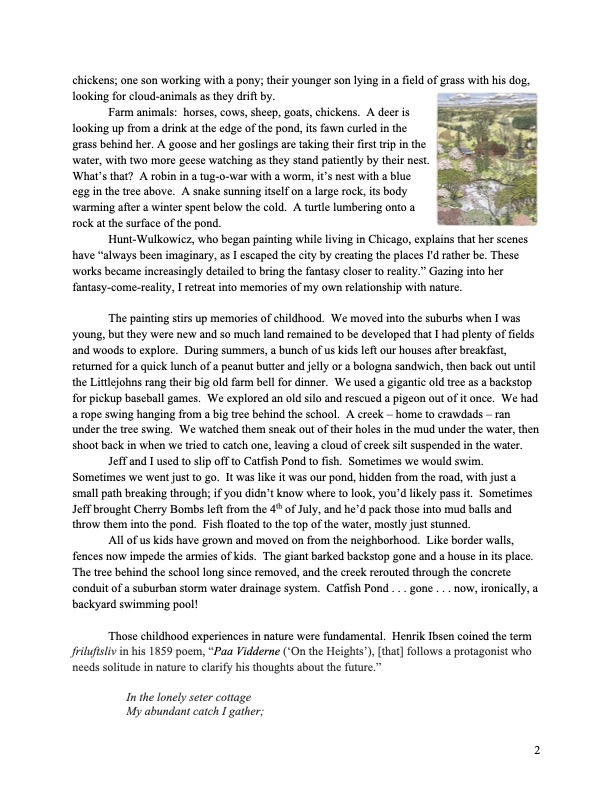

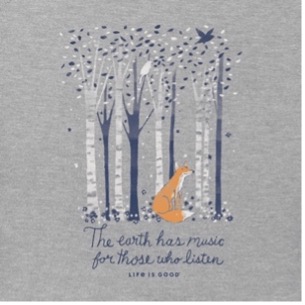
Note: The t-shirt graphics in this essay are from Life is Good®. I love their shirts and highly recommend them. Quality materials and creative messages. This is not a paid endorsement . . . though I’m open to consideration! 🙂
 Mike's Fountain Pen
What a beautiful story of nature during this stressful time. Thanks for the blog.
LikeLike